FSA Photography and the 1930s An Online Professional Development - - PowerPoint PPT Presentation

fsa photography and the 1930 s
SMART_READER_LITE
LIVE PREVIEW

FSA Photography and the 1930s An Online Professional Development - - PowerPoint PPT Presentation

FSA Photography and the 1930s An Online Professional Development Seminar Sara Blair Professor of English University of Michigan We will begin promptly on the hour. The silence you hear is normal. If you do not hear anything when the


slide-1
SLIDE 1

We will begin promptly on the hour. The silence you hear is normal. If you do not hear anything when the images change, e-mail Caryn Koplik ckoplik@nationalhumanitiescenter.org for assistance.

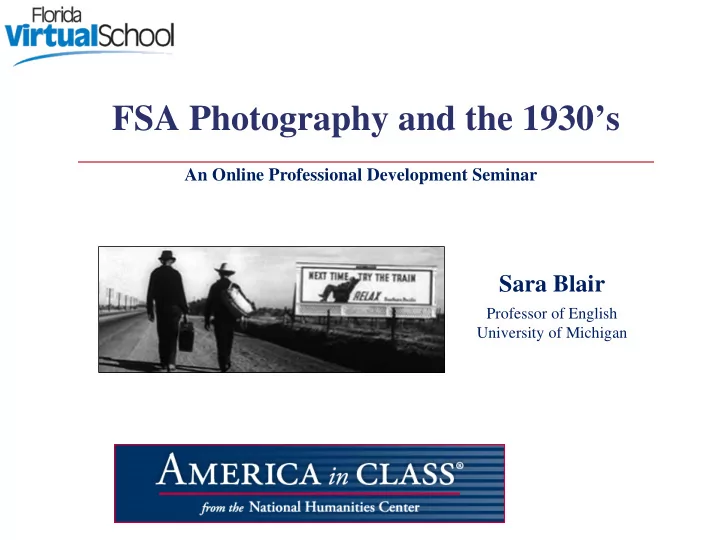
FSA Photography and the 1930’s

Sara Blair

Professor of English University of Michigan

An Online Professional Development Seminar

slide-2
SLIDE 2

americainclass.org 2

FSA Photography and the 1930’s

FROM THE FORUM

  • How do we get students to analyze photographs instead of just viewing them?
  • How did photojouralism evolve?
  • Why are there so many iconic photos from the Great Depression?
  • Were the documentary photos of the 1930s staged, as were the iconic photos of the Civil War?
  • What impact did the FSA photos have?
  • What was the purpose of the FSA photography program?
  • Were the FSA photos intended to be propaganda or documentation?
  • To what extent are the FSA photos and photojournalistic images like them objective?
slide-3
SLIDE 3

americainclass.org 3

FSA Photography and the 1930’s

FRAMING QUESTIONS

  • What does the FSA photographic archive teach us about the Great

Depression?

  • How were the images made, and what were their aims?
  • What understanding of America’s shared history do these images make

possible?

  • How can we critically engage these photographs and use them as learning

tools?

slide-4
SLIDE 4

americainclass.org 4

Sara Blair

Professor of English University of Michigan Primary Interests: late nineteenth- and twentieth-century American culture, photography and visual culture, modernism and modernity. Trauma and Documentary Photography of the FSA co-authored with Eric Rosenberg (2012) Harlem Crossroads: Black Writers and the Photograph in the Twentieth Century (2007)

slide-5
SLIDE 5

americainclass.org 5

FSA Photography and the 1930’s

Analyzing Photographs: What’s in a Picture

  • Who, what, where: What can we say about the event or action the photograph

records?

  • Subject matter: Why did the photographer include these particular elements? What

don’t you see in the picture?

  • Composition & framing: How do people or objects fill the frame? What’s in focus

(or not)? Where does your eye go as you look at the photograph?

  • Capture: What might have happened just before or after this picture was taken? What

kind of moment is captured?

  • Perspective: Why did the photographer take the picture from this angle? What would

the scene have looked like from another vantage point — from left, right, behind, above, or below?

slide-6
SLIDE 6

americainclass.org 6

FSA Photography and the 1930’s

What were the FSA photographs?

  • Body of 250,000 images created between 1935 and early 1940s
  • Funded by the Resettlement Administration of the FSA
  • Intended to build popular support for federal spending on relief programs
  • Paid for photographers to work on specific projects across the U.S.
  • Created the largest public archive of American life in U.S. history
slide-7
SLIDE 7

americainclass.org 7

FSA Photography and the 1930’s

John Thomson, London Nomades, 1876

slide-8
SLIDE 8

americainclass.org 8

FSA Photography and the 1930’s

A shantytown in New York, Daily Graphic, 1880 (first photograph reproduced in a daily newspaper)

slide-9
SLIDE 9

americainclass.org 9

FSA Photography and the 1930’s

Jacob Riis, Five Cent Lodging, 1889

slide-10
SLIDE 10

americainclass.org 10

FSA Photography and the 1930’s

Marion Post Wolcott, Migrant Workers Waiting for Pay, Florida, 1939

slide-11
SLIDE 11

americainclass.org 11

FSA Photography and the 1930’s

Dorothea Lange, Migrant shed worker, northeast Florida, 1936

slide-12
SLIDE 12

americainclass.org 12

FSA Photography and the 1930’s

Walker Evans, Lucille Burroughs, daughter of a cotton sharecropper, Hale County, Alabama, 1936

slide-13
SLIDE 13

americainclass.org 13

FSA Photography and the 1930’s

Ben Shahn, Boone County, Arkansas. The family of a Resettlement Administration client in the doorway of their home, 1935

slide-14
SLIDE 14

americainclass.org 14

FSA Photography and the 1930’s

Walker Evans, Wash stand in the dog-run of Floyd Burroughs’ house, Hale County, Alabama, 1936

slide-15
SLIDE 15

americainclass.org 15

FSA Photography and the 1930’s

Walker Evans, Floyd Burroughs’ Work Shoes, Hale County, Alabama, 1936

slide-16
SLIDE 16

americainclass.org 16

FSA Photography and the 1930’s

slide-17
SLIDE 17

americainclass.org 17

FSA Photography and the 1930’s

slide-18
SLIDE 18

americainclass.org 18

FSA Photography and the 1930’s

slide-19
SLIDE 19

americainclass.org 19

FSA Photography and the 1930’s

slide-20
SLIDE 20

americainclass.org 20

FSA Photography and the 1930’s

Dorothea Lange, Migrant agricultural worker's family. Seven hungry children. Mother aged thirty-

  • two. Father is a native Californian. Destitute in pea picker's camp, Nipomo, California, because of the

failure of the early pea crop. These people had just sold their tent in order to buy food. Of the twenty- five hundred people in this camp most of them were destitute, 1936

slide-21
SLIDE 21

americainclass.org 21

FSA Photography and the 1930’s

Dorothea Lange, Destitute pea pickers in California. Mother of seven children. Age thirty-two. Nipomo, California, 1936

slide-22
SLIDE 22

americainclass.org 22

FSA Photography and the 1930’s

slide-23
SLIDE 23

americainclass.org 23

FSA Photography and the 1930’s

slide-24
SLIDE 24

americainclass.org 24

FSA Photography and the 1930’s

Florence Thompson Castle with Dorothea Lange’s portrait of her as “Migrant Mother”

slide-25
SLIDE 25

americainclass.org 25

FSA Photography and the 1930’s

Arthur Rothstein, The Bleached Skull of a Steer on the dry sun-baked earth of the South Dakota Badlands, 1936

slide-26
SLIDE 26

americainclass.org 26

FSA Photography and the 1930’s

Carl Mydans, Abandoned land and poor pasture at Florida Withlacoochee River Agricultural Demonstration Project near Brooksville, Florida, 1936

slide-27
SLIDE 27

americainclass.org 27

FSA Photography and the 1930’s

Walker Evans, Bethlehem graveyard and steel mill, Pennsylvania, 1935

slide-28
SLIDE 28

americainclass.org 28

FSA Photography and the 1930’s

Dorothea Lange, Plantation overseer near Clarksdale, Mississippi, 1936

slide-29
SLIDE 29

americainclass.org 29

FSA Photography and the 1930’s

Ben Shahn, Medicine Show, Huntingdon, Tennessee, 1935

slide-30
SLIDE 30

americainclass.org 30

FSA Photography and the 1930’s

Ben Shahn, Cotton pickers, Pulaski County, Arkansas, 1935

slide-31
SLIDE 31

americainclass.org 31

FSA Photography and the 1930’s

Dorothea Lange, Toward Los Angeles, California, 1937

slide-32
SLIDE 32

americainclass.org 32

FSA Photography and the 1930’s

Gordon Parks, Washington, D.C., government charwoman, 1942

slide-33
SLIDE 33

americainclass.org 33

Final slide. Thank You