From Program to Process To make the program s code and data come - - PowerPoint PPT Presentation

from program to process
SMART_READER_LITE
LIVE PREVIEW

From Program to Process To make the program s code and data come - - PowerPoint PPT Presentation

From Program to Process To make the program s code and data come alive need a CPU The Process need memory the process address space for data, code, stack, heap A running program need registers PC, SP, regular registers need access to


slide-1
SLIDE 1

The Process

A running program

From Program to Process

To make the program’ s code and data come alive

need a CPU need memory — the process’ address space

for data, code, stack, heap

need registers

PC, SP, regular registers

need access to I/O

list of open files

A First Cut at the API

Create

causes the OS to create a new process

Destroy

forcefully terminates a process

Wait (for the process to end) Other controls

e.g. to suspend or resume the process

Status

running? suspended? blocked? for how long?

How the OS Keeps Track

  • f a Process

A process has code

OS must track program counter

A process has a stack

OS must track stack pointer

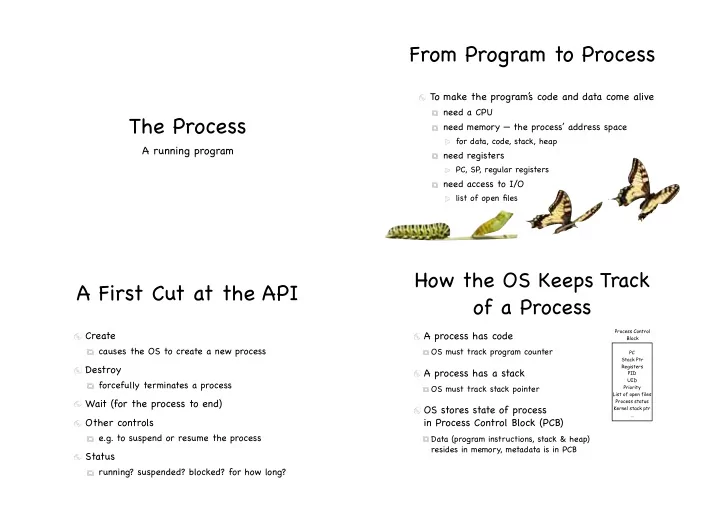
OS stores state of process in Process Control Block (PCB)

Data (program instructions, stack & heap) resides in memory, metadata is in PCB

PC Stack Ptr Registers PID UID Priority List of open files Process status Kernel stack ptr … Process Control Block

slide-2
SLIDE 2

You’ll Never Walk Alone

Machines run (and thus OS must manage) multiple processes

how should the machine’ s resources be mapped to these processes?

OS as a referee…

You’ll Never Walk Alone

Machines run (and thus OS must manage) multiple processes

how should the machine’ s resources be mapped to these processes?

Enter the illusionist!

give every process the illusion of running

  • n a private CPU

which appears slower than the machine’ s

give every process the illusion of running

  • n a private memory

which may appear larger(??) than the machine’ s

Virtualize the CPU

}

Virtualize memory

}

Isolating Applications

Buggy apps can crash

  • ther apps

Buggy apps can crash OS Buggy apps can hog all resources Malicious apps can violate privacy of other apps

App 1 App 2 App 3

Operating System

Reading and writing memory, managing resources, accessing I/O...

Malicious apps can change the OS

Mechanism and Policy

Mechanism

what the system can do

Policy

what the system should do

Mechanisms should not determine policies!

slide-3
SLIDE 3

The Process, Refined

An abstraction for isolation

the execution of an application program with restricted rights

The enforcing mechanism must not hinder functionality

still efficient use of hardware enable safe communication App 1

OS

Hardware

The Process, Refined

An abstraction for isolation

the execution of an application program with restricted rights

The enforcing mechanism must not hinder functionality

still efficient use of hardware enable safe communication App 1

OS

Hardware

Special

The process abstraction is enforced by the kernel all kernel is in the OS not all the OS is in the kernel (why not? robustness) widgets libraries, window managers etc

How can the OS Enforce Restricted Rights?

Easy: kernel interprets each instruction!

App 1

OS

Hardware

slow many instructions are safe: do we really need to involve the OS?

slide-4
SLIDE 4

How can the OS enforce restricted rights?

Mechanism: Dual Mode Operation

hardware to the rescue: use a mode bit

in user mode, processor checks every instruction in kernel mode, unrestricted rights

hardware to the rescue (again) to make checks efficient

App 1

OS

Hardware

Amongst our weaponry are such diverse elements as…

Privileged instructions

in user mode, no way to execute potentially unsafe instructions

Memory isolation

in user mode, memory accesses outside a process’ memory region are prohibited

Timer interrupts

kernel must be able to periodically regain control from running process

  • I. Privileged instructions

Set mode bit I/O ops Memory management ops Disable interrupts Set timers Halt the processor

  • I. Privileged instructions

But how can an app do I/O then?

system calls achieve access to kernel mode

  • nly at specific locations specified by OS

Executing a privileged instruction while in user mode (naughty naughty…) causes a processor exception….

...which passes control to the kernel

slide-5
SLIDE 5

Crossing the line

user process kernel

user process executing calls system call return from system call execute system call

trap mode bit := 0 mode bit := 1 return mode bit = 1 mode bit = 0

  • II. Memory Protection

Virtual address space: set of memory addresses that process can “touch”

CPU works with virtual addresses

Physical address space: set of memory addresses supported by hardware

Virtual address space

Stack Code Initialized data Heap DLL ’ s mapped segments

Step 1: Virtualize Memory

  • II. Memory Isolation

Implement a function mapping

a486d9 5e3a07

Virtual Physical Advantages: isolation relocation data sharing multiplexing

⟨pid, virtual address⟩ physical address pi

Step 2: Address Translation

into

Isolation

At all times, functions used by different processes map to disjoint ranges — aka “Stay in your room!”

pi pj

slide-6
SLIDE 6

Relocation

The range of the function used by a process can change over time

pi

Relocation

The range of the function used by a process can change over time — “Move to a new room!”

pi

Data Sharing

Map different virtual addresses of distinct processes to the same physical address — “Share the kitchen!”

pi pj

5e3a07 04d26a 119af3

Multiplexing

Create illusion of almost infinite memory by changing domain (set of virtual addresses) that maps to a given range of physical addresses — ever lived in a studio?

pi

slide-7
SLIDE 7

Multiplexing

The domain (set of virtual addresses) that map to a given range of physical addresses can change over time

pi

Multiplexing

The domain (set of virtual addresses) that map to a given range of physical addresses can change over time

pi

Multiplexing

The domain (set of virtual addresses) that map to a given range of physical addresses can change over time

pi

Multiplexing

The domain (set of virtual addresses) that map to a given range of physical addresses can change over time

pi

slide-8
SLIDE 8

More Multiplexing

At different times, different processes can map part of their virtual address space into the same physical memory — change tenants!

pi pj

More Multiplexing

pi pj

At different times, different processes can map part of their virtual address space into the same physical memory — change tenants!

A simple mapping mechanism: Base & Bound

CPU

Bound Register Base Register

1500 1000 MAXsys

500 1000

p’ s physical address space ≤ + yes no Memory Exception Logical addresses Physical addresses

On Base & Limit

Contiguous Allocation: contiguous virtual addresses are mapped to contiguous physical addresses Isolation is easy, but sharing is hard

Two copies of emacs: want to share code, but have heap and stack distinct...

And there is more…

Hard to relocate Hard to account for dynamic changes in both heap and stack

slide-9
SLIDE 9
  • III. Timer Interrupts

Hardware timer

can be set to expire after specified delay (time or instructions) when it does, control is passed back to the kernel

Other interrupts (e.g. I/O completion) also give control to kernel

Interrupt Management

Interrupt controllers implements interrupt priorities: Interrupts include descriptor of interrupting device Priority selector circuit examines all interrupting devices, reports highest level to the CPU Controller can also buffer interrupts coming from different devices more on this later… interrupt controller

interrupt

Interrupt Management

Maskable interrupts can be turned off by the CPU for critical processing Nonmaskable interrupts indicate serious errors (power out warning, unrecoverable memory error, etc.) interrupt controller

interrupt

System calls/traps

user program requests OS service

synchronous/non- maskable

Types of Interrupts

Interrupts

HW device requires OS service

timer, I/O device, interprocessor

asynchronous/maskable

Exceptions

process missteps (e.g. division by zero) attempt to perform a privileged instruction

sometime on purpose! (breakpoints)

synchronous/non-maskable

slide-10
SLIDE 10

Interrupt Handling

Two objectives

handle the interrupt and remove the cause restore what was running before the interrupt

state may have been modified on purpose

Two “actors” in handling the interrupt

the hardware goes first the kernel code takes control by running the interrupt handler

A Tale of Two Stack Pointers

Interrupt is a program: it needs a stack!

so, each process has two stacks pointers:

  • ne when running in kernel mode

another when running in user mode

Why not using the user-level stack pointer?

user SP may be badly aligned or pointing to non writable memory user stack may not be large enough, and may spill to

  • verwrite important data

security: kernel could leave sensitive data on stack pointing SP to kernel address could corrupt kernel

Handling Interrupts: HW

On interrupt, hardware:

sets supervisor mode (if not set already) disable (masks) interrupts pushes PC, SP, and PSW

  • f user program on interrupt stack

sets PC to point to the first instruction of the appropriate interrupt handler

depends on interrupt type interrupt handler specified in interrupt vector loaded at boot time

Interrupt Vector

I/O interrupt handler System Call handler Page fault handler

Condition codes interrupts enabled bit kernel mode bit

(partially privileged)

Handling Interrupts: SW

We are now running the interrupt handler!

IH first pushes the registers’ contents on the interrupt stack (part of the PCB)

need registers to run the IH

  • nly saves necessary registers (that’

s why done in SW, not HW)

slide-11
SLIDE 11

Typical Interrupt Handler Code

HandleInterruptX:

PUSH %Rn PUSH %R1 … CALL _handleX POP %R1 POP %Rn …

} }

restore the registers saved above

  • nly need to save registers not

saved by the handler function RETURN_FROM_INTERRUPT

Returning from an Interrupt

Hardware pops PC, SP, PSW Depending on content of PSW

switch to user mode enable interrupts

From exception and system call, increment PC

  • n return (we don’

t want to execute again the same instruction)

  • n exception, handler changes PC at the base of

the stack

  • n system call, increment is done by hw when saving

user level state

  • 1. Allocate & initialize PCB
  • 2. Setup initial page table (to initialize a new address space)
  • 3. Load program intro address space
  • 4. Allocate user-level and kernel-level stacks.

5.Copy arguments (if any) to the base of the user-level stack

  • 6. Simulate an interrupt

a)push initial PC, user SP b)push PSW (supervisor mode off, interrupts enabled) 7.Clear all other registers 8.RETURN_FROM_INTERRUPT

Starting a new process: the recipe Interrupt Handling

  • n x86

User-level Process Registers Kernel

Code

foo() { while(...) { x = x+1; y = y-2 } }

Stack Code

handler() { pusha ... }

Interrupt Stack EFLAGS Other Registers: EAX, EBX, ... SS:ESP

Stack segment Offset

CS:EIP

Code segment Offset

Stack pointer Program counter Flags

slide-12
SLIDE 12

Interrupt Handling

  • n x86

User-level Process Registers Kernel

Code

foo() { while(...) { x = x+1; y = y-2 } }

Stack Code

handler() { pusha ... }

Interrupt Stack Other Registers: EAX, EBX, ... EFLAGS SS:ESP CS:EIP

  • 1. Change mode bit
  • 2. Disable interrupts
  • 3. Save key registers to temporary location
  • 4. Switch onto the kernel interrupt stack

EFLAGS SS:ESP CS:EIP

Stack pointer Program counter Flags

Hardware performs these steps

Interrupt Handling

  • n x86

User-level Process Registers Kernel

Code

foo() { while(...) { x = x+1; y = y-2 } }

Stack Code

handler() { pusha ... }

Interrupt Stack Other Registers: EAX, EBX, ... EFLAGS SS:ESP CS:EIP

  • 1. Change mode bit
  • 2. Disable interrupts
  • 3. Save key registers to temporary location
  • 4. Switch onto the kernel interrupt stack
  • 5. Push key registers onto new stack

EFLAGS SS:ESP CS:EIP

Hardware performs these steps

Interrupt Handling

  • n x86

User-level Process Registers Kernel

Code

foo() { while(...) { x = x+1; y = y-2 } }

Stack Code

handler() { pusha ... }

Interrupt Stack Other Registers: EAX, EBX, ... EFLAGS SS:ESP CS:EIP

  • 1. Change mode bit
  • 2. Disable interrupts
  • 3. Save key registers to temporary location
  • 4. Switch onto the kernel interrupt stack
  • 5. Push key registers onto new stack

EFLAGS SS:ESP CS:EIP

Hardware performs these steps

Interrupt Handling

  • n x86

User-level Process Registers Kernel

Code

foo() { while(...) { x = x+1; y = y-2 } }

Stack Code

handler() { pusha ... }

Interrupt Stack Other Registers: EAX, EBX, ... EFLAGS SS:ESP CS:EIP

  • 1. Change mode bit
  • 2. Disable interrupts
  • 3. Save key registers to temporary location
  • 4. Switch onto the kernel interrupt stack
  • 5. Push key registers onto new stack
  • 6. Save error code (optional)

EFLAGS SS:ESP CS:EIP

Hardware performs these steps

slide-13
SLIDE 13

Interrupt Handling

  • n x86

User-level Process Registers Kernel

Code

foo() { while(...) { x = x+1; y = y-2 } }

Stack Code

handler() { pusha ... }

Interrupt Stack Other Registers: EAX, EBX, ... EFLAGS SS:ESP CS:EIP

  • 1. Change mode bit
  • 2. Disable interrupts
  • 3. Save key registers to temporary location
  • 4. Switch onto the kernel interrupt stack
  • 5. Push key registers onto new stack
  • 6. Save error code (optional)

EFLAGS SS:ESP CS:EIP Error

Hardware performs these steps

Software (handler) performs this step

Interrupt Handling

  • n x86

User-level Process Registers Kernel

Code

foo() { while(...) { x = x+1; y = y-2 } }

Stack Code

handler() { pusha ... }

Interrupt Stack Other Registers: EAX, EBX, ... EFLAGS SS:ESP CS:EIP

EFLAGS SS:ESP CS:EIP Error

  • 8. Handler pushes all registers on stack
  • 1. Change mode bit
  • 2. Disable interrupts
  • 3. Save key registers to temporary location
  • 4. Switch onto the kernel interrupt stack
  • 5. Push key registers onto new stack
  • 6. Save error code (optional)

7 . Transfer control to interrupt handler

Hardware performs these steps
  • 1. Change mode bit
  • 2. Disable interrupts
  • 3. Save key registers to temporary location
  • 4. Switch onto the kernel interrupt stack
  • 5. Push key registers onto new stack
  • 6. Save error code (optional)

7 . Transfer control to interrupt handler

Hardware performs these steps

Interrupt Handling

  • n x86

User-level Process Registers Kernel

Code

foo() { while(...) { x = x+1; y = y-2 } }

Stack Code

handler() { pusha ... }

Interrupt Stack Other Registers: EAX, EBX, ... EFLAGS SS:ESP CS:EIP

EFLAGS SS:ESP CS:EIP Error

  • 8. Handler pushes all registers on stack

Software (handler) performs this step

Interrupt Handling

  • n x86

User-level Process Registers Kernel

Code

foo() { while(...) { x = x+1; y = y-2 } }

Stack Code

handler() { pusha ... }

Interrupt Stack Other Registers: EAX, EBX, ... EFLAGS SS:ESP CS:EIP

EFLAGS SS:ESP CS:EIP Error All Registers: SS, ESP, EAX, EBX,...

  • 8. Handler pushes all registers on stack

Software (handler) performs this step

  • 1. Change mode bit
  • 2. Disable interrupts
  • 3. Save key registers to temporary location
  • 4. Switch onto the kernel interrupt stack
  • 5. Push key registers onto new stack
  • 6. Save error code (optional)

7 . Transfer control to interrupt handler

Hardware performs these steps

slide-14
SLIDE 14

Interrupt Safety

Kernel should disable device interrupts as little as possible

interrupts are best serviced quickly

Thus, device interrupts are often disabled selectively

e.g., clock interrupts enabled during disk interrupt handling

This leads to potential “race conditions”

system’ s behavior depends on timing of uncontrollable events

Interrupt Race Example

Disk interrupt handler enqueues a task to be executed after a particular time

while clock interrupts are enabled

Clock interrupt handler checks queue for tasks to be executed

may remove tasks from the queue

Clock interrupt may happen during enqueue Concurrent access to a shared data structure (the queue!)

Making code interrupt-safe

Make sure interrupts are disabled while accessing mutable data! But don’ t we have locks?

Consider

void function () { lock(mtx); /* code */ unlock(mtx); }

Is function thread-safe?

Operates correctly when accessed simultaneously by multiple threads

Is function interrupt-safe?

Operates correctly when called again (re-entered) before it completes

To make it so, grab a lock To make it so, disable interrupts

Example of Interrupt-Safe Code

Why not simply re-enable interrupts?

Say we did. What if then we call enqueue from code that expects interrupts to be disabled?

Oops…

Instead, remember interrupt level at time of call; when done, restore that level

void enqueue(struct task *task) { int level = interrupt_disable(); /* update queue */ interrupt_restore(level); }

slide-15
SLIDE 15

Many Standard C Functions are not Interrupt-Safe

Pure system calls are interrupt-safe

e.g., read(), write(), etc.

Functions that don’ t use global data are interrupt-safe

e.g., strlen(), strcpy(), etc.

malloc(), free (), and printf() are not interrupt-safe

must disable interrupts before using it in an interrupt handler

and you may not want to anyway (printf() is huge!)

But they are all thread-safe!

System calls

Programming interface to the services the OS provides:

read input/write to screen create/read/write/delete files create new processes send/receive network packets get the time / set alarms terminate current process …

The Skinny

System call interface

Portable OS Kernel Portable OS Library

x86 ARM PowerPC 10Mbps/100Mbps/1Gbps Ethernet 1802.11 a/b/g/n SCSI Graphics accellerators LCD Screens Web Browsers Email Databases Word Processing Compilers Web Servers

Simple and powerful interface allows separation of concern Eases innovation in user space and HW “Narrow waist" makes it highly portable robust (small attack surface) Internet IP layer also

  • ffers skinny interface

Much care spent in keeping interface secure e.g., parameters first copied to kernel space, then checked

to prevent them from being changed after they are checked!

Executing a System Call

Process:

Calls system call function in library Places arguments in registers and/or pushes them onto user stack Places syscall type in a dedicated register Executes syscall machine instruction

Kernel

Executes syscall interrupt handler Places result in dedicated register Executes RETURN_FROM_INTERRUPT

Process:

Executes RETURN_FROM_FUNCTION

slide-16
SLIDE 16

Executing read System Call

int main(argc, argv){ … read(fd, buffer, nbytes) … } stack frame for main()

UPC USP KSP

user stack interrupt stack user space kernel space UPC: user program counter USP: user stack pointer KSP: kernel stack pointer note: interrupt stack is empty while process running

int main(argc, argv){ … c = read(fd, buffer, nbytes) … }

Executing read System Call

stack frame for main()

USP KSP

user space kernel space UPC: user program counter USP: user stack pointer KSP: kernel stack pointer note: interrupt stack is empty while process running

_read: mov READ, %R0 syscall return

user stack interrupt stack

UPC

Executing read System Call

stack frame for main()

USP KSP

user space kernel space UPC: user program counter USP: user stack pointer KSP: kernel stack pointer note: interrupt stack is empty while process running

nbytes

_read: mov READ, %R0 syscall return

user stack

UPC

interrupt stack

int main(argc, argv){ … c = read(fd, buffer, nbytes) … }

&buffer fd

Executing read System Call

stack frame for main()

USP KSP

user space kernel space

stack frame for _read _read: mov READ, %R0 syscall return

user stack

UPC

interrupt stack

int main(argc, argv){ … c = read(fd, buffer, nbytes) … }

UPC: user program counter USP: user stack pointer KSP: kernel stack pointer

note: interrupt stack is empty while process running

slide-17
SLIDE 17

Executing read System Call

stack frame for main()

USP KSP

user space kernel space

stack frame for _read _read: mov READ, %R0 syscall return

user stack

UPC

HandleIntrSyscall: push %Rn … push %R1 call __handleSyscall pop %R1 … pop %Rn return_from_interrupt

KPC

interrupt stack

int main(argc, argv){ … c = read(fd, buffer, nbytes) … }

Executing read System Call

stack frame for main()

USP KSP

user space kernel space

stack frame for _read _read: mov READ, %R0 syscall return

user stack

UPC

HandleIntrSyscall: push %Rn … push %R1 call __handleSyscall pop %R1 … pop %Rn return_from_interrupt

KPC

USP, UPC, PSW

interrupt stack

int main(argc, argv){ … c = read(fd, buffer, nbytes) … }

Executing read System Call

stack frame for main()

USP KSP

user space kernel space

stack frame for _read _read: mov READ, %R0 syscall return

user stack

UPC

HandleIntrSyscall: push %Rn … push %R1 call __handleSyscall pop %R1 … pop %Rn return_from_interrupt

KPC

USP, UPC, PSW saved registers

interrupt stack

int main(argc, argv){ … c = read(fd, buffer, nbytes) … }

Executing read System Call

stack frame for main()

USP KSP

user space kernel space

stack frame for _read _read: mov READ, %R0 syscall return

user stack

UPC

HandleIntrSyscall: push %Rn … push %R1 call __handleSyscall pop %R1 … pop %Rn return_from_interrupt

KPC

USP, UPC, PSW saved registers

interrupt stack

int handleSyscall(int type){ switch (type) { case READ: … } } int main(argc, argv){ … c = read(fd, buffer, nbytes) … }

slide-18
SLIDE 18

Executing read System Call

stack frame for main()

USP KSP

user space kernel space

stack frame for _read _read: mov READ, %R0 syscall return

user stack

UPC

HandleIntrSyscall: push %Rn … push %R1 call __handleSyscall pop %R1 … pop %Rn return_from_interrupt

KPC

USP, UPC, PSW saved registers

interrupt stack

int handleSyscall(int type){ switch (type) { case READ: … } } stack frame for handleSyscall() int main(argc, argv){ … c = read(fd, buffer, nbytes) … }

What if read needs to block?

read may need to block if

It reads from a terminal It reads from disk, and block is not in cache It reads from a remote file server

We should run another process!

Virtualizing the CPU

OS keeps a PCB for each process It has space to hold a ``frozen” version of the state process’ s state

Program counter Process status (ready, running, etc) CPU registers CPU scheduling info Memory management info Account info I/O status info

to be saved when the process relinquishes the CPU

PC Stack Ptr Registers PID UID Priority List of open files Process status Kernel stack ptr Location in Memory Location of executable

  • n disk

Process Control Block

and reloaded when the process reacquires the CPU

Process Life Cycle

Ready Init Running Waiting Zombie

72

slide-19
SLIDE 19

Process Life Cycle

Ready Init Running Waiting Zombie

73

PCB: being created Registers: uninitialized

Process Life Cycle

Ready Init Running Waiting Zombie

74

Admitted to the Ready queue

PCB: being created Registers: uninitialized

Process Life Cycle

Ready Init Running Waiting Zombie

75

PCB: on the Ready queue Registers: pushed by kernel code onto interrupt stack

Admitted to the Ready queue

Process Life Cycle

Ready Init Running Waiting Zombie

76

PCB: currently executing Registers: popped from interrupt stack into CPU

Admitted to the Ready queue Dispatch

slide-20
SLIDE 20

Process Life Cycle

Ready Init Running Waiting Zombie

77

PCB: on Ready queue Registers: pushed onto interrupt stack (SP saved in PCB)

Admitted to the Ready queue Dispatch Yield

Process Life Cycle

Ready Init Running Waiting Zombie

78

Admitted to the Ready queue Dispatch Yield

PCB: currently executing Registers: popped from interrupt stack into CPU

Process Life Cycle

Ready Init Running Waiting Zombie

79

Admitted to the Ready queue Dispatch Yield

PCB: on specific waiting queue (I/O device, lock, etc.) Registers: on interrupt stack

blocking call e.g., read(), wait()

Process Life Cycle

Ready Init Running Waiting Zombie

80

Admitted to the Ready queue Dispatch Yield

PCB: on Ready queue Registers: on interrupt stack

blocking call e.g., read(), wait() blocking call completion

slide-21
SLIDE 21

Process Life Cycle

Ready Init Running Waiting Zombie

81

Admitted to the Ready queue Dispatch Yield blocking call e.g., read(), wait() blocking call completion

PCB: currently executing Registers: popped from interrupt stack into CPU

Process Life Cycle

Ready Init Running Waiting Zombie

82

Admitted to the Ready queue Dispatch Yield blocking call e.g., read(), wait() blocking call completion

PCB: on Finished queue, ultimately deleted Registers: no longer needed

done exit()

Invariants to keep in mind

At most one process/core running at any time When CPU in user mode, current process is RUNNING and its interrupt stack is empty If process is RUNNING

its PCB not on any queue it is not necessarily in USER mode

If process is RUNNABLE or WAITING

its registers are saved at the top of its interrupt stack its PCB is either

  • n the READY queue (if RUNNABLE)
  • n some WAIT queue (if WAITING)

If process is a ZOMBIE

its PCB is on FINISHED queue

Process cannot clean up itself (why?) Process can be cleaned up

by some other process, checking for zombies before returning to RUNNING state

  • r by parent which waits for it

but what if parent turns into a zombie first?

  • r by a dedicated “reaper” process

Linux uses a combination

if alive, parent cleans up child that it is waiting for if parent is dead, child process is inherited by the initial process, which is continually waiting

Cleaning up Zombies

slide-22
SLIDE 22

How to Yield/Wait?

Must switch from executing the current process to executing some other READY process

Current process: RUNNING READY Next process: READY RUNNING

<latexit sha1_base64="k2oEsuOfOe2VmRv5A0ON1LMNQk=">AB6HicdVDLSsNAFL2pr1pfVZduBovgKiQqPlYWXeiygrGFpTJdNoOnWTCzI1Sj/CjeLK4tf4Cy79Bb/ApNVFfRy4cDjnXOaeCWIpDrOm5WbmZ2bX8gvFpaWV1bXiusbN0YlmnGPKal0LaCGSxFxDwVKXos1p2EgeTXonWd+9ZrI1R0jf2YN0LaiURbMIqp5PtadLpItVZ3hWax5NrOGOR/Ujr9eL8YAUClWXz1W4olIY+QSWpM3XVibAyoRsEkHxb8xPCYsh7t8MH40iHZSaUWaSudToRkrE7laGhMPwzSZEixa356mfiXV0+wfdwYiChOkEds8lA7kQVyWqTltCcoeynhDIt0gsJ61JNGafk1V37P3DA3fIb/Jd3Vvz6x3SunVD6DCfKwBduwCy4cQRkuoQIeMIjhAZ5hZPWse+vRepEc9bXziZMwXr5BC+xkEg=</latexit><latexit sha1_base64="tKyo8yq/Ogcp4JZBLk/tlvKOvc0=">AB6HicdVBJTgJBFP2NE+KEw85NRWLiqtMtxmEl0YUuMbGFhCakuigQvWQqt8aJBzCjcaVxgN4Dq/gkit4ArtBFzi85Ccv72f+q+8SAqNlvVuZKamZ2bnsvO5hcWl5ZX86tqVDmPFuMNCGaqRzWXIuAOCpS8GilOfU/yitc9Tf3KNVdahMEl9iJe92k7EC3BKCaS6yrR7iBVKrzJNfIF27RGIP+TwvH8Ox143ZYbuTf3GbIYp8HyCTVumZbEdb7VKFgkg9ybqx5RFmXtnl/dOmAbCdSk7RClUyAZKRO5Kivdc/3kqRPsaN/eqn4l1eLsXVY74sgipEHbPxQK5YEQ5LWJk2hOEPZSwhlSiQXEtahijJMPietbpnF/T27aJHf5Lu6s2semfaFVSidwBhZ2IQt2AEbDqAE51AGBxhEcA9P8Gx0jTvjwXgcRzPG1846TMB4+QbvZHF</latexit><latexit sha1_base64="tKyo8yq/Ogcp4JZBLk/tlvKOvc0=">AB6HicdVBJTgJBFP2NE+KEw85NRWLiqtMtxmEl0YUuMbGFhCakuigQvWQqt8aJBzCjcaVxgN4Dq/gkit4ArtBFzi85Ccv72f+q+8SAqNlvVuZKamZ2bnsvO5hcWl5ZX86tqVDmPFuMNCGaqRzWXIuAOCpS8GilOfU/yitc9Tf3KNVdahMEl9iJe92k7EC3BKCaS6yrR7iBVKrzJNfIF27RGIP+TwvH8Ox143ZYbuTf3GbIYp8HyCTVumZbEdb7VKFgkg9ybqx5RFmXtnl/dOmAbCdSk7RClUyAZKRO5Kivdc/3kqRPsaN/eqn4l1eLsXVY74sgipEHbPxQK5YEQ5LWJk2hOEPZSwhlSiQXEtahijJMPietbpnF/T27aJHf5Lu6s2semfaFVSidwBhZ2IQt2AEbDqAE51AGBxhEcA9P8Gx0jTvjwXgcRzPG1846TMB4+QbvZHF</latexit><latexit sha1_base64="tKyo8yq/Ogcp4JZBLk/tlvKOvc0=">AB6HicdVBJTgJBFP2NE+KEw85NRWLiqtMtxmEl0YUuMbGFhCakuigQvWQqt8aJBzCjcaVxgN4Dq/gkit4ArtBFzi85Ccv72f+q+8SAqNlvVuZKamZ2bnsvO5hcWl5ZX86tqVDmPFuMNCGaqRzWXIuAOCpS8GilOfU/yitc9Tf3KNVdahMEl9iJe92k7EC3BKCaS6yrR7iBVKrzJNfIF27RGIP+TwvH8Ox143ZYbuTf3GbIYp8HyCTVumZbEdb7VKFgkg9ybqx5RFmXtnl/dOmAbCdSk7RClUyAZKRO5Kivdc/3kqRPsaN/eqn4l1eLsXVY74sgipEHbPxQK5YEQ5LWJk2hOEPZSwhlSiQXEtahijJMPietbpnF/T27aJHf5Lu6s2semfaFVSidwBhZ2IQt2AEbDqAE51AGBxhEcA9P8Gx0jTvjwXgcRzPG1846TMB4+QbvZHF</latexit><latexit sha1_base64="tKyo8yq/Ogcp4JZBLk/tlvKOvc0=">AB6HicdVBJTgJBFP2NE+KEw85NRWLiqtMtxmEl0YUuMbGFhCakuigQvWQqt8aJBzCjcaVxgN4Dq/gkit4ArtBFzi85Ccv72f+q+8SAqNlvVuZKamZ2bnsvO5hcWl5ZX86tqVDmPFuMNCGaqRzWXIuAOCpS8GilOfU/yitc9Tf3KNVdahMEl9iJe92k7EC3BKCaS6yrR7iBVKrzJNfIF27RGIP+TwvH8Ox143ZYbuTf3GbIYp8HyCTVumZbEdb7VKFgkg9ybqx5RFmXtnl/dOmAbCdSk7RClUyAZKRO5Kivdc/3kqRPsaN/eqn4l1eLsXVY74sgipEHbPxQK5YEQ5LWJk2hOEPZSwhlSiQXEtahijJMPietbpnF/T27aJHf5Lu6s2semfaFVSidwBhZ2IQt2AEbDqAE51AGBxhEcA9P8Gx0jTvjwXgcRzPG1846TMB4+QbvZHF</latexit><latexit sha1_base64="WwyK4GfHYwGHnHM7HYcAlpR1fsE=">AB6HicdVDLSsNAFL2pr1pfVZduBovgKiS2+NgV3bisYGyhKWUynbRDJ5kwc6OU0o9wo7hS/Bp/wb8xaeuiPg4MHM45w73nBokUBh3n0yosLa+srhXSxubW9s75d29O6NSzbjHlFS6FVDpYi5hwIlbyWa0yiQvBkMr3K/ec+1ESq+xVHCOxHtxyIUjGIm+b4W/QFSrdVDqVuLYzBfmfVGCORrf84fcUSyMeI5PUmLbrJNgZU42CST4p+anhCWVD2ufj6aYTcpRJPRIqnb0YyVRdyNHImFEUZMmI4sD89HLxL6+dYnjeGYs4SZHbDYoTCVBRfLapCc0ZyhHGaFMi2xDwgZU4bZcfLqjl09rblVh/wm39W9E/vCdm+cSv1yfoMiHMAhHIMLZ1CHa2iABwSeIJXeLOG1qP1bL3MogVr/mcfFmC9fwFLtY1P</latexit>

<latexit sha1_base64="k2oEsuOfOe2VmRv5A0ON1LMNQk=">AB6HicdVDLSsNAFL2pr1pfVZduBovgKiQqPlYWXeiygrGFpTJdNoOnWTCzI1Sj/CjeLK4tf4Cy79Bb/ApNVFfRy4cDjnXOaeCWIpDrOm5WbmZ2bX8gvFpaWV1bXiusbN0YlmnGPKal0LaCGSxFxDwVKXos1p2EgeTXonWd+9ZrI1R0jf2YN0LaiURbMIqp5PtadLpItVZ3hWax5NrOGOR/Ujr9eL8YAUClWXz1W4olIY+QSWpM3XVibAyoRsEkHxb8xPCYsh7t8MH40iHZSaUWaSudToRkrE7laGhMPwzSZEixa356mfiXV0+wfdwYiChOkEds8lA7kQVyWqTltCcoeynhDIt0gsJ61JNGafk1V37P3DA3fIb/Jd3Vvz6x3SunVD6DCfKwBduwCy4cQRkuoQIeMIjhAZ5hZPWse+vRepEc9bXziZMwXr5BC+xkEg=</latexit><latexit sha1_base64="tKyo8yq/Ogcp4JZBLk/tlvKOvc0=">AB6HicdVBJTgJBFP2NE+KEw85NRWLiqtMtxmEl0YUuMbGFhCakuigQvWQqt8aJBzCjcaVxgN4Dq/gkit4ArtBFzi85Ccv72f+q+8SAqNlvVuZKamZ2bnsvO5hcWl5ZX86tqVDmPFuMNCGaqRzWXIuAOCpS8GilOfU/yitc9Tf3KNVdahMEl9iJe92k7EC3BKCaS6yrR7iBVKrzJNfIF27RGIP+TwvH8Ox143ZYbuTf3GbIYp8HyCTVumZbEdb7VKFgkg9ybqx5RFmXtnl/dOmAbCdSk7RClUyAZKRO5Kivdc/3kqRPsaN/eqn4l1eLsXVY74sgipEHbPxQK5YEQ5LWJk2hOEPZSwhlSiQXEtahijJMPietbpnF/T27aJHf5Lu6s2semfaFVSidwBhZ2IQt2AEbDqAE51AGBxhEcA9P8Gx0jTvjwXgcRzPG1846TMB4+QbvZHF</latexit><latexit sha1_base64="tKyo8yq/Ogcp4JZBLk/tlvKOvc0=">AB6HicdVBJTgJBFP2NE+KEw85NRWLiqtMtxmEl0YUuMbGFhCakuigQvWQqt8aJBzCjcaVxgN4Dq/gkit4ArtBFzi85Ccv72f+q+8SAqNlvVuZKamZ2bnsvO5hcWl5ZX86tqVDmPFuMNCGaqRzWXIuAOCpS8GilOfU/yitc9Tf3KNVdahMEl9iJe92k7EC3BKCaS6yrR7iBVKrzJNfIF27RGIP+TwvH8Ox143ZYbuTf3GbIYp8HyCTVumZbEdb7VKFgkg9ybqx5RFmXtnl/dOmAbCdSk7RClUyAZKRO5Kivdc/3kqRPsaN/eqn4l1eLsXVY74sgipEHbPxQK5YEQ5LWJk2hOEPZSwhlSiQXEtahijJMPietbpnF/T27aJHf5Lu6s2semfaFVSidwBhZ2IQt2AEbDqAE51AGBxhEcA9P8Gx0jTvjwXgcRzPG1846TMB4+QbvZHF</latexit><latexit sha1_base64="tKyo8yq/Ogcp4JZBLk/tlvKOvc0=">AB6HicdVBJTgJBFP2NE+KEw85NRWLiqtMtxmEl0YUuMbGFhCakuigQvWQqt8aJBzCjcaVxgN4Dq/gkit4ArtBFzi85Ccv72f+q+8SAqNlvVuZKamZ2bnsvO5hcWl5ZX86tqVDmPFuMNCGaqRzWXIuAOCpS8GilOfU/yitc9Tf3KNVdahMEl9iJe92k7EC3BKCaS6yrR7iBVKrzJNfIF27RGIP+TwvH8Ox143ZYbuTf3GbIYp8HyCTVumZbEdb7VKFgkg9ybqx5RFmXtnl/dOmAbCdSk7RClUyAZKRO5Kivdc/3kqRPsaN/eqn4l1eLsXVY74sgipEHbPxQK5YEQ5LWJk2hOEPZSwhlSiQXEtahijJMPietbpnF/T27aJHf5Lu6s2semfaFVSidwBhZ2IQt2AEbDqAE51AGBxhEcA9P8Gx0jTvjwXgcRzPG1846TMB4+QbvZHF</latexit><latexit sha1_base64="tKyo8yq/Ogcp4JZBLk/tlvKOvc0=">AB6HicdVBJTgJBFP2NE+KEw85NRWLiqtMtxmEl0YUuMbGFhCakuigQvWQqt8aJBzCjcaVxgN4Dq/gkit4ArtBFzi85Ccv72f+q+8SAqNlvVuZKamZ2bnsvO5hcWl5ZX86tqVDmPFuMNCGaqRzWXIuAOCpS8GilOfU/yitc9Tf3KNVdahMEl9iJe92k7EC3BKCaS6yrR7iBVKrzJNfIF27RGIP+TwvH8Ox143ZYbuTf3GbIYp8HyCTVumZbEdb7VKFgkg9ybqx5RFmXtnl/dOmAbCdSk7RClUyAZKRO5Kivdc/3kqRPsaN/eqn4l1eLsXVY74sgipEHbPxQK5YEQ5LWJk2hOEPZSwhlSiQXEtahijJMPietbpnF/T27aJHf5Lu6s2semfaFVSidwBhZ2IQt2AEbDqAE51AGBxhEcA9P8Gx0jTvjwXgcRzPG1846TMB4+QbvZHF</latexit><latexit sha1_base64="WwyK4GfHYwGHnHM7HYcAlpR1fsE=">AB6HicdVDLSsNAFL2pr1pfVZduBovgKiS2+NgV3bisYGyhKWUynbRDJ5kwc6OU0o9wo7hS/Bp/wb8xaeuiPg4MHM45w73nBokUBh3n0yosLa+srhXSxubW9s75d29O6NSzbjHlFS6FVDpYi5hwIlbyWa0yiQvBkMr3K/ec+1ESq+xVHCOxHtxyIUjGIm+b4W/QFSrdVDqVuLYzBfmfVGCORrf84fcUSyMeI5PUmLbrJNgZU42CST4p+anhCWVD2ufj6aYTcpRJPRIqnb0YyVRdyNHImFEUZMmI4sD89HLxL6+dYnjeGYs4SZHbDYoTCVBRfLapCc0ZyhHGaFMi2xDwgZU4bZcfLqjl09rblVh/wm39W9E/vCdm+cSv1yfoMiHMAhHIMLZ1CHa2iABwSeIJXeLOG1qP1bL3MogVr/mcfFmC9fwFLtY1P</latexit>
  • 1. Save kernel registers of Current on its interrupt stack
  • 2. Save kernel SP of Current in its PCB
  • 3. Restore kernel SP of Next from its PCB
  • 4. Restore kernel registers of Next from its interrupt stack

Yielding

pushq %rbp pushq %rbx pushq %r15 pushq %r14 pushq %r8 pushq %r12 pushq %r13 pushq %r11 pushq %r10 pushq %r9 pushq %rbp pushq %rbx pushq %r15 pushq %r14 pushq %r8 pushq %r12 pushq %r13 pushq %r11 pushq %r10 pushq %r9 movq %rsp, (%rdi) movq %rsi, %rsp ctx_switch: / /ip already pushed retq

struct pcb *current, *next; void yield(){ assert(current->state == RUNNING); current->state = RUNNABLE; runQueue.add(current); next = scheduler(); next->state = RUNNING; ctx_switch(&current->sp, next->sp) current = next; }

Starting a New Process

ctx_start: pushq %rbp pushq %rbx pushq %r15 pushq %r14 pushq %r13 pushq %r12 pushq %r11 pushq %r10 pushq %r9 pushq %r8 movq %rsp, (%rdi) movq %rsi, %rsp callq ctx_entry

void createProcess( func ){ current->state = READY; readyQueue.add(current); struct pcb *next = malloc(…); next->func = func; next->state = RUNNING; ctx_start(&current->sp, next->top_of_stack) current = next; } void ctx_entry(){ current = next; (*current->func)(); current->state = ZOMBIE; finishedQueue.add(current); next = scheduler(); next->state = RUNNING; ctx_switch(&current->sp, next->sp) / / this location cannot be reached }

Anybody there?

What if no process is READY?

scheduler() would return NULL — aargh!

To avoid armageddon

OS always runs a low priority process, in an infinite loop executing the HLT instruction

halts CPU until next interrupt

Interrupt handler executes yield() if some other process is put on the Ready queue

slide-23
SLIDE 23

Three Flavors of Context Switching

Interrupt: from user to kernel space

  • n system call, exception, or interrupt

Px user stack Px interrupt stack

Yield: between two processes, inside kernel

from one PCB/interrupt stack to another Px interrupt stack Py interrupt stack

Return from interrupt: from kernel to user space

with the homonymous instruction Px interrupt stack Px user stack

<latexit sha1_base64="k2oEsuOfOe2VmRv5A0ON1LMNQk=">AB6HicdVDLSsNAFL2pr1pfVZduBovgKiQqPlYWXeiygrGFpTJdNoOnWTCzI1Sj/CjeLK4tf4Cy79Bb/ApNVFfRy4cDjnXOaeCWIpDrOm5WbmZ2bX8gvFpaWV1bXiusbN0YlmnGPKal0LaCGSxFxDwVKXos1p2EgeTXonWd+9ZrI1R0jf2YN0LaiURbMIqp5PtadLpItVZ3hWax5NrOGOR/Ujr9eL8YAUClWXz1W4olIY+QSWpM3XVibAyoRsEkHxb8xPCYsh7t8MH40iHZSaUWaSudToRkrE7laGhMPwzSZEixa356mfiXV0+wfdwYiChOkEds8lA7kQVyWqTltCcoeynhDIt0gsJ61JNGafk1V37P3DA3fIb/Jd3Vvz6x3SunVD6DCfKwBduwCy4cQRkuoQIeMIjhAZ5hZPWse+vRepEc9bXziZMwXr5BC+xkEg=</latexit><latexit sha1_base64="tKyo8yq/Ogcp4JZBLk/tlvKOvc0=">AB6HicdVBJTgJBFP2NE+KEw85NRWLiqtMtxmEl0YUuMbGFhCakuigQvWQqt8aJBzCjcaVxgN4Dq/gkit4ArtBFzi85Ccv72f+q+8SAqNlvVuZKamZ2bnsvO5hcWl5ZX86tqVDmPFuMNCGaqRzWXIuAOCpS8GilOfU/yitc9Tf3KNVdahMEl9iJe92k7EC3BKCaS6yrR7iBVKrzJNfIF27RGIP+TwvH8Ox143ZYbuTf3GbIYp8HyCTVumZbEdb7VKFgkg9ybqx5RFmXtnl/dOmAbCdSk7RClUyAZKRO5Kivdc/3kqRPsaN/eqn4l1eLsXVY74sgipEHbPxQK5YEQ5LWJk2hOEPZSwhlSiQXEtahijJMPietbpnF/T27aJHf5Lu6s2semfaFVSidwBhZ2IQt2AEbDqAE51AGBxhEcA9P8Gx0jTvjwXgcRzPG1846TMB4+QbvZHF</latexit><latexit sha1_base64="tKyo8yq/Ogcp4JZBLk/tlvKOvc0=">AB6HicdVBJTgJBFP2NE+KEw85NRWLiqtMtxmEl0YUuMbGFhCakuigQvWQqt8aJBzCjcaVxgN4Dq/gkit4ArtBFzi85Ccv72f+q+8SAqNlvVuZKamZ2bnsvO5hcWl5ZX86tqVDmPFuMNCGaqRzWXIuAOCpS8GilOfU/yitc9Tf3KNVdahMEl9iJe92k7EC3BKCaS6yrR7iBVKrzJNfIF27RGIP+TwvH8Ox143ZYbuTf3GbIYp8HyCTVumZbEdb7VKFgkg9ybqx5RFmXtnl/dOmAbCdSk7RClUyAZKRO5Kivdc/3kqRPsaN/eqn4l1eLsXVY74sgipEHbPxQK5YEQ5LWJk2hOEPZSwhlSiQXEtahijJMPietbpnF/T27aJHf5Lu6s2semfaFVSidwBhZ2IQt2AEbDqAE51AGBxhEcA9P8Gx0jTvjwXgcRzPG1846TMB4+QbvZHF</latexit><latexit sha1_base64="tKyo8yq/Ogcp4JZBLk/tlvKOvc0=">AB6HicdVBJTgJBFP2NE+KEw85NRWLiqtMtxmEl0YUuMbGFhCakuigQvWQqt8aJBzCjcaVxgN4Dq/gkit4ArtBFzi85Ccv72f+q+8SAqNlvVuZKamZ2bnsvO5hcWl5ZX86tqVDmPFuMNCGaqRzWXIuAOCpS8GilOfU/yitc9Tf3KNVdahMEl9iJe92k7EC3BKCaS6yrR7iBVKrzJNfIF27RGIP+TwvH8Ox143ZYbuTf3GbIYp8HyCTVumZbEdb7VKFgkg9ybqx5RFmXtnl/dOmAbCdSk7RClUyAZKRO5Kivdc/3kqRPsaN/eqn4l1eLsXVY74sgipEHbPxQK5YEQ5LWJk2hOEPZSwhlSiQXEtahijJMPietbpnF/T27aJHf5Lu6s2semfaFVSidwBhZ2IQt2AEbDqAE51AGBxhEcA9P8Gx0jTvjwXgcRzPG1846TMB4+QbvZHF</latexit><latexit sha1_base64="tKyo8yq/Ogcp4JZBLk/tlvKOvc0=">AB6HicdVBJTgJBFP2NE+KEw85NRWLiqtMtxmEl0YUuMbGFhCakuigQvWQqt8aJBzCjcaVxgN4Dq/gkit4ArtBFzi85Ccv72f+q+8SAqNlvVuZKamZ2bnsvO5hcWl5ZX86tqVDmPFuMNCGaqRzWXIuAOCpS8GilOfU/yitc9Tf3KNVdahMEl9iJe92k7EC3BKCaS6yrR7iBVKrzJNfIF27RGIP+TwvH8Ox143ZYbuTf3GbIYp8HyCTVumZbEdb7VKFgkg9ybqx5RFmXtnl/dOmAbCdSk7RClUyAZKRO5Kivdc/3kqRPsaN/eqn4l1eLsXVY74sgipEHbPxQK5YEQ5LWJk2hOEPZSwhlSiQXEtahijJMPietbpnF/T27aJHf5Lu6s2semfaFVSidwBhZ2IQt2AEbDqAE51AGBxhEcA9P8Gx0jTvjwXgcRzPG1846TMB4+QbvZHF</latexit><latexit sha1_base64="WwyK4GfHYwGHnHM7HYcAlpR1fsE=">AB6HicdVDLSsNAFL2pr1pfVZduBovgKiS2+NgV3bisYGyhKWUynbRDJ5kwc6OU0o9wo7hS/Bp/wb8xaeuiPg4MHM45w73nBokUBh3n0yosLa+srhXSxubW9s75d29O6NSzbjHlFS6FVDpYi5hwIlbyWa0yiQvBkMr3K/ec+1ESq+xVHCOxHtxyIUjGIm+b4W/QFSrdVDqVuLYzBfmfVGCORrf84fcUSyMeI5PUmLbrJNgZU42CST4p+anhCWVD2ufj6aYTcpRJPRIqnb0YyVRdyNHImFEUZMmI4sD89HLxL6+dYnjeGYs4SZHbDYoTCVBRfLapCc0ZyhHGaFMi2xDwgZU4bZcfLqjl09rblVh/wm39W9E/vCdm+cSv1yfoMiHMAhHIMLZ1CHa2iABwSeIJXeLOG1qP1bL3MogVr/mcfFmC9fwFLtY1P</latexit>

<latexit sha1_base64="k2oEsuOfOe2VmRv5A0ON1LMNQk=">AB6HicdVDLSsNAFL2pr1pfVZduBovgKiQqPlYWXeiygrGFpTJdNoOnWTCzI1Sj/CjeLK4tf4Cy79Bb/ApNVFfRy4cDjnXOaeCWIpDrOm5WbmZ2bX8gvFpaWV1bXiusbN0YlmnGPKal0LaCGSxFxDwVKXos1p2EgeTXonWd+9ZrI1R0jf2YN0LaiURbMIqp5PtadLpItVZ3hWax5NrOGOR/Ujr9eL8YAUClWXz1W4olIY+QSWpM3XVibAyoRsEkHxb8xPCYsh7t8MH40iHZSaUWaSudToRkrE7laGhMPwzSZEixa356mfiXV0+wfdwYiChOkEds8lA7kQVyWqTltCcoeynhDIt0gsJ61JNGafk1V37P3DA3fIb/Jd3Vvz6x3SunVD6DCfKwBduwCy4cQRkuoQIeMIjhAZ5hZPWse+vRepEc9bXziZMwXr5BC+xkEg=</latexit><latexit sha1_base64="tKyo8yq/Ogcp4JZBLk/tlvKOvc0=">AB6HicdVBJTgJBFP2NE+KEw85NRWLiqtMtxmEl0YUuMbGFhCakuigQvWQqt8aJBzCjcaVxgN4Dq/gkit4ArtBFzi85Ccv72f+q+8SAqNlvVuZKamZ2bnsvO5hcWl5ZX86tqVDmPFuMNCGaqRzWXIuAOCpS8GilOfU/yitc9Tf3KNVdahMEl9iJe92k7EC3BKCaS6yrR7iBVKrzJNfIF27RGIP+TwvH8Ox143ZYbuTf3GbIYp8HyCTVumZbEdb7VKFgkg9ybqx5RFmXtnl/dOmAbCdSk7RClUyAZKRO5Kivdc/3kqRPsaN/eqn4l1eLsXVY74sgipEHbPxQK5YEQ5LWJk2hOEPZSwhlSiQXEtahijJMPietbpnF/T27aJHf5Lu6s2semfaFVSidwBhZ2IQt2AEbDqAE51AGBxhEcA9P8Gx0jTvjwXgcRzPG1846TMB4+QbvZHF</latexit><latexit sha1_base64="tKyo8yq/Ogcp4JZBLk/tlvKOvc0=">AB6HicdVBJTgJBFP2NE+KEw85NRWLiqtMtxmEl0YUuMbGFhCakuigQvWQqt8aJBzCjcaVxgN4Dq/gkit4ArtBFzi85Ccv72f+q+8SAqNlvVuZKamZ2bnsvO5hcWl5ZX86tqVDmPFuMNCGaqRzWXIuAOCpS8GilOfU/yitc9Tf3KNVdahMEl9iJe92k7EC3BKCaS6yrR7iBVKrzJNfIF27RGIP+TwvH8Ox143ZYbuTf3GbIYp8HyCTVumZbEdb7VKFgkg9ybqx5RFmXtnl/dOmAbCdSk7RClUyAZKRO5Kivdc/3kqRPsaN/eqn4l1eLsXVY74sgipEHbPxQK5YEQ5LWJk2hOEPZSwhlSiQXEtahijJMPietbpnF/T27aJHf5Lu6s2semfaFVSidwBhZ2IQt2AEbDqAE51AGBxhEcA9P8Gx0jTvjwXgcRzPG1846TMB4+QbvZHF</latexit><latexit sha1_base64="tKyo8yq/Ogcp4JZBLk/tlvKOvc0=">AB6HicdVBJTgJBFP2NE+KEw85NRWLiqtMtxmEl0YUuMbGFhCakuigQvWQqt8aJBzCjcaVxgN4Dq/gkit4ArtBFzi85Ccv72f+q+8SAqNlvVuZKamZ2bnsvO5hcWl5ZX86tqVDmPFuMNCGaqRzWXIuAOCpS8GilOfU/yitc9Tf3KNVdahMEl9iJe92k7EC3BKCaS6yrR7iBVKrzJNfIF27RGIP+TwvH8Ox143ZYbuTf3GbIYp8HyCTVumZbEdb7VKFgkg9ybqx5RFmXtnl/dOmAbCdSk7RClUyAZKRO5Kivdc/3kqRPsaN/eqn4l1eLsXVY74sgipEHbPxQK5YEQ5LWJk2hOEPZSwhlSiQXEtahijJMPietbpnF/T27aJHf5Lu6s2semfaFVSidwBhZ2IQt2AEbDqAE51AGBxhEcA9P8Gx0jTvjwXgcRzPG1846TMB4+QbvZHF</latexit><latexit sha1_base64="tKyo8yq/Ogcp4JZBLk/tlvKOvc0=">AB6HicdVBJTgJBFP2NE+KEw85NRWLiqtMtxmEl0YUuMbGFhCakuigQvWQqt8aJBzCjcaVxgN4Dq/gkit4ArtBFzi85Ccv72f+q+8SAqNlvVuZKamZ2bnsvO5hcWl5ZX86tqVDmPFuMNCGaqRzWXIuAOCpS8GilOfU/yitc9Tf3KNVdahMEl9iJe92k7EC3BKCaS6yrR7iBVKrzJNfIF27RGIP+TwvH8Ox143ZYbuTf3GbIYp8HyCTVumZbEdb7VKFgkg9ybqx5RFmXtnl/dOmAbCdSk7RClUyAZKRO5Kivdc/3kqRPsaN/eqn4l1eLsXVY74sgipEHbPxQK5YEQ5LWJk2hOEPZSwhlSiQXEtahijJMPietbpnF/T27aJHf5Lu6s2semfaFVSidwBhZ2IQt2AEbDqAE51AGBxhEcA9P8Gx0jTvjwXgcRzPG1846TMB4+QbvZHF</latexit><latexit sha1_base64="WwyK4GfHYwGHnHM7HYcAlpR1fsE=">AB6HicdVDLSsNAFL2pr1pfVZduBovgKiS2+NgV3bisYGyhKWUynbRDJ5kwc6OU0o9wo7hS/Bp/wb8xaeuiPg4MHM45w73nBokUBh3n0yosLa+srhXSxubW9s75d29O6NSzbjHlFS6FVDpYi5hwIlbyWa0yiQvBkMr3K/ec+1ESq+xVHCOxHtxyIUjGIm+b4W/QFSrdVDqVuLYzBfmfVGCORrf84fcUSyMeI5PUmLbrJNgZU42CST4p+anhCWVD2ufj6aYTcpRJPRIqnb0YyVRdyNHImFEUZMmI4sD89HLxL6+dYnjeGYs4SZHbDYoTCVBRfLapCc0ZyhHGaFMi2xDwgZU4bZcfLqjl09rblVh/wm39W9E/vCdm+cSv1yfoMiHMAhHIMLZ1CHa2iABwSeIJXeLOG1qP1bL3MogVr/mcfFmC9fwFLtY1P</latexit>

<latexit sha1_base64="k2oEsuOfOe2VmRv5A0ON1LMNQk=">AB6HicdVDLSsNAFL2pr1pfVZduBovgKiQqPlYWXeiygrGFpTJdNoOnWTCzI1Sj/CjeLK4tf4Cy79Bb/ApNVFfRy4cDjnXOaeCWIpDrOm5WbmZ2bX8gvFpaWV1bXiusbN0YlmnGPKal0LaCGSxFxDwVKXos1p2EgeTXonWd+9ZrI1R0jf2YN0LaiURbMIqp5PtadLpItVZ3hWax5NrOGOR/Ujr9eL8YAUClWXz1W4olIY+QSWpM3XVibAyoRsEkHxb8xPCYsh7t8MH40iHZSaUWaSudToRkrE7laGhMPwzSZEixa356mfiXV0+wfdwYiChOkEds8lA7kQVyWqTltCcoeynhDIt0gsJ61JNGafk1V37P3DA3fIb/Jd3Vvz6x3SunVD6DCfKwBduwCy4cQRkuoQIeMIjhAZ5hZPWse+vRepEc9bXziZMwXr5BC+xkEg=</latexit><latexit sha1_base64="tKyo8yq/Ogcp4JZBLk/tlvKOvc0=">AB6HicdVBJTgJBFP2NE+KEw85NRWLiqtMtxmEl0YUuMbGFhCakuigQvWQqt8aJBzCjcaVxgN4Dq/gkit4ArtBFzi85Ccv72f+q+8SAqNlvVuZKamZ2bnsvO5hcWl5ZX86tqVDmPFuMNCGaqRzWXIuAOCpS8GilOfU/yitc9Tf3KNVdahMEl9iJe92k7EC3BKCaS6yrR7iBVKrzJNfIF27RGIP+TwvH8Ox143ZYbuTf3GbIYp8HyCTVumZbEdb7VKFgkg9ybqx5RFmXtnl/dOmAbCdSk7RClUyAZKRO5Kivdc/3kqRPsaN/eqn4l1eLsXVY74sgipEHbPxQK5YEQ5LWJk2hOEPZSwhlSiQXEtahijJMPietbpnF/T27aJHf5Lu6s2semfaFVSidwBhZ2IQt2AEbDqAE51AGBxhEcA9P8Gx0jTvjwXgcRzPG1846TMB4+QbvZHF</latexit><latexit sha1_base64="tKyo8yq/Ogcp4JZBLk/tlvKOvc0=">AB6HicdVBJTgJBFP2NE+KEw85NRWLiqtMtxmEl0YUuMbGFhCakuigQvWQqt8aJBzCjcaVxgN4Dq/gkit4ArtBFzi85Ccv72f+q+8SAqNlvVuZKamZ2bnsvO5hcWl5ZX86tqVDmPFuMNCGaqRzWXIuAOCpS8GilOfU/yitc9Tf3KNVdahMEl9iJe92k7EC3BKCaS6yrR7iBVKrzJNfIF27RGIP+TwvH8Ox143ZYbuTf3GbIYp8HyCTVumZbEdb7VKFgkg9ybqx5RFmXtnl/dOmAbCdSk7RClUyAZKRO5Kivdc/3kqRPsaN/eqn4l1eLsXVY74sgipEHbPxQK5YEQ5LWJk2hOEPZSwhlSiQXEtahijJMPietbpnF/T27aJHf5Lu6s2semfaFVSidwBhZ2IQt2AEbDqAE51AGBxhEcA9P8Gx0jTvjwXgcRzPG1846TMB4+QbvZHF</latexit><latexit sha1_base64="tKyo8yq/Ogcp4JZBLk/tlvKOvc0=">AB6HicdVBJTgJBFP2NE+KEw85NRWLiqtMtxmEl0YUuMbGFhCakuigQvWQqt8aJBzCjcaVxgN4Dq/gkit4ArtBFzi85Ccv72f+q+8SAqNlvVuZKamZ2bnsvO5hcWl5ZX86tqVDmPFuMNCGaqRzWXIuAOCpS8GilOfU/yitc9Tf3KNVdahMEl9iJe92k7EC3BKCaS6yrR7iBVKrzJNfIF27RGIP+TwvH8Ox143ZYbuTf3GbIYp8HyCTVumZbEdb7VKFgkg9ybqx5RFmXtnl/dOmAbCdSk7RClUyAZKRO5Kivdc/3kqRPsaN/eqn4l1eLsXVY74sgipEHbPxQK5YEQ5LWJk2hOEPZSwhlSiQXEtahijJMPietbpnF/T27aJHf5Lu6s2semfaFVSidwBhZ2IQt2AEbDqAE51AGBxhEcA9P8Gx0jTvjwXgcRzPG1846TMB4+QbvZHF</latexit><latexit sha1_base64="tKyo8yq/Ogcp4JZBLk/tlvKOvc0=">AB6HicdVBJTgJBFP2NE+KEw85NRWLiqtMtxmEl0YUuMbGFhCakuigQvWQqt8aJBzCjcaVxgN4Dq/gkit4ArtBFzi85Ccv72f+q+8SAqNlvVuZKamZ2bnsvO5hcWl5ZX86tqVDmPFuMNCGaqRzWXIuAOCpS8GilOfU/yitc9Tf3KNVdahMEl9iJe92k7EC3BKCaS6yrR7iBVKrzJNfIF27RGIP+TwvH8Ox143ZYbuTf3GbIYp8HyCTVumZbEdb7VKFgkg9ybqx5RFmXtnl/dOmAbCdSk7RClUyAZKRO5Kivdc/3kqRPsaN/eqn4l1eLsXVY74sgipEHbPxQK5YEQ5LWJk2hOEPZSwhlSiQXEtahijJMPietbpnF/T27aJHf5Lu6s2semfaFVSidwBhZ2IQt2AEbDqAE51AGBxhEcA9P8Gx0jTvjwXgcRzPG1846TMB4+QbvZHF</latexit><latexit sha1_base64="WwyK4GfHYwGHnHM7HYcAlpR1fsE=">AB6HicdVDLSsNAFL2pr1pfVZduBovgKiS2+NgV3bisYGyhKWUynbRDJ5kwc6OU0o9wo7hS/Bp/wb8xaeuiPg4MHM45w73nBokUBh3n0yosLa+srhXSxubW9s75d29O6NSzbjHlFS6FVDpYi5hwIlbyWa0yiQvBkMr3K/ec+1ESq+xVHCOxHtxyIUjGIm+b4W/QFSrdVDqVuLYzBfmfVGCORrf84fcUSyMeI5PUmLbrJNgZU42CST4p+anhCWVD2ufj6aYTcpRJPRIqnb0YyVRdyNHImFEUZMmI4sD89HLxL6+dYnjeGYs4SZHbDYoTCVBRfLapCc0ZyhHGaFMi2xDwgZU4bZcfLqjl09rblVh/wm39W9E/vCdm+cSv1yfoMiHMAhHIMLZ1CHa2iABwSeIJXeLOG1qP1bL3MogVr/mcfFmC9fwFLtY1P</latexit>

Switching between Processes

Process 1 Process 2 User Space Kernel Space

1. Save Process 1 user registers

  • 2. Save Process 1 kernel registers

and restore Process 2 kernel registers

  • 3. Restore Process 2 user registers

read(file) 1 disk_read() 2 return from interrupt 3

resume

System Calls to Create a New Process

Windows

CreateProcess(…);

Unix (Linux)

fork() + exec(…)

CreateProcess (Simplified)

if (!CreateProcess( NULL, // No module name (use command line) argv[1], // Command line NULL, // Process handle not inheritable NULL, // Thread handle not inheritable FALSE, // Set handle inheritance to FALSE 0, // No creation flags NULL, // Use parent's environment block NULL, // Use parent's starting directory &si, // Pointer to STARTUPINFO structure &pi ) // Ptr to PROCESS_INFORMATION structure )

[Windows]

slide-24
SLIDE 24

fork (actual form)

int pid = fork();

[Unix]

process identifier

..but needs exec(…)

Kernel Actions to Create a Process

fork()

allocate ProcessID initialize PCB create and initialize new address space inform scheduler new process is READY

exec(program, arguments)

load program into address space copy arguments into address space’ s memory initialize h/w context to start execution at ``start”

CreateProcess(…) does both

Syscall Description fork()

Create a child process as a clone of the current process. Return to both parent and child. Return child’ s pid to parent process; return 0 to child

exec

(prog, args) Run application prog in the current process with the specified args (replacing any code and data that was present in process)

wait

(&status)

Pause until a child process has exited exit

(status)

Tell kernel current process is complete and its data structures (stack, heap, code) should be garbage collected. May keep PCB.

kill

(pid, type)

Send an interrupt of a specified type to a process (a bit of an overdramatic misnomer…)

Creating and managing processes

[Unix]

In action

pid = fork(); if (pid==0) exec(B); else wait(&status); Process 13 Program A pid ? PC

slide-25
SLIDE 25

In action

pid = fork(); if (pid==0) exec(B); else wait(&status); Process 13 Program A pid ? pid = fork(); if (pid==0) exec(B); else wait(&status); Process 13 Program A pid PC 14 pid = fork(); if (pid==0) exec(B); else wait(&status); Process 14 Program A pid PC main() { … exit(3); } PC pid Process 14 Program B PC main() { … exit(3); } PC Process 14 Program B

In action

pid = fork(); if (pid==0) exec(B); else wait(&status); Process 13 Program A PC pid ? pid = fork(); if (pid==0) exec(B); else wait(&status); Process 13 Program A pid PC 14 Status 3

What is a shell?

Runs programs on behalf of the user Allows programmer to create/manage set of programs

sh Original Unix shell (Bourne, 1977) csh BSD Unix C shell (tcsh enhances it) bash “Bourne again” shell

Every command typed in the shell starts a child process

  • f the shell

Runs at user-level. Uses syscalls: fork, exec, etc.

Job control system

The Unix shell (simplified)

while(! EOF) read input handle regular expressions int pid = fork() / / create child if (pid == 0) { / / child here exec(“program”, argc, argv0,...); } else { / / parent here ... }

slide-26
SLIDE 26

ID Name Default Action Corresponding Event 2 SIGINT Terminate Interrupt (e.g., CTRL-C from keyboard) 9 SIGKILL Terminate Kill program (cannot override or ignore) 14 SIGALRM Terminate Timer signal 17 SIGCHLD Ignore Child stopped or terminated 20 SIGSTP Stop until SIGCONT Stop signal from terminal (e.g., CTRL-Z from keyboard)

Signals (Virtualized Interrupts)

Asynchronous notifications in user space

int main() { pid_t pid[N]; int i, child_status; for (i = 0; i < N; i++) / / N forks if ((pid[i] = fork()) == 0) { while(1); / / child infinite loop } /* Parent terminates the child processes */ for (i = 0; i < N; i++) { / / parent continues executing printf("Killing proc. %d\n", pid[i]); kill(pid[i], SIGINT); } /* Parent reaps terminated children */ for (i = 0; i < N; i++) { pid_t wpid = wait(&child_status); if (WIFEXITED(child_status)) / / parent checks for each child’ s exit printf("Child %d terminated w/ exit status %d\n", wpid, WEXITSTATUS(child_status)); else printf("Child %d terminated abnormally\n", wpid); } exit(0); }

Signal Example

void int_handler(int sig) { printf("Process %d received signal %d\n", getpid(), sig); exit(0); } int main() { pid_t pid[N]; int i, child_status; signal(SIGINT, int_handler) / / register handler for SIGINT for (i = 0; i < N; i++) / / N forks if ((pid[i] = fork()) == 0) { while(1); / / child infinite loop } /* Parent terminates the child processes */ for (i = 0; i < N; i++) { / / parent continues executing printf("Killing proc. %d\n", pid[i]); kill(pid[i], SIGINT); } /* Parent reaps terminated children */ for (i = 0; i < N; i++) { pid_t wpid = wait(&child_status); if (WIFEXITED(child_status)) / / parent checks for each child’ s exit printf("Child %d terminated w/ exit status %d\n", wpid, WEXITSTATUS(child_status)); else printf("Child %d terminated abnormally\n", wpid); } exit(0); }

Handler Example

Kernel Operation (conceptual, simplified)

Initialize devices Initialize “first process” while (TRUE) { while device interrupts pending

  • handle device interrupts

while system calls pending

  • handle system calls

if run queue is non-empty

  • select a runnable process and switch to it
  • therwise
  • wait for device interrupt

} C P U S c h e d u l i n g

slide-27
SLIDE 27

Booting an OS Kernel

Basic Input/Output System In ROM; includes the first instructions fetched and executed

BIOS

Bootloader OS Kernel Login app Bootloader

1

BIOS copies Bootloader, checking its cryptographic hash to make sure it has not been tampered with Bootloader copies OS Kernel, checking its cryptographic hash

Booting an OS Kernel

BIOS

Bootloader OS Kernel Login app Bootloader

2

OS Kernel

Bootloader copies OS Kernel, checking its cryptographic hash

Booting an OS Kernel

BIOS

Bootloader OS Kernel Login app Bootloader

2

OS Kernel

Kernel initializes its data structures (devices, interrupt vector table, etc)

Booting an OS Kernel

BIOS

Bootloader OS Kernel Login app Bootloader

3

OS Kernel

slide-28
SLIDE 28

Kernel: Copies first process from disk

Booting an OS Kernel

BIOS

Bootloader OS Kernel Login app Bootloader

4

OS Kernel Login app

Kernel: Copies first process from disk

Booting an OS Kernel

BIOS

Bootloader OS Kernel Login app Bootloader

4

OS Kernel Login app

Changes PC and sets mode bit to 1 And the dance begins!