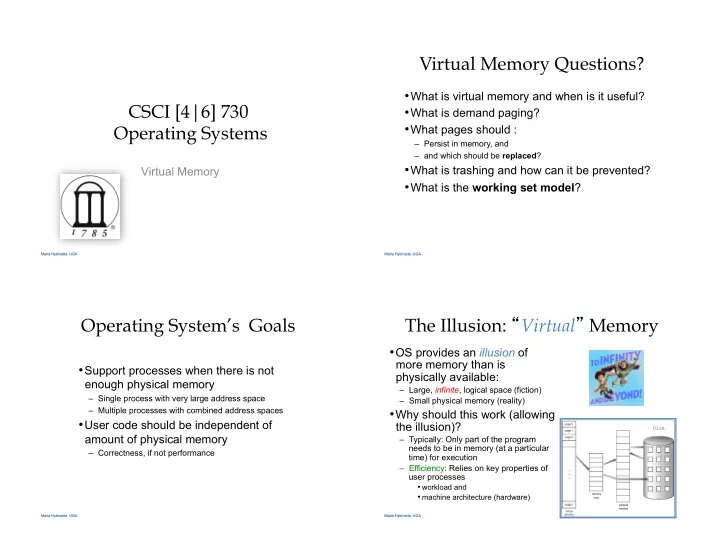
SLIDE 3 Maria Hybinette, UGA Maria Hybinette, UGA
Virtual Memory Approach: Intuition
- Idea: OS keeps unreferenced pages on disk and
referenced pages in physical memory
– Slower, cheaper backing store than memory
– Even when not all pages are loaded into main memory
- OS and hardware cooperate to provide illusion of large disk
as fast as main memory
– Same behavior as if all of address space in main memory – Hopefully have similar performance!
– OS must have mechanism to identify location of each page in address space in memory, or on disk – OS must have (allocation) policy for
- determining which pages live in memory, and
- which (remain) on disk
– OS must have (replacement) policy which pages should be evicted.
Maria Hybinette, UGA Maria Hybinette, UGA
Reflect: Virtual Address Space Mechanisms
- Each page in virtual address space maps to one of three
locations:
– Physical main memory: Small, fast, expensive – Disk (backing store): Large, slow, cheap – Nothing (error): Free
Disk Storage main memory cache registers Smaller, faster and more expensive Bigger, slower and cheaper
Leverage memory hierarchy of machine architecture Each layer acts as backing store for the layer above
Maria Hybinette, UGA Maria Hybinette, UGA
Virtual Address Space Mechanisms
Extend page tables with an extra bit to indicate whether it is in memory or
- n disk (a resident bit):
- valid (or invalid)
- Page in memory: valid bit set in page
table entry (PTE)
- Page out to disk: valid bit cleared
(invalid)
- PTE points to block on disk
- Causes trap into OS when page is
referenced
- Trap: page fault
- Page table ?
– Main memory – Cache (the look-aside buffer) TLB
1 1 1 1 !
Frame # valid-invalid bit page table Maria Hybinette, UGA Maria Hybinette, UGA
Virtual Memory Mechanisms (cont)
The TLB factor: Hardware and OS cooperate to translate addresses
- First, hardware checks TLB for virtual address
– TLB hit: Address translation is done; page in physical memory – TLB miss:
- Hardware or OS walk page tables
- If PTE designates page is valid, then page in physical
memory
- Main Memory Miss: Not in main memory: Page
fault (i.e., invalid)
– Trap into OS (not handled by hardware) – [if memory is full)] OS selects victim page in memory to replace
- Write victim page out to disk if modified (add dirty
bit to PTE)
– OS reads referenced page from disk into memory – Page table is updated, valid bit is set – Process continues execution
page table f CPU logical address p d f d physical address physical memory p TLB miss page number frame number TLB hit TLB