From October 29-30th, representatives from more than 40 civil society - - PDF document

from october 29 30th representatives from more than 40
SMART_READER_LITE
LIVE PREVIEW

From October 29-30th, representatives from more than 40 civil society - - PDF document

From October 29-30th, representatives from more than 40 civil society organizations met in Quito, Ecuador during the VII Ministerial Conference of the Free Trade Area of the Americas (FTAA) to discuss the role played by environment and sustainable


slide-1
SLIDE 1

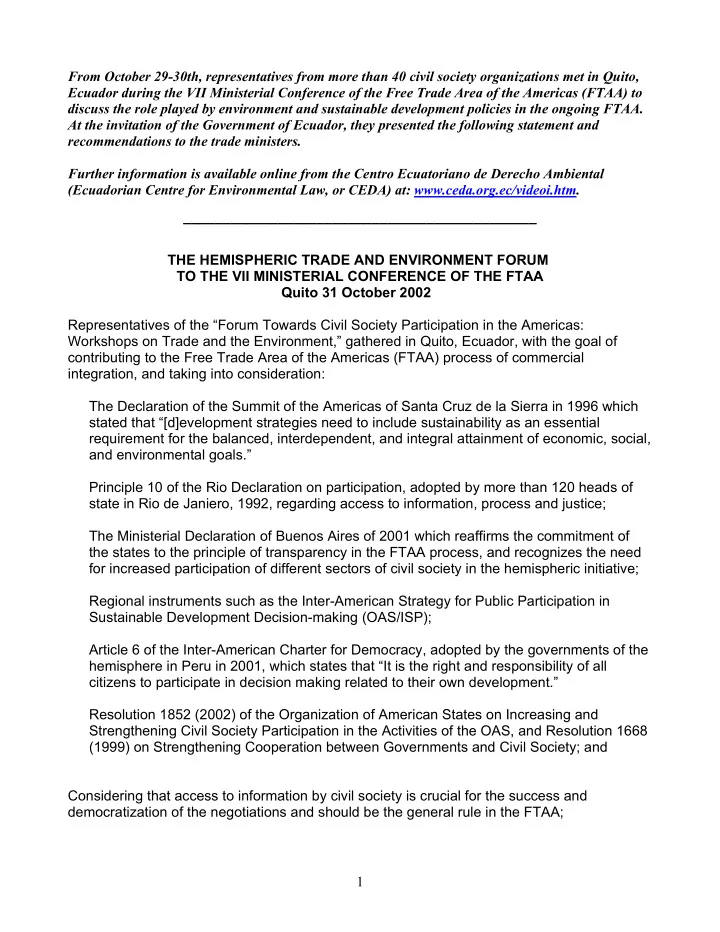
1 From October 29-30th, representatives from more than 40 civil society organizations met in Quito, Ecuador during the VII Ministerial Conference of the Free Trade Area of the Americas (FTAA) to discuss the role played by environment and sustainable development policies in the ongoing FTAA. At the invitation of the Government of Ecuador, they presented the following statement and recommendations to the trade ministers. Further information is available online from the Centro Ecuatoriano de Derecho Ambiental (Ecuadorian Centre for Environmental Law, or CEDA) at: www.ceda.org.ec/videoi.htm. _____________________________________________ THE HEMISPHERIC TRADE AND ENVIRONMENT FORUM TO THE VII MINISTERIAL CONFERENCE OF THE FTAA Quito 31 October 2002 Representatives of the “Forum Towards Civil Society Participation in the Americas: Workshops on Trade and the Environment,” gathered in Quito, Ecuador, with the goal of contributing to the Free Trade Area of the Americas (FTAA) process of commercial integration, and taking into consideration: The Declaration of the Summit of the Americas of Santa Cruz de la Sierra in 1996 which stated that “[d]evelopment strategies need to include sustainability as an essential requirement for the balanced, interdependent, and integral attainment of economic, social, and environmental goals.” Principle 10 of the Rio Declaration on participation, adopted by more than 120 heads of state in Rio de Janiero, 1992, regarding access to information, process and justice; The Ministerial Declaration of Buenos Aires of 2001 which reaffirms the commitment of the states to the principle of transparency in the FTAA process, and recognizes the need for increased participation of different sectors of civil society in the hemispheric initiative; Regional instruments such as the Inter-American Strategy for Public Participation in Sustainable Development Decision-making (OAS/ISP); Article 6 of the Inter-American Charter for Democracy, adopted by the governments of the hemisphere in Peru in 2001, which states that “It is the right and responsibility of all citizens to participate in decision making related to their own development.” Resolution 1852 (2002) of the Organization of American States on Increasing and Strengthening Civil Society Participation in the Activities of the OAS, and Resolution 1668 (1999) on Strengthening Cooperation between Governments and Civil Society; and Considering that access to information by civil society is crucial for the success and democratization of the negotiations and should be the general rule in the FTAA;

slide-2
SLIDE 2

2 Emphasising the Ministers’ commitment to transparency in San Jose, Costa Rica, March, 1998, to facilitate the participation of different social sectors and noting, in this respect, the release of the Draft Negotiating Text, after the Ministerial Conference in Buenos Aires, Argentina, in May, 2001; The development of the integration process should ensure the satisfaction of the interests of participating nations, recognizing existing social and economic differences. Convinced that that process of the FTAA should be built upon a dialogue and effective participation between the governors and the governed, and that economic integration cannot be successful without serious consideration of the diversity of social, economic, cultural, political and environmental realities among the countries of the Western Hemisphere; Conscious that economic integration must be accompanied by the strengthening of environmental and social institutions; And emphasising that the common good and improvements in the quality of life for human beings are the ultimate goal of all economic development processes, and that governments serve their citizens; We recommend: With Regard to Intellectual Property and Biodiversity Negotiations on intellectual property rights should seek to balance the aim of protecting intellectual property with the goal of disseminating information, including technological knowledge. Negotiations should take into consideration the interests of innovators, users of technology, and civil society. In this sense, provisions should be included so as to ensure the protection

  • f intellectual property rights in a manner consistent with human rights, national public policy
  • bjectives, the principles of sustainable development, and fairness among stakeholders.

Recommendations:

  • 1. Regarding access to genetic resources and intellectual property:

a) That the Ministers reaffirm the sovereign rights of states over their biological and genetic resources, in addition to the right to regulate such access in accordance with national legislation and international commitments; b) That clauses should be included requiring legal certification of access and prior informed consent as substantive conditions for the concession of such rights, in addition to the annulment of any rights granted in breach of such requirements; c) That, recalling that intellectual property law grants monopoly rights to innovations; equivalent legal and institutional mechanisms should be explored to protect information derived from Biodiversity.

  • 2. Regarding the protection of traditional knowledge:
slide-3
SLIDE 3

3 a) That the rights of indigenous and local communities to dispose of their knowledge, innovations and practices be reaffirmed; b) That mechanisms be incorporated to intellectual property laws, conditioning the grant

  • f intellectual property rights to the compliance with regulations governing access to

resources and protection of traditional knowledge; c) That a sui géneris regime should be established to protect the knowledge, innovations and practices of local and indigenous communities.

  • 3. Regarding the protection of rights over plant varieties.

a) That the intellectual property system established by states should recognize the duties undertaken under other multilateral agreement such as the creation of sui géneris regimes that take into account among others: public policy goals in the conservation and sustainable use of genetic resources and the fair and equitable distribution of benefits and the protection of farmers’ rights; b) That no obligation should be required of states regarding compliance with the provisions of the Union for the Protection of Varietals (UPOV) (78 or 91 Acts);

  • 4. Regarding Technology Transfer;

a) That technology transfer should be considered a fundamental objective of FTAA. In this

sense, the existence of intellectual property rights should not be seen as a hindrance or impediment to the transfer of technology;

b) That legal mechanisms be established to promote the acquisition and transfer of

technology (including tax cuts), facilitation of strategic alliances, use of compulsory licensing and technology training programs;

  • 5. Regarding enforcement of rights;

a) Compliance with the Biodiversity Convention or national and regional regulations dealing with access to genetic resources and protection of local and indigenous community knowledge, innovations and practices should be promoted; b) That mechanisms should be established to prevent and sanction non-competitive market practices and the abuse of intellectual property rights. With Regard to Investment Investments are crucial for sustainable development in the hemisphere. In order to promote sustainable development, rules on investment should include the following principles, among

  • thers:
  • Balance between the rights and obligations of the investor and the member states of

FTAA

  • Nondiscrimination between domestic and foreign investors

Recommendations:

  • 1. Clarify the substantive rules on investment in order to preserve the ability of states to

regulate affairs in the public interest;

slide-4
SLIDE 4

4

  • 2. Define the responsibilities of the investors’ state with relation to environmental and social

performance of its nationals, in particular to avoid double standards on an international level;

  • 3. Create within the framework of the FTAA an open and transparent dispute resolution

system among member states, with a right of appeal, and including a fund to cover the costs of litigation where necessary;

  • 4. Ensure the obligation of the parties to not weaken domestic environmental, social and

labor-related standards with a view to attracting investment. This undertaking should be accompanied by effective mechanisms to ensure enforcement of environmental, social and labor-related regulations. With Regard to Market Access Recognizing the asymmetries in the levels of development in the countries of the hemisphere, special and differentiated treatment should be assured for the most vulnerable economies; Perverse subsidies, which have negative economic, social and environmental consequences, constitute an inequitable mechanism preventing developing countries from competing on a level playing field under the accord. Recommendations:

  • 1. That the process of trade liberalization goes hand in hand with business development

policies, with emphasis on small and medium enterprises, and technical assistance that secures access to markets on a competitive basis for producers from least developed countries;

  • 2. The precautionary principle should be adopted to avoid potentially negative impacts of

trade on sustainable development;

  • 3. Agree to reduce or eliminate perverse subsidies, and especially those related to

agriculture, without prejudice to the rational use of incentives when these are used to promote sustainable and equitable production processes;

  • 4. Harmonization of environmental quality and performance standards should be gradual

and incremental, affording special and differential treatment for developing countries. With Regard to Sustainability Assessments Sustainability Assessments provide a precise and comprehensive tool for the development of trade policies by identifying the economic costs of social and environmental problems. Furthermore, Sustainability Assessments provide a means of anticipating serious or

slide-5
SLIDE 5

5 irreversible environmental impacts, such as the collapse of certain fisheries or aquifer depletion, in the hemisphere. Recommendations: 1 That the Tripartite Commission establish an official Sustainability Assessment process for the agreement before, and in the event of its entry into force, after the FTAA. This Assessment should build upon the experience and methodologies developed within and beyond the hemisphere (such as, for example, those promoted and used by UNEP, ECLAC, EU, WWF and the Stockholm Environment Institute), considering: a) Informed citizen participation b) Methods discussed and applied case by case that take into account the economic, social, cultural and environmental conditions of each country c) Flexible, precise and comprehensive methodologies d) With national and regional scope e) Identifying mitigation measures and f) Commitment to implementation

  • 2. The evaluation and experiences of existing trade liberalization processes

should be considered.

  • 3. The FTAA process should aim at strengthening the institutional capacities of the

countries of the hemisphere for assessing the impacts of trade policies. With Regard to Mechanisms for Participation Recommendations:

  • 1. That the following concrete mechanisms for informed public participation in the FTAA

negotiations be established:

  • a. Provide for observer status for civil society representatives in the FTAA

Negotiating Groups, the Trade Negotiations Committee, and Ministerial

  • meetings. In this regard, the MERCOSUR subgroups and NAFTA procedures

for participation are examples for the FTAA;

  • b. Create effective mechanisms to ensure a right to a reasoned response to the

contributions of civil society presented to the FTAA negotiating mechanisms.

  • c. Generate transparent mechanisms for dissemination of information, such as

inclusion of civil society contributions on the FTAA web site, the preparation of indices of civil society presentations, and the publication of meeting summaries;

  • d. Instruct the Technical Committee on Institutional Matters to establish an

advisory body of experts;

  • e. Adopt, at a minimum, the policies of the WTO for publication and release of

documents;

  • f. Facilitate civil society in following the final stages of negotiations; and in

particular authorize the release of updated draft text;

slide-6
SLIDE 6

6

  • g. Recommend that the Inter-American Development Bank and other inter-

governmental organizations provide funds to facilitate civil society participation in the negotiation process.

  • h. Urge governments to include civil society representatives in national negotiating

delegations;

  • 2. Establish and strengthen substantive and effective regional and sub-regional

consultative, incorporating initiatives of the OAS;

  • 3. Establish and strengthen substantive and effective consultative mechanisms at the

national level which integrates civil society participation in the different issues related to the FTAA negotiations process;

  • 4. Establish opportunities and mechanisms for public participation that allow the

consideration of interests and positions of non-governmental actors in FTAA dispute settlement procedures. In particular, the right of non-governmental actors to participate in dispute settlement procedures and to submit amicus curiae briefs should be recognized.

  • 5. Fulfill commitments adopted consistently and repeatedly by Heads of State, and

embraced within international instruments and national norms, to integrate civil society in decision-making processes. In this regard, in the FTAA, Ministers should analyze, develop and establish a permanent hemispheric environmental cooperation mechanism, with the following purposes:

  • a. Compile and disseminate information, and undertake research and

assessments with regard to trade and sustainable development;

  • b. Coordinate technical assistance;
  • c. Consult and collaborate with national, sub-regional and regional environmental

authorities and institutions;

  • d. Interact and consult regularly with civil society in the design and implementation
  • f its work plan, and in addressing trans-boundary environmental problems.

Final Note The Hemispheric Trade and Environment Forum to the VII Ministerial Conference of the FTAA, which met in Quito, Ecuador, 29-30 October 2002, requests that this document be made available on the FTAA Web Site and that it receive a formal reply during the next Meeting of Vice Ministers of the FTAA.

This document represents a consensus of participants in the forum, but does not necessarily reflect the positions of the participating organizations with regard to each of the points presented.