
SLIDE 1
From Librarian to Proficient Manager
WebJunction Webinar - November 4, 2014 Michele Leininger, PhD CandidateUniversity of Pittsburgh
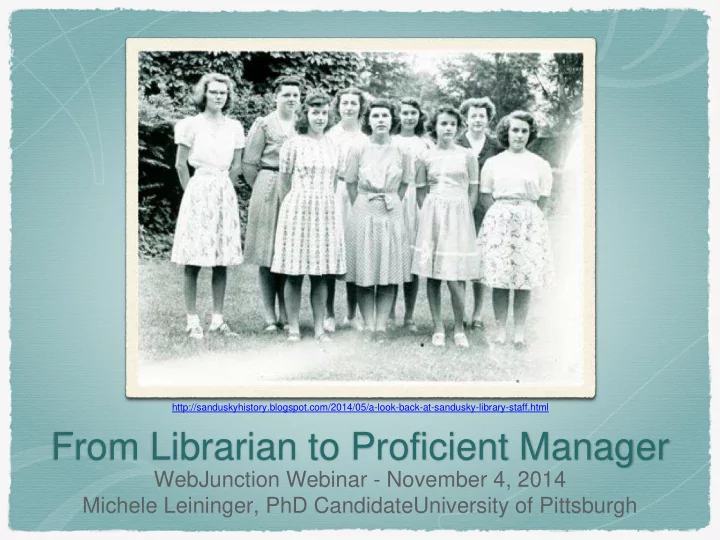
http://sanduskyhistory.blogspot.com/2014/05/a-look-back-at-sandusky-library-staff.html
From Librarian to Proficient Manager WebJunction Webinar - November - - PowerPoint PPT Presentation
http://sanduskyhistory.blogspot.com/2014/05/a-look-back-at-sandusky-library-staff.html From Librarian to Proficient Manager WebJunction Webinar - November 4, 2014 Michele Leininger, PhD CandidateUniversity of Pittsburgh Objectives: How the
WebJunction Webinar - November 4, 2014 Michele Leininger, PhD CandidateUniversity of Pittsburgh
http://sanduskyhistory.blogspot.com/2014/05/a-look-back-at-sandusky-library-staff.html
How the information was gathered and why it’s important (Methodology). The experiences of the participants, including the tools, processes, and preferences involved in learning and the transformational journey. The important role of the organization, both formally and informally encouraging and supporting the journey. The implications of the research practitioners and the role we can play in furthering public library management research.
Identify area of research interest. Review the research literature. Develop research questions. Design research study. Collect and analyze data. Write up results. Publish.
As practitioners, we are readers, participants, and
Explains approach, purpose, and thought process Reveals bias and potential issues Shows applicability and quality
Very important debate in academic circles; some importance to practitioners. Simplified: Qualitative: truth is created by each of us and is informed by beliefs, experiences, knowledge. Quantitative: truth exists separately and is uncovered through scientific method of testing hypotheses.
Most debate is either/or. Some researchers, however, believe that quantitative and qualitative are
Choice is dependent on: Topic and previous knowledge Research questions In turn, the choice suggests set of research tools to help answer research questions.
Topics cover all areas of the continuum. Qualitative research is used to explore and describe topics, building
then used to create and test theories, furthering knowledge. Without knowledge based in research, we borrow from other fields’ research, making assumptions about our own. We need to build our own solid foundation for theory-building.
http://fdrlibrary.wordpress.com/tag/research/
Particularly true in this specific area. Very little research in general ~ what does often focuses on Directors only. These are often based on assumptions because no full description of all types of managers’ experiences exists.
http://librarycentral.acisd.org/researchCentral.cf m?page=researchPathFinder&pathfinderid=41
No research explores their “truth,” revealing what those stories are, especially HOW they became managers. Need to collect lots of stories so we can create a stronger foundation to build our own theories on. This research seeks to begin that collection of stories and start laying the foundation.
To describe the phenomenon, this research study is: Case Study With Embedded Subunits Tools: Diary Entries and Interviews Collected data is basically stories on how they each made that transition or are in the process of making that transition. From the stories, the emerging information focuses on what this process looks like for individuals, groups of individuals, and the organization itself.
What are the most influential or impactful ways that public library managers gain knowledge, proficiency and/or expertise? In their view, what are the critical knowledge, skills, and behaviors necessary to succeed at being a public library manager? How do public library managers view leadership and what role does it play in their work? How do managers make meaning out of their challenges and experiences and apply the lessons learned?
http://research-methodology.net/research-methodology/research-design/
http://www.loc.gov/pictures/item/oem2002004172/PP/
http://www.flickr.com/photos/homerlibrary/4331023 83/sizes/m/in/set-72157600025264371/
http://www.loc.gov/pictures/item/2004668395/resource/
http://commons.wikimedia.org/wiki/File:Carnegie_Librar y_of_Pittsburgh_Main_Entrance.jpg
The intricacies of a large
what; how to get things done). How to get experience and move up (the Senior Librarian position). Operating more as a team and a system.
http://homepages.rootsweb.ancestry.com/~maggieoh/western.html
http://mecanem.com/blog/?p=255
http://carnegielibrary.org/about/strategicplan/updates/
https://weekly.blog.gustavus.edu/2013/11/01/stepping-stones- to-success-students-work-towards-graduate-and-professional- school/
Complexity of the public library also emerging from data. Compared to two similar business studies show that some things are the same, but other important findings are different. Preponderance of data ~ in other words, we need lots and lots of stories, both of individuals and organizations. More data means more commonalities, from which theories can be built and tested, creating a unique framework specific to public libraries and their management. Surprise! Case study proves to be potentially more unique instead of the common EveryLibrary.
Find commonalities about how managers learn and then look for ways to support that. Create a mix of the informal and formal social learning through mentorships/coaching, learning opportunities, and time (and place) to for the network to get together. Encourage reflective opportunities and practices throughout everything. Become intentional about developmental assignments and succession planning.
From these stories, the biggest impact on learning is
social. Check out some great titles, but be sure to read and discuss them with others for a powerful impact: Managing Transitions (Bridges) and Crucial Conversations (Patterson). Reexamine all your work relationships and
informal mentorships, but looking at them that way may open you up to even more information and learning.
This study can begin to inform LIS management courses, certificates of study, and professional continuing education. Most identified: dealing with staff issues. Most recommended: provide the basics of HR and staffing issues before have to deal with it in the field. Information + field experience + practice = proficiency. Could provide leadership in collecting individual and
between researchers/educators and practitioners.
Find your own story. Use the questions from this study as prompts ~ and then add your own. Discover your most powerful and influential vignette, which is the core of your own management style. Find a partner, workgroup, community of practice/network, or even your organization to uncover more than just your own story for comparison and ideas. Replicate your own version of the study and share the data ~ necessary to build our knowledge and research foundation.
Start by keeping a reflective diary ~ use the learning guide to get started. If you do try to replicate any of the study (or create your own), write an article for a journal. Share it!! Write to me ~ send along your stories and findings!
http://commons.wikimedia.org/wiki/File:Enfant_écrivant- Henriette_Browne.jpg