from Australia Mattia Amadio 2 year PhD student About Australia 6 - - PowerPoint PPT Presentation

from australia
SMART_READER_LITE
LIVE PREVIEW

from Australia Mattia Amadio 2 year PhD student About Australia 6 - - PowerPoint PPT Presentation

Flood damage functions: a lesson from Australia Mattia Amadio 2 year PhD student About Australia 6 largest Nation 7.7 million km 2 (EU28 = 4.4 mil km 2 ) Natural hazards and Risk management Canberra and ANU ANU is ranked 22 nd in the world


slide-1
SLIDE 1

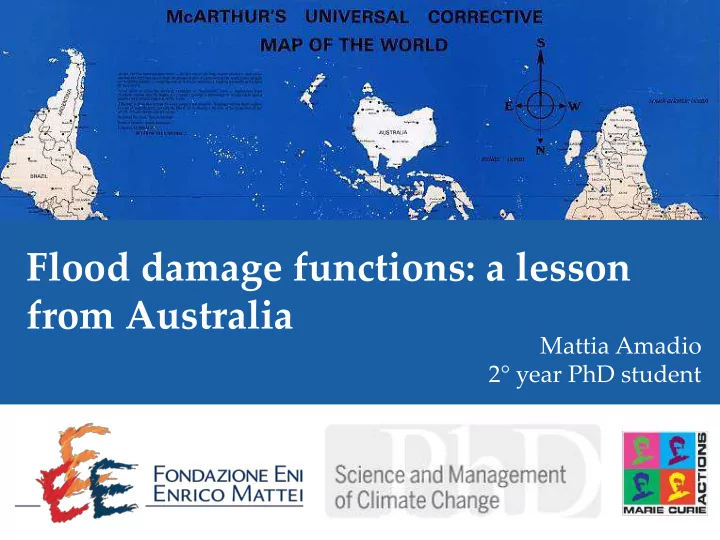
Flood damage functions: a lesson from Australia

Mattia Amadio 2° year PhD student

slide-2
SLIDE 2

About Australia

6° largest Nation 7.7 million km2

(EU28 = 4.4 mil km2)

slide-3
SLIDE 3

Natural hazards and Risk management

slide-4
SLIDE 4

Canberra and ANU

ANU is ranked 22nd in the world and first in Australia 1,5 km2 campus 10,000 undergraduate 11,000 postgraduate 3,753 staff employees

slide-5
SLIDE 5

Canberra and ANU

What adaptation options and policies improve or maintain farm productivity under future uncertainty?

slide-6
SLIDE 6

My research topic: Flood Risk Assessment

(E) Exposed asset (H) Hazard depth

1 0,75 1,5 2,25 3 3,75 4,5 Agriculture Purification plant Roads Companies 0,5 1 0,5 1 1,5 2 2,5 3 3,5 4 4,5 5

Structure Contents Companies Agriculture Farm house Roads

(R) Flood damage

Reliable risk assessment strongly depends

  • n the quality of

basedata and on the calibration of the method

APPLICATION IN ITALY Uneven quality of spatial data across regions Lack of a broad national study

  • n loss functions

Damage records for model validation are poor, fragmented and inconsistent

Direct, tangible impact of floods in Italy

(V) Damage curves

slide-7
SLIDE 7

Improve Flood Damage Modelling

Expected annual losses: 500-800 million Euro

(Feyen et al., 2012)

Population exposed to medium flood hazard (100-200 years RP) at municipality scale

8% of land 10% of population (ISPRA 2014)

1

Risk Management needs precise, detailed and reliable information about potential impacts in order to adopt cost-effective measures to reduce losses

  • Test existing depth-damage functions
  • Improve the description of exposed

value

  • Calibrate a new loss function

Likely to be more than double by 2050 (Jongman et al., 2014)

slide-8
SLIDE 8

GVA(€)

Dasymetric map of Population and GVA for Italy

Multiple ancillary data sources

  • Soil sealing
  • Land use
  • Buildings (limited to Emilia-Romagna)
  • Macrocategories of Gross Value Added for

Local Market Areas

  • Population tracts from ISTAT census (2011)

Dasymetric map of Italy GVA (250m)

  • n the basis of land use and population

Exposure calculated

  • n recent flood hazard

scenarios (Alfieri 2015)

slide-9
SLIDE 9

Dasymetric map of Population and GVA for Italy

Two dasymetric methods are compared to the GHSL population dataset

Better land-use description = More reliable population density projection

Adjusted R2 0.72 0.24 Both significant within 95% confidence interval

slide-10
SLIDE 10

Flood Loss Modelling with FLF-IT

Study collaboration on Flood Loss Functions for residential structures Transferability of an Australian method employed to produce a relative, synthetic loss function for residential structures based

  • n empirical

damage records (21 million EUR for structural damage alone)

2014

slide-11
SLIDE 11

A function to describe the relationship between floodwater depth and structural damage to residential buildings. Damage is compared to pre-event mean market value. A three-fold cross- validation procedure has been applied on damage records in

  • rder to validate the

curve.

Flood Loss Modelling with FLF-IT

𝑒ℎ = ℎ 𝐼

1 𝑠

× 𝐸𝑛𝑏𝑦 Bootstrapping approach

Damage records are resampled and the most appropriate value of the root function and maximum damage share are selected by chi- square test of goodness of fit.

slide-12
SLIDE 12

Learning to code a .netCDF statistical tool

Development

  • f a python tool

to perform clipping and zonal statistics directly on netCDF datasets

An increasing number of datasets, especially from climatic models, are released in .cdf format which allows multiple spatial layers for different time steps.

slide-13
SLIDE 13

Questions?