
SLIDE 1
20-21 SEPTEMBER | GOLD COAST, AUSTRALIA
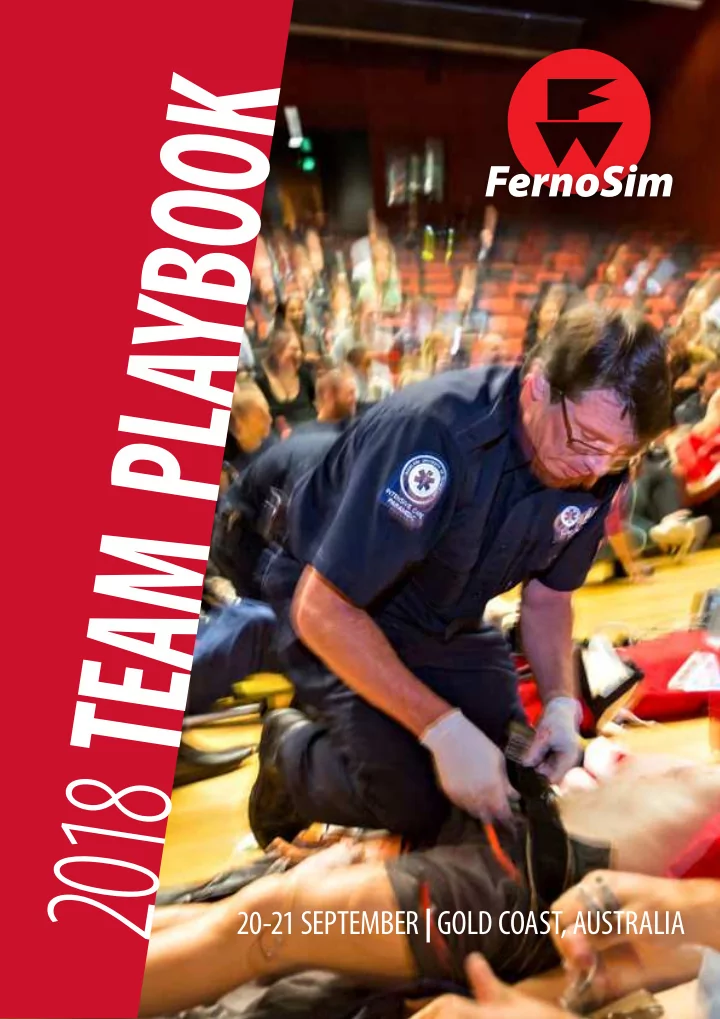
2018 TEAM PLAYBOOK 20-21 SEPTEMBER | GOLD COAST, AUSTRALIA FERNO - - PDF document
2018 TEAM PLAYBOOK 20-21 SEPTEMBER | GOLD COAST, AUSTRALIA FERNO AUSTRALIA PARAMEDIC SIMULATION CHALLENGE 20-21 SEPT 2018 | GOLD COAST, AUSTRALIA CONTENTS Important Dates / / / / / / / / / / / / / / / / / / / / / / /
20-21 SEPTEMBER | GOLD COAST, AUSTRALIA
WWW.FERNO.COM.AU/FERNOSIM
FERNO AUSTRALIA PARAMEDIC SIMULATION CHALLENGE
20-21 SEPT 2018 | GOLD COAST, AUSTRALIA2 CONTENTS
Important Dates / / / / / / / / / / / / / / / / / / / / / / / / / / / / / / / / / / / / / / / / / / / / / / / / / / / / / / / / / / / / / / / / / / / / / / / / / 3 Useful Contacts / / / / / / / / / / / / / / / / / / / / / / / / / / / / / / / / / / / / / / / / / / / / / / / / / / / / / / / / / / / / / / / / / / / / / / / / / / 3 Social Media / / / / / / / / / / / / / / / / / / / / / / / / / / / / / / / / / / / / / / / / / / / / / / / / / / / / / / / / / / / / / / / / / / / / / / / / / / / / / 3 Introduction / / / / / / / / / / / / / / / / / / / / / / / / / / / / / / / / / / / / / / / / / / / / / / / / / / / / / / / / / / / / / / / / / / / / / / / / / / / / / 4 Team Composition / / / / / / / / / / / / / / / / / / / / / / / / / / / / / / / / / / / / / / / / / / / / / / / / / / / / / / / / / / / / / / / / / / / / / / / 5 Registration and Entry Fee / / / / / / / / / / / / / / / / / / / / / / / / / / / / / / / / / / / / / / / / / / / / / / / / / / / / / / / / / / / / / / / 5 Registration Process / / / / / / / / / / / / / / / / / / / / / / / / / / / / / / / / / / / / / / / / / / / / / / / / / / / / / / / / / / / / / / / / / / / / / / 5 Mandatory Forms / / / / / / / / / / / / / / / / / / / / / / / / / / / / / / / / / / / / / / / / / / / / / / / / / / / / / / / / / / / / / / / / / / / / / / / / 5 Uniforms / / / / / / / / / / / / / / / / / / / / / / / / / / / / / / / / / / / / / / / / / / / / / / / / / / / / / / / / / / / / / / / / / / / / / / / / / / / / / / / / 6 Team Check-In / / / / / / / / / / / / / / / / / / / / / / / / / / / / / / / / / / / / / / / / / / / / / / / / / / / / / / / / / / / / / / / / / / / / / / / / / / 6 Team Lock Down / / / / / / / / / / / / / / / / / / / / / / / / / / / / / / / / / / / / / / / / / / / / / / / / / / / / / / / / / / / / / / / / / / / / / / / / 7 Permissible Equipment / / / / / / / / / / / / / / / / / / / / / / / / / / / / / / / / / / / / / / / / / / / / / / / / / / / / / / / / / / / / / / / / / / 7 Equipment Supplied by FernoSim / / / / / / / / / / / / / / / / / / / / / / / / / / / / / / / / / / / / / / / / / / / / / / / / / / / / / / / / 8 Medications Supplied / / / / / / / / / / / / / / / / / / / / / / / / / / / / / / / / / / / / / / / / / / / / / / / / / / / / / / / / / / / / / / / / / / / 9 Body Substance Isolation (BSI) and Personal Protective Equipment (PPE) / / / / / / / / / / / / / / / / / 10 The FernoSim Competition Process / / / / / / / / / / / / / / / / / / / / / / / / / / / / / / / / / / / / / / / / / / / / / / / / / / / / / 10 Scoring of the Final Competition / / / / / / / / / / / / / / / / / / / / / / / / / / / / / / / / / / / / / / / / / / / / / / / / / / / / / / / / 11 Awards Ceremony / / / / / / / / / / / / / / / / / / / / / / / / / / / / / / / / / / / / / / / / / / / / / / / / / / / / / / / / / / / / / / / / / / / / / / 11 Procedural Guidelines / / / / / / / / / / / / / / / / / / / / / / / / / / / / / / / / / / / / / / / / / / / / / / / / / / / / / / / / / / / / / / / / / / / 12 Key Skills / / / / / / / / / / / / / / / / / / / / / / / / / / / / / / / / / / / / / / / / / / / / / / / / / / / / / / / / / / / / / / / / / / / / / / / / / / / / / / / 12 Reference Material / / / / / / / / / / / / / / / / / / / / / / / / / / / / / / / / / / / / / / / / / / / / / / / / / / / / / / / / / / / / / / / / / / / / / / 17
Follow the conversation: #FernoSim
3 FERNO AUSTRALIA PARAMEDIC SIMULATION CHALLENGE
20-21 SEPT 2018 | GOLD COAST, AUSTRALIAImportant Dates
DATE TIME DESCRIPTION Friday 20 JULY 2018 17:00 AEDT REGISTRATION DEADLINE Thursday 20 September 09:30 - 11:30 Team check-in, Briefjng and FernoSim gear inspection 12:00* Group 1 transfer to FernoSim Preliminary Challenge 12:30 - 16:00* FernoSim Preliminary Challenge Evening PAIC 2018 Welcome Reception Friday 21 September All Day Conference & Exhibition 16:30 Team Lock Down / Communications Black Out 17:30 - 21:00 FernoSim Finals Saturday 25 November All Day Conference & Exhibition Evening PAIC2018 Dinner and FernoSim Presentation Fees section. * A Preliminary Challenge will be held should FernoSim registrations exceed a threshold ** The PAIC 2018 Welcome Reception is included in the Conference Fee and only open to registered delegates. Participating FernoSim teams are eligible for a deeply discounted conference fee. Refer
Useful Contacts
FernoSim Registration Ceserina Thomson fernosim@ferno.com.au +61 (0)411 601202 FernoSim Challenge Rules Colin Allen fernosim@ferno.com.au +61 (0)417 745576
Social Media
Join us on social media! Follow us on Facebook, Instagram, Twitter or YouTube for news, tips and behind-the-scenes fun and share your own stories in the lead up to the competition. The official hashtags are #FernoSim and #PAIC2018 Ferno Australia Paramedic Sim Challenge FernoSim @FernoSim Ferno Australia (FernoSim Playlist)
Fees
FernoSim Challenge AU $200 per team (maximum of four per team) PAIC 2018 (Optional) AU $350 per person - special discounted registration fee for team members only and covers PAIC2018 sessions and Welcome Reception Gala Dinner TBA - still in negotiation BACK TO CONTENTS PAGE
WWW.FERNO.COM.AU/FERNOSIM
FERNO AUSTRALIA PARAMEDIC SIMULATION CHALLENGE
20-21 SEPT 2018 | GOLD COAST, AUSTRALIA4 INTRODUCTION
Objectives The objective of the Ferno Australia Paramedic Simulation Challenge (FernoSim) is to create a fun, challenging and educational experience for emergency medical personnel. Our aim is to promote paramedic excellence and provide an opportunity that results in team individuals being better prepared for the many challenges they may encounter in the fjeld. FernoSim provides a platform for paramedics to hone their collective professional skills. It’s also an opportunity for participants expand their professional network and to share their expertise, experience, techniques and technology with colleagues from around the world. About the FernoSim Challenge FernoSim Preliminary Challenge Should the number of registrations exceed a set threshold, a Preliminary Challenge will be held on 20 September. The Preliminary Challenge will consist of a number of 10-minute scenarios conducted at work skill stations to challenge your clinical skills and knowledge, team communications and effjciency. The six highest scoring teams will go through to the FernoSim Finals. FernoSim Finals Challenge The FernoSim Final will be held on Friday 21st September. The Challenge is a 20-minute, scenario-based incident that tests each team’s ability to manage multiple patients with varying illnesses or injuries in front of a large AUience of their peers. The Competition focuses directly on each team’s ability to:
effjcient manner. The competition also serves as an exceptional learning opportunity for the AUience and participating teams. These rules and regulations are designed to ensure standardisation in team preparation and on-site operation and administration of the FernoSim, operated by the FernoSim organising committee. To ensure consistency with the rules and regulations, only the designated FernoSim Coordinator is permitted to render an interpretation of the rules and regulation, offjcially address team concerns or make on-site operational/ administrative decisions.
BACK TO CONTENTS PAGE Follow the conversation: #FernoSim
5 FERNO AUSTRALIA PARAMEDIC SIMULATION CHALLENGE
20-21 SEPT 2018 | GOLD COAST, AUSTRALIATeam Composition
event of illness or injury of one of the three primary team members or other reason acceptable to FernoSim
advance notifjcation and approval of the FernoSim Coordinator.
paramedic certifjcation. Registration and Entry Fee Registration for the FernoSim is strictly limited and accepted on a fjrst-come-fjrst-served basis. A team is not considered to be registered without submitting a complete application and entry fee. Registration fees for the Paramedic component of FernoSim is AU $200 per team of up to 4 members and includes participation in Ferno Australia Paramedic Simulation Challenge 2018. The FernoSim schedule has been devised to avoid timetable clashes with the PAIC program. Apart from Team Lock Down, teams are free to attend all conference sessions. The special discount rate for FernoSim team members is AU $350 per person. Tickets to the PAIC2018 Conference Awards Dinner are not included in the conference fee. Tickets can be purchased
Dinner to receive Awards. Registration Process
Mandatory Forms An interactive FernoSim Entry Forms Pack is available for download which can be completed on your computer or tablet, stored to your device and returned to us by email. The Forms can also be printed and hand completed if you
NOTE: Failure to complete the waiver, or failure to abide by the principles and practices outlined in the waiver, will result in a team or team member’s disqualifjcation without any refund. Submit all your registration materials to:
FERNOSIM@FERNO.COM.AU BACK TO CONTENTS PAGE WWW.FERNO.COM.AU/FERNOSIM
FERNO AUSTRALIA PARAMEDIC SIMULATION CHALLENGE
20-21 SEPT 2018 | GOLD COAST, AUSTRALIA6
Uniforms We can guarantee there’s going to be alot of photos and video taken throughout FernoSim for broadcast far and
FernoSim challenge and at the awards presentation. Team Check-in and Briefing
not include details of the scenario. #YouWish!
necessary for the scenario. After the Briefjng is your opportunity to inspect all the equipment. Team Lock Down During the FernoSim challenge, all competing teams will be sequestered in a secured holding area while not competing to ensure the secrecy of the scenario details. A communications black out will come into play once Lock Down begins. After competing in the Competition, teams will not return to the holding area. Designated FernoSim Crew or Security will be responsible for gathering and returning all of the teams’ gear and equipment which is returned to you after completion of their scenario. Teams are welcome to attend the remainder of the FernoSim Challenge as a spectator - most do. During Lock Down:
web access devices are allowed in the Team Holding Area nor are they to be carried by team members during competition phases. Your electronic goodies will be collected and returned to you after completion of your scenario.
individuals who have seen or competed in the event.
conversation relative to the competition while outside the Lock Down Room will be disqualifjed from the competition and may cause their team to be disqualifjed.
Follow the conversation: #FernoSim
7 FERNO AUSTRALIA PARAMEDIC SIMULATION CHALLENGE
20-21 SEPT 2018 | GOLD COAST, AUSTRALIAProvision of Restricted Information to Other Teams or Team Members
event and a recommended timeline.
teams who have not yet completed the scenario(s). Permissible Equipment No portable equipment may be carried on the competitor’s body or in/on the competitor’s uniform during the competition, with the exception of:
This includes, but is not limited to scene ID vests, IV/IO catheters, rescue airways laryngoscopes or laryngoscope blades. Review/reference “cheat sheets” will not be allowed in the competition. Examples include printed or electronic fjeld drug guides, quick reference drug calculations or formulas, radio report summary cards, and any other material that would provide an advantage to the competing team. The only exception is a paediatric, length-based resuscitation tape which a team may carry in their kits/bags.
BACK TO CONTENTS PAGE WWW.FERNO.COM.AU/FERNOSIM
FERNO AUSTRALIA PARAMEDIC SIMULATION CHALLENGE
20-21 SEPT 2018 | GOLD COAST, AUSTRALIA8
Equipment Supplied by FernoSim The following equipment will be provided on site and therefore FernoSim teams are not required to bring these items. EQUIPMENT QUANTITY NOTES Monitor / Defjbrillator / Pacer / SpO2/Capnography capable 1 To Be Advised Oxygen Unit 1 CPAP Unit with O2 adaptors 1 complete unit Long spine board, straps head device 1 Cervical collars - adult & child sizes (adjustable col- lars acceptable) 1 full set Bag-valve mask with connective tubing 1 Thermometer (oral, digital or rectal) 1 Glucometer 1 Pulse oximeter (may be integral to cardiac monitor) 1 Suction device with suction tubing and catheters/ handles capable of oropharyngeal and endotra- cheal 1 Safety goggles or face shield 1 per team member Sharps container 1 Kits/Bags of equipment to include drugs, IV sup- plies, airway devices, ET tube holders, trauma dressings etc. 1 One full kit per team will be given prior to commencing the scenario Gloves and other body substance isolation per- sonal protective equipment Suffjcient for each team member Masks not necessary because of interference they may cause with communication between a competitor and FernoSim judges ETCO2 device 1 Laryngoscope handle and blades 1 adult and 1 paediatric handle Video laryngoscopes not permitted Triage tags 20 triage tags
BACK TO CONTENTS PAGE Follow the conversation: #FernoSim
9 FERNO AUSTRALIA PARAMEDIC SIMULATION CHALLENGE
20-21 SEPT 2018 | GOLD COAST, AUSTRALIAMedications The following medications will be provided in the supplied Drug Kit. Teams should be prepared in the use
A Adrenaline Amiodarone Aspirin Atropine B Benztropine C Calcium gluconate 10% Ceftriaxone Clopidogrel D Droperidol E Enoxaparin F Fentanyl Furosemide G Glucagon Glucose 10% Glucose 5% Glucose gel Glyceryl trinitrate H Heparin Hydrocortisone Hydroxocobalamin Hypertonic saline 7 /5% I Ibuprofen Insulin Isoprenaline K Ketamine L Lidocaine 1% Loratadine M Magnesium sulphate Metraminol Methoxyfmurane Metoprolo Midazolam N Naloxone Noradrenaline O Ondansetron Oxygen Oxytocin P Packed red blood cells Paracetamol Phenytoin R Rocuronium S Sabutamol Sodium bicarbonate Sodium chloride T Tececplase Ticagrelor Triofjban Tranexamic acid W Water for injection
BACK TO CONTENTS PAGE WWW.FERNO.COM.AU/FERNOSIM
FERNO AUSTRALIA PARAMEDIC SIMULATION CHALLENGE
20-21 SEPT 2018 | GOLD COAST, AUSTRALIA10
If your country/region/EMS system uses a drug considered to be equivalent/comparable to any of these medications, and you have concerns that no drug(s) on this list are equal in action to your specifjc medication(s) in question, you must notify the competition organiser as soon as possible or by 30 August 2018 at the latest of:
Body Substance Isolation (BSI) and Personal Protective Equipment (PPE)
stafg.
available in the health-care setting.
The FernoSim Competition Process The competition will be conducted in a special FERNOSIM arena located within Sea World Resort Conference Centre. Video cameras will project the action on a screen to allow spectators to have a close-up view of patient parameters and team performance. A microphone attached to each team’s leader will allow the AUience to hear orders given, assessments and care being completed and overall professional approach of the competing team. Finalists must be present at the Team Holding Area for Lock Down at the designated time. Team competition
reading material, playing cards etc. for entertainment. The competition will involve all teams performing in front of an AUience and multiple judges in a 20-minute scenario. One team member must be identifjed as the team leader. Competitors will be briefed on the fjnal event when they are brought into the arena area to compete. Each team will be judged on their overall ability to assess and treat all patients involved in the scenario, request appropriate agencies or resources (if applicable) and successfully complete the maximum amount of skill and treatment objectives for the incident in the available time. Each team will be presented with multiple patients with varying levels of acuity. Competitors will be expected to efgectively assess each patient, properly intervene and competently overcome scenario-based challenges. Competitors competing in the scenario should practice performing assessments and treatment options as outlined in the assigned reference materials. We also recommend team preparation to include practicing all skills. Since clinical
BACK TO CONTENTS PAGE Follow the conversation: #FernoSim
11 FERNO AUSTRALIA PARAMEDIC SIMULATION CHALLENGE
20-21 SEPT 2018 | GOLD COAST, AUSTRALIAprofjciency and timely intervention are key components of the scoring process, every competitor should be prepared well in advance. Scoring of the Final Competition Scoring for the Competition will place an emphasis on each team’s ability to assess and treat multiple patients effjciently and efgectively in the 20 minutes maximum timeframe. As with any Competition, the decision of the judges in assessing penalties, and the overall ranking will be fjnal and not subject to debate or challenge. Awards Ceremony - Saturday, 22 September All teams accepted to participate in the Competition will assemble in uniform at the pre-dinner drinks venue at a time to be confjrmed, to be properly recognised for their training and participation in the competition. The Bronze (3rd place), Silver (2nd place) and Gold (1st place) teams (and team Alternates) will then be announced and awarded their medals. Procedural Guidelines To ensure continuity of judging, guidelines for performing BLS and ALS skills will be presented to each competing
For the competition, you should make decisions based on the knowledge that:
scene /
from the arena - one of which is a Level 1 (highest level) Trauma Centre /
WWW.FERNO.COM.AU/FERNOSIM
FERNO AUSTRALIA PARAMEDIC SIMULATION CHALLENGE
20-21 SEPT 2018 | GOLD COAST, AUSTRALIA12
Simulation It is diffjcult to accurately portray diseases in a manikin or actor despite advances in moulage techniques. As such, each competitor will need to verbalize assessment, procedure or treatment information to gain the appropriate
at the proper angle, looked for a fmash of blood, lowered the needle angle and advanced the catheter without the needle. The collective goal of the organizers is to create as close to reality simulations as possible. Despite the best intentions, some diseases and/or injuries will not appear exactly as they would in a true scenario. Competitors cannot assume that what they see is precisely what is intended. With that in mind, a feedback judge will provide any information that the team requests but will not voluntarily ofger information without solicitation. Direct questions must be asked for specifjc information. For instance, asking questions such as, “How does the patient look?” will not allow the judge to divulge details. In this case, the competitor should ask such questions as, “I am inspecting the chest. What do I see?” When performing skills, competitors must actually do the procedure from start to fjnish on the manikin provided. If the skill cannot feasibly be performed, the competitor will need to state each step of the skill. Example: Pleural decompression
escape.
Key skills To assist teams in practicing for the competition, key skills are outlined below to provide a basis for standardization. Each is outlined in general terms and not meant to be a defjnitive reference point. Consult the referenced textbooks for a step-by-step guide to performing interventions. Basic Airway Management (This skill will be performed on a manikin):
etc.) as indicated by the scenario.
into the unit.
Follow the conversation: #FernoSim
13 FERNO AUSTRALIA PARAMEDIC SIMULATION CHALLENGE
20-21 SEPT 2018 | GOLD COAST, AUSTRALIAAdvanced Airway Management (Perform the intervention as outlined in the textbook references): Properly secure the airway using current acceptable fjeld practices as outlined by the referenced textbooks. Intubation or cricothyroidotomy will be performed on a manikin. Selection of the proper equipment must be verbalized to the judges to receive full credit.
immobilization while performing a trauma intubation.) The team will be disqualifjed if airway patency is not achieved when necessary.
assessed to ensure patency. Examples include: equal rise and fall of chest, end-tidal CO2 detection, increased pulse oximetry values, visualization of tube passing through the vocal cords, and auscultation of lung fjelds plus epigastric region.
Intravenous/Intraosseous Access (Perform the intervention as outlined in the textbook references):
the ground) will result in team disqualifjcation.
has been correctly done.
amount of fmuid. Administering Medications (Perform the intervention as outlined in the textbook references):
up epinephrine, you cannot say that it is diphenhydramine and/or administer it as diphenhydramine. If a team member does so, intentionally or accidentally, the team will be disqualifjed.
Electrical Interventions (Perform the intervention as outlined in the textbook references):
intervention as outlined in the textbook references):
WWW.FERNO.COM.AU/FERNOSIM
FERNO AUSTRALIA PARAMEDIC SIMULATION CHALLENGE
20-21 SEPT 2018 | GOLD COAST, AUSTRALIA14
Immobilizing the Spine (Perform the intervention as outlined in the textbook references):
Fracture Immobilization (Perform the intervention as outlined in the textbook references):
necessary for the application of a traction splint.
judge.
Wound Care (Perform the intervention as outlined in the textbook references):
determine the severity of the injury.
appropriate.
Newborn Delivery (Perform the intervention as outlined in the textbook references):
Cardiopulmonary Resuscitation (Perform the intervention as outlined in the current American Heart Association [AHA] Guidelines):
compressions.
Initial Assessment:
Follow the conversation: #FernoSim
15 FERNO AUSTRALIA PARAMEDIC SIMULATION CHALLENGE
20-21 SEPT 2018 | GOLD COAST, AUSTRALIADetailed Examination:
acceptable; however, you must tell the judge what each letter stands for the fjrst time you use this abbreviated version.
are listening for breath sounds while the stethoscope dangles around your neck will not result in points or information. Patient Triage:
resources available to you. Triage scoring will be based on the following injuries/conditions presented on clearly notated cards attached to patients/manikins: RED (First priority patients you feel could survive for at least 30 minutes if removed, treated and sent to a defjnitive care facility)
control of the scene)
extent)
YELLOW (Second priority patients you feel could survive for at least 60 minutes if removed treated and sent to a defjnitive care facility)
GREEN (Third priority patients you feel could survive for at least 90 minutes if removed treated and sent to a hospital
WWW.FERNO.COM.AU/FERNOSIM
FERNO AUSTRALIA PARAMEDIC SIMULATION CHALLENGE
20-21 SEPT 2018 | GOLD COAST, AUSTRALIA16
BLACK (Individuals that are deceased on scene, or those you do not feel could survive for more than 10 minutes after you triage them even if sent to a hospital immediately.)
Re-triage any inappropriately tagged (prioritized) patients you fjnd on arrival of your crew. This may consist of a triage tag/color-coded triage indicator in place or a patient located on an inappropriately colored triage tarp. Criteria for Induced Hypothermia
Procedure guidelines
benzodiazepine are acceptable). Reference material The following textbooks will be used in the selection and scoring of the scenarios:
Publishing;
Cardiovascular Care.
BACK TO CONTENTS PAGE