From Appalachia to Alaska: Coal Development and the Environmental - - PowerPoint PPT Presentation

from appalachia to alaska coal development and the
SMART_READER_LITE
LIVE PREVIEW

From Appalachia to Alaska: Coal Development and the Environmental - - PowerPoint PPT Presentation

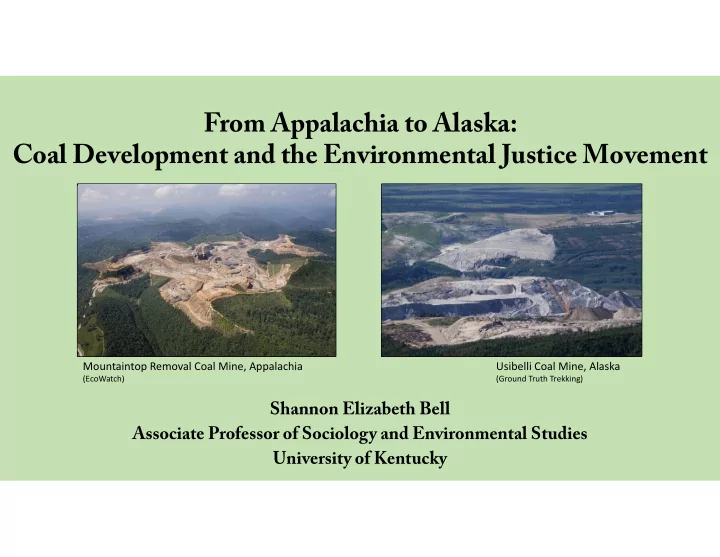
From Appalachia to Alaska: Coal Development and the Environmental Justice Movement Mountaintop Removal Coal Mine, Appalachia Usibelli Coal Mine, Alaska (EcoWatch) (Ground Truth Trekking) Shannon Elizabeth Bell Associate Professor of Sociology


slide-1
SLIDE 1

From Appalachia to Alaska: Coal Development and the Environmental Justice Movement

Shannon Elizabeth Bell Associate Professor of Sociology and Environmental Studies University of Kentucky

Usibelli Coal Mine, Alaska

(Ground Truth Trekking)

Mountaintop Removal Coal Mine, Appalachia

(EcoWatch)

slide-2
SLIDE 2

U.S. Coal‐Fired Power Plants

  • 386,000 tons of toxic air emissions

annually

  • 67 different air toxics
  • 55 known neurotoxins
  • 24 known, probable, or possible

carcinogens

  • Fine Particle Pollution = 23,600

premature deaths/year

(American Lung Assoc., 2011; Physicians for Social Responsibility, 2009; U.S. EPA 2005).

2

slide-3
SLIDE 3

Central Appalachia

3

slide-4
SLIDE 4

Mountaintop Removal Coal Mining

4

slide-5
SLIDE 5

Flooding

5

slide-6
SLIDE 6

Maria Gunnoe

6

slide-7
SLIDE 7

Maria Gunnoe

…I found out one morning at 3:00 in the morning, it was thundering and lightning, and I go in, and I find her setting on the edge of her bed with her shoes and her coat and her pants [on]. And I found out then, what it was putting my daughter through. And that is what pissed me off. How dare they steal that from my

  • child. The security of being able to sleep in her own bed. The coal

companies now own that. They now own my child’s security in her own bed. And how can they expect me as a mother to look

  • ver that? How is it, what if I done this to their kids? What if I

created terror in their children’s lives? And that’s what it’s done to my children…

7

slide-8
SLIDE 8

Coal Preparation Plants and Coal Dust

8

slide-9
SLIDE 9

Sylvester, WV

9

slide-10
SLIDE 10

“We could walk outside here on days like today and the sun looked like a kaleidoscope, like you was looking through a kaleidoscope there was so much coal dust in the air. And I mean it just plastered our homes. Our homes were just polluted completely with it…You couldn’t cook outside, you couldn’t do nothing outside. And not only that, then it began to seep through your windows and things and coming inside of your home…And I mean, right now, in

  • rder to get all the coal dust out of our homes, we’re going

to have to take them apart and rebuild them because there’s no way you can get it all out. There’s just no way you can do it.” – Pauline Canterberry

10

slide-11
SLIDE 11

“You know, it’s not easy to sit and watch your home being destroyed, something you have worked for all your life…we found out through

  • ur lawsuit – because we all

had our homes appraised [for it] – that our homes have lost 90% of their value.” ‐‐ Pauline Canterberry

11

slide-12
SLIDE 12

We’re being discriminated against. We’re being sacrificed here for energy for the rest

  • f the world. For more money for the

people that already has more than they know what to do with. And it isn’t right. To me, it isn’t the American Way. It will never be the American Way for the America I envision, that we’re supposed to be here. It’s just for greed. It’s just greed. You know, why should we give up everything we own for somebody else to have cheap energy? For a world of people that’s already pampered to death. It’s the injustice of it. ‐ Pauline Canterberry

Photo: Vivian Stockman Photo: Colin Finlay, Vanity Fair 12

slide-13
SLIDE 13

Coal Slurry Impoundments & Injections

Coal Slurry from “Washing” Coal: ‐ Chemicals ‐ Heavy metals, including arsenic beryllium, cadmium, among others

13

slide-14
SLIDE 14

Coal Slurry Impoundment Breaches

Buffalo Creek, West Virginia ‐‐ 1972 ‐ 125 dead, thousands homeless Martin County, Kentucky ‐ 2000 ‐ 250 million gallons of coal waste spilled ‐ Polluted more than 70 miles of streams

14

slide-15
SLIDE 15

Coal Slurry Injection Sites

Water contamination from coal slurry: ‐ Cancer ‐ Gall bladder disease ‐ Skin disorders ‐ Organ failure

15

slide-16
SLIDE 16

Maria Lambert, Prenter, WV

16

slide-17
SLIDE 17

“Everybody was showing their water, Terry Keith had her water, and they were talking about the health issues and how…to bathe in it was causing people’s skin to itch and turn red; and how it had bad odor and how it looked coming out of the water tanks, and…the different illnesses, the brain tumors, the gall bladder problems, stomach problems, children’s teeth falling out, and all of these things. And it’s like, a light bulb going off all here, there, yonder,

  • everywhere. And it’s like my whole life flashing

before my eyes, because my children had lost their teeth, my parents had had cancer, we’d had our gall bladders removed, and all of these things was, it’s just like, oh no, it’s not just us, it’s the whole community, and we’re not even blood related.” ‐‐ Maria Lambert, Prenter, WV

17

slide-18
SLIDE 18

Donetta Blankenship

“I started getting sick at the end of February 2005. … I stayed nauseous, I stayed tired. My urine was changing colors. I started having problems with my eyes. … The first week of April, I started noticing I could look at my skin and it looked a little yellow.…I thought maybe it was the sun doing it to me. And, my husband, he kinda noticed it, even getting in my

  • eyes. You know, the white parts of my eyes was lookin’ yellow. Then on

that Tuesday morning, my kids, I got them up for school, and my daughter looked at me, she said, “Mommy,” she said, “What’s wrong with you? You look yella.” And she got Josh, my son, to look at me, and he agreed with her. And I told him, I said, “Honey, when you look yella,” I said, “that means you’re about to die.” Me not knowing, you know, that I was about ready to … I ended up having to go to the hospital. … My enzymes—liver enzymes—was up in the—it was close to 10,000.”

18

slide-19
SLIDE 19

Coal in drinking water

  • Well‐documented medical disorders from organic coal compounds in drinking

water, including diseases of the kidneys and urinary tract, endocrine disruption, and cancer.

  • Balken Endemic Nephropathy (BEN): causes end‐stage renal failure; high rate
  • f co‐incidence of cancers of the renal pelvis or upper urinary tract

Orem WH, Tatu CA, Lerch HE, Maharaj SVM, Pavlovic N, Paunescu V, Dumitrascu V. (2004).Identification and environmental significance of the organic compounds in water supplies associated with a Balkan endemic nephropathy region in Romania. Journal of Environmental Health Research. 3:53–61. Maharaj, S. V. M., Orem, W. H., Tatu, C. A., Lerch III, H. E., & Szilagyi, D. N. (2014). Organic compounds in water extracts of coal: links to Balkan endemic nephropathy. Environmental geochemistry and health, 36(1), 1‐17. Gaitan E, Cooksey RC, Legan J, Cruse JM, Lindsay RH, Hill J. (1993). Antithyroid and goitrogenic effects of coal‐water extracts from iodine‐sufficient goiter areas. Thyroid. 3:49–53. doi: 10.1089/thy.1993.3.49. Bunnell JE, Tatu CA, Bushon RN, Stoeckel DM, Brady AMG, Beck M, Lerch HE, McGee B, Hanson BC, Shi R, Orem WH. (2006). Possible linkages between lignite aquifers, pathogenic microbes, and renal pelvic cancer in northwestern Louisiana, USA. Environmental Geochemistry and Health. 28:577–587. doi: 10.1007/s10653‐006‐9056‐y.

19
slide-20
SLIDE 20

Higher rates of:

  • Birth defects
  • Cancer
  • Cardiovascular conditions
  • Respiratory illnesses
  • Mortality
  • Ahern, Melissa M., and Michael Hendryx. 2008. Health Disparities and Environmental Competence: A Case Study of

Appalachian Coal Mining. Environmental Justice 1 (2): 81–86.

  • Ahern, Melissa M., Michael Hendryx, Jamison Conley, Evan Fedorko, Alan Ducatman, and Keith J. Zullig. 2011. The

Association between Mountaintop Mining and Birth Defects among Live Births in Central Appalachia, 1996–2003. Environmental Research 111 (6): 838–846.

  • Hendryx, Michael. 2008. Mortality Rates in Appalachian Coal Mining Counties: 24 Years Behind the Nation.

Environmental Justice 1 (1): 5–11.

  • Hendryx, Michael, and Melissa M. Ahern. 2008. Relations Between Health Indicators and Residential Proximity to

Coalmining in West Virginia. American Journal of Public Health 98: 669–671.

  • Hendryx, Michael, Melissa M. Ahern, and Timothy R. Nurkiewicz. 2007. Hospitalization Patterns Associated with

Appalachian Coal Mining. Journal of Toxicology and Environmental Health 70: 2064–2070.

  • Hendryx, Michael, Leah Wolfe, Juhua Luo, and Bo Webb. 2012. Self‐Reported Cancer Rates in Two Rural Areas of

West Virginia with and without Mountaintop Coal Mining. Journal of Community Health 37 (2): 320–327.

20

slide-21
SLIDE 21

Grassroots, women‐driven environmental justice movement

21

slide-22
SLIDE 22
  • However, most of the affected population

remains uninvolved in the movement.

  • Organizers have been forced to recruit

participants from outside the region

22

slide-23
SLIDE 23

Wh Why?

Why is there such limited participation at the local level?

23

slide-24
SLIDE 24

WV Coal Employment and Coal Production Job losses mainly due to technological advances in coal mining: Longwall mining Surface mining

24

slide-25
SLIDE 25

Why is there such limited participation in the coalfield justice movement at the local level?

25

slide-26
SLIDE 26

Methods

  • 13 months of field research conducted

between July 2006 and May 2009.

  • In‐depth interviews
  • Participant observation
  • Content analysis
  • Geospatial viewshed analysis
  • Photovoice in 5 communities

26

slide-27
SLIDE 27

Phase I of the Research

  • Depleted social capital in coalfield communities
  • The coal‐related hegemonic masculinity of the region
  • The coal industry’s cultural manipulation efforts
  • Hidden destruction

27

slide-28
SLIDE 28

Challenge: Most social movement studies take place after individuals have become activists (McAdam and Paulsen 2003) To understand barriers, necessary to study individuals who are not yet activists but who could become activists.

28

slide-29
SLIDE 29

Used Photovoice to create a micromobilization context among five groups of non‐activist women

29

slide-30
SLIDE 30
  • 54 women (47 non‐activists, 7 activists)
  • 5 coalfield communities
  • Monthly reflection meetings in each community
  • 2 regional meetings
  • Local and regional exhibits and presentations

30

slide-31
SLIDE 31

“Winter Glow”

The sun coming down through the trees and lighting up the snow took my breath away.

31

slide-32
SLIDE 32

“Please Pass the Bottle Bill!”

This picture was taken of Little Harts Creek after a rain. As you can see, trash piles up against our bridges almost anytime it rains. Look at all those bottles! The biggest part of the trash we see piled up by our bridges is pop bottles and water bottles. This is really nasty to look at, and all this trash is also very hard on the wildlife in our area. If we had a bottle deposit in our state, a lot of this wouldn’t be here. I would really like to see our state pass the Bottle Bill.

32

slide-33
SLIDE 33

“Mountaintop Removal at Marthatown”

In many areas of Boone County, the entire top half of a mountain is removed to retrieve a very thin seam of coal, like the one pictured here. This mountaintop removal mine has supposedly been closed down and is to begin being reclaimed. From the looks of it, I see no way possible to reclaim this land.

33

slide-34
SLIDE 34

Flooding

High water is a major concern for local residents. Mountaintop removal, strip mining, and logging cause more water run‐off from the mountains when it rains. That, in turn, causes flooding.

34

slide-35
SLIDE 35
  • 34 non‐activist women completed the 8‐month project
  • 18 created coal‐critical photostories for public

exhibits

  • Only 5 of these 18 women became involved in the

environmental justice movement

35

slide-36
SLIDE 36

“Heritage Rock”

36

slide-37
SLIDE 37

37

slide-38
SLIDE 38

“The Death of a Community Treasure”

The rock formation in the top two photographs was called [Heritage Rock]…It has been a landmark to our community for generations. On January 6, 2009… Community members were invited to attend a “town forum” to (supposedly) give us the opportunity to provide input about whether the Department of Environmental Protection (DEP) should renew Pritchard Mining Company’s expired mining permit, which included the area of Daniel Boone Rock. There were about 100 people total at this meeting. At least 10‐12 community members spoke out against renewing the permit, while only

  • ne community person spoke for it. Despite our time and

effort, the day after this meeting – January 7th – the mining company tore down one of the rocks, and the others soon

  • followed. Obviously, this meeting was in name only. We

now feel that the DEP doesn’t take the input of the community seriously.

38

slide-39
SLIDE 39

39

slide-40
SLIDE 40

“I really hadn’t intended for it to be…so much against the mining industry as a whole. You know, I was, I was against the mountaintop thing, but it seemed like, you know, it kinda went to being against miners totally… It seems like there’s, there’s just so much against it right now. And I kinda feel bad because…I voiced my opinion on it, and maybe, you know, helped it to go that way, I don’t know…That wasn’t my plans, in taking the mountaintop removal pictures, you know. But it just seems like it’s just everybody, well not everybody, but a bunch, are going against the mining industry. And, you know, that’s the way we made our

  • living. My husband worked in the mines for twenty‐some years,

and I wasn’t against it all together, just against the mountaintop

  • part. .. after we saw the way it was going, we did back off.”

40

slide-41
SLIDE 41

“I’ve kind of retracted myself from certain groups and everything because I just felt like I didn’t want my name to be out there with [them] because of some of the things that they were doing that I totally didn’t agree with. I mean, I agree with their cause, but I think there’s a way to go about things…… they’re taking stuff a little farther than what I’m comfortable with…”

41

slide-42
SLIDE 42

“…We have to live here, and I respect their causes, and I understand a lot of them, that’s kind of what they’ve dedicated their life to, but don’t, don’t try to force, you know?” “I don’t want to be involved with something like that; it’s just not me.”

42

slide-43
SLIDE 43

“They got – who was it ‐ Daryl Hannah – Daryl Hannah came in and got arrested. Well, that put it into national [news], which really makes people talk and get upset, and it opened a big can of worms because words got harsh. It put people back away from that negotiating line. It really is difficult to get them up to that point …it takes a lot of work to get the confidence, to get people to open up to even just listen to you...I don’t know how they’ll get them to open up again…it’ll take a lot of work.” – Photovoice participant Dorothy

43

slide-44
SLIDE 44

44

slide-45
SLIDE 45

Coal‐Industry sponsored “Astroturf” (fake grassroots) organizations

45

slide-46
SLIDE 46
  • “If you talk about the bad things that’s happened [because
  • f coal mining]…everybody’s like, ‘Oh, you’re against coal.’”
  • “When somebody says, ‘You’re against coal,’ what they

mean is, ‘You’re against me’…that doesn’t go away.”

46

slide-47
SLIDE 47
  • “It backlashed on us, Shannon….we had

repercussions over it.”

  • An “outsider stigma” could have consequences

due to the region’s loss in social capital

47

slide-48
SLIDE 48

 Actress Daryl Hannah and Climate Scientist James Hanson being photographed and interviewed at a 2009 protest

Actress Daryl Hannah being arrested at the 2009 protest

48

slide-49
SLIDE 49

The environmental justice platform is influential because it is grounded in a struggle for human rights

EJ movements need local voices to give credibility to the claims of injustice If the local identities of these movements are lost, they may also lose their power.

49