Frithjof Karsch, BNL/Bielefeld Frithjof Karsch, BNL/Bielefeld USQCD - - PowerPoint PPT Presentation

frithjof karsch bnl bielefeld
SMART_READER_LITE
LIVE PREVIEW

Frithjof Karsch, BNL/Bielefeld Frithjof Karsch, BNL/Bielefeld USQCD - - PowerPoint PPT Presentation

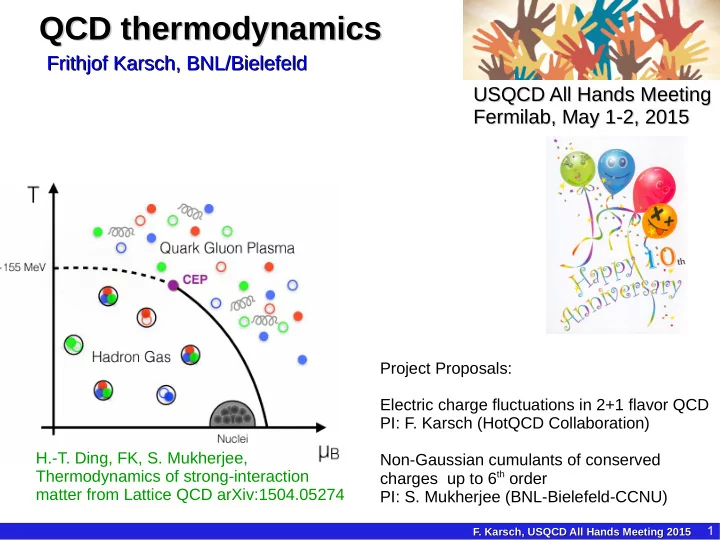
QCD thermodynamics QCD thermodynamics Frithjof Karsch, BNL/Bielefeld Frithjof Karsch, BNL/Bielefeld USQCD All Hands Meeting USQCD All Hands Meeting Fermilab, May 1-2, 2015 Fermilab, May 1-2, 2015 Project Proposals: Electric charge


slide-1
SLIDE 1
  • F. Karsch, USQCD All Hands Meeting 2015
  • F. Karsch, USQCD All Hands Meeting 2015

1
USQCD All Hands Meeting USQCD All Hands Meeting Fermilab, May 1-2, 2015 Fermilab, May 1-2, 2015

Project Proposals: Electric charge fluctuations in 2+1 flavor QCD PI: F. Karsch (HotQCD Collaboration) Non-Gaussian cumulants of conserved charges up to 6th order PI: S. Mukherjee (BNL-Bielefeld-CCNU)

QCD thermodynamics QCD thermodynamics

Frithjof Karsch, BNL/Bielefeld Frithjof Karsch, BNL/Bielefeld

H.-T. Ding, FK, S. Mukherjee, Thermodynamics of strong-interaction matter from Lattice QCD arXiv:1504.05274

slide-2
SLIDE 2
  • F. Karsch, USQCD All Hands Meeting 2015
  • F. Karsch, USQCD All Hands Meeting 2015

2

QCD thermodynamics and the Heavy Ion QCD thermodynamics and the Heavy Ion Collision Program at RHIC Collision Program at RHIC

What are the phases of strongly

interacting matter, and what role do they play in the cosmos? What does QCD predict for the properties of strongly interacting matter? What governs the transition of quarks and gluons into pions and nucleons?

Key Questions Key Questions NSAC Long Range Plan 2007 NSAC Long Range Plan 2007

NSAC Long Range Plan 2015

NSAC Long Range Plan 2015

slide-3
SLIDE 3
  • F. Karsch, USQCD All Hands Meeting 2015
  • F. Karsch, USQCD All Hands Meeting 2015

3

Bedanga Mohanty (STAR),

  • pening talk given at

''Critical Point and Onset of Deconfinement 2013”, Napa PoS CPOD 2013 (2013) 001

Exploring the QCD phase diagram in Theory and Experiment Exploring the QCD phase diagram in Theory and Experiment

slide-4
SLIDE 4
  • F. Karsch, USQCD All Hands Meeting 2015
  • F. Karsch, USQCD All Hands Meeting 2015

4

Exploring the QCD phase diagram Exploring the QCD phase diagram

controlled by the QCD equation of state, controlled by – LHC: establish contact with the QCD PHASE transition – RHIC: establish contact with the QCD critical point

  • bservable consequences:

freeze-out/hadronization pattern of mesons and baryons, controlled by

LHC LHC

slide-5
SLIDE 5
  • F. Karsch, USQCD All Hands Meeting 2015
  • F. Karsch, USQCD All Hands Meeting 2015

5

Exploring the QCD phase diagram Exploring the QCD phase diagram

controlled by the QCD equation of state, controlled by – LHC: establish contact with the QCD PHASE transition – RHIC: establish contact with the QCD critical point

  • bservable consequences:

freeze-out/hadronization pattern of mesons and baryons, controlled by

LHC LHC

crossover line: (P. Petreczky)

slide-6
SLIDE 6
  • F. Karsch, USQCD All Hands Meeting 2015
  • F. Karsch, USQCD All Hands Meeting 2015

6

RHIC beam energy scan: Exploring the QCD phase diagram with net charge fluctuations Exploring the QCD phase diagram with net charge fluctuations

search for the critical point search for the critical point generalized susceptibilities generalized susceptibilities

slide-7
SLIDE 7
  • F. Karsch, USQCD All Hands Meeting 2015
  • F. Karsch, USQCD All Hands Meeting 2015

7

RHIC beam energy scan: Exploring the QCD phase diagram with net charge fluctuations Exploring the QCD phase diagram with net charge fluctuations

search for the critical point search for the critical point generalized susceptibilities generalized susceptibilities

need to know the EoS at non-zero (S. Mukherjee)

– coefficients in the Taylor expansion

  • f the Equation of State
slide-8
SLIDE 8
  • F. Karsch, USQCD All Hands Meeting 2015
  • F. Karsch, USQCD All Hands Meeting 2015

8

RHIC beam energy scan: Exploring the QCD phase diagram with net charge fluctuations Exploring the QCD phase diagram with net charge fluctuations

search for the critical point search for the critical point generalized susceptibilities generalized susceptibilities

need to know the EoS at non-zero (S. Mukherjee)

– coefficients in the Taylor expansion

  • f the Equation of State

need to know the properties

  • f charge fluctuations at

(HotQCD)

– higher order cumulants of net-charge (B,Q,S) fluctuations measured in the BES at RHIC

slide-9
SLIDE 9
  • F. Karsch, USQCD All Hands Meeting 2015
  • F. Karsch, USQCD All Hands Meeting 2015

9

Net proton number fluctuations at RHIC Net proton number fluctuations at RHIC

STAR Collaboration, PRL 112, 032302 (2014)

kurtosis mean variance skewness

higher order cumulants characterize shape of conserved charge distributions

slide-10
SLIDE 10
  • F. Karsch, USQCD All Hands Meeting 2015
  • F. Karsch, USQCD All Hands Meeting 2015 10

Cumulants of conserved charge fluctuations Cumulants of conserved charge fluctuations

net electric charge fluctuations net electric charge fluctuations net baryon number fluctuations net baryon number fluctuations

STAR Collaboration, PRL 112, 032302 (2014)

  • J. Mitchell (for PHENIX),

CPOD2014 (2015) 075

slide-11
SLIDE 11
  • F. Karsch, USQCD All Hands Meeting 2015
  • F. Karsch, USQCD All Hands Meeting 2015 11

Cumulants of conserved charge fluctuations Cumulants of conserved charge fluctuations

new STAR preliminary and error new STAR preliminary and error projection for BES-II projection for BES-II Exploring the properties of the phases of QCD matter - research

  • pportunities and priorities for the next decade
  • U. Heinz et al., arXiV:1501.06477
  • X. Luo (for STAR), CPOD2014 (2015) 019
  • J. Mitchell (for PHENIX),

CPOD2014 (2015) 075

slide-12
SLIDE 12
  • F. Karsch, USQCD All Hands Meeting 2015
  • F. Karsch, USQCD All Hands Meeting 2015

Conserved e-Charge Cumulants in (2+1)-flavor QCD Conserved e-Charge Cumulants in (2+1)-flavor QCD

the simplest case: cumulants of electric charge fluctuations

pressure: leading order is most problematic

– electric charge fluctuations are dominated by pions – taste violations are the largest source for systematic errors large lattices are needed to control them

A-project (INCITE): HotQCD

slide-13
SLIDE 13
  • F. Karsch, USQCD All Hands Meeting 2015
  • F. Karsch, USQCD All Hands Meeting 2015 13

Electric charge fluctuations in (2+1)-flavor QCD Electric charge fluctuations in (2+1)-flavor QCD

– taste violations are the largest source

  • f systematic errors in the pion sector

quadratic and quartic electric charge fluctuations

slide-14
SLIDE 14
  • F. Karsch, USQCD All Hands Meeting 2015
  • F. Karsch, USQCD All Hands Meeting 2015 14

Electric charge fluctuations in (2+1)-flavor QCD Electric charge fluctuations in (2+1)-flavor QCD

cumulants of electric charge fluctuations

leading order is most problematic next-to-leading order (and higher) is controlled by baryons: signal-to-noise ratio is the main problem – but can be handled

slide-15
SLIDE 15
  • F. Karsch, USQCD All Hands Meeting 2015
  • F. Karsch, USQCD All Hands Meeting 2015

Equation of state of (2+1)-flavor QCD Equation of state of (2+1)-flavor QCD

– improves over earlier hotQCD calculations:

  • A. Bazavov et al., Phys. Rev. D80, 014504 (2009)
  • A. Bazavov et al. (hotQCD) ,
  • Phys. Rev. D90 (2014) 094503

– consistent with results from Budapest-Wuppertal (stout): S. Borsanyi et al., PL B730, 99 (2014)

pressure pressure, entropy entropy & energy energy density

– up to the crossover region the QCD EoS agrees quite well with hadron resonance gas (HRG) model calculations; However However, QCD results are systematically above HRG

slide-16
SLIDE 16
  • F. Karsch, USQCD All Hands Meeting 2015
  • F. Karsch, USQCD All Hands Meeting 2015

Equation of state of (2+1)-flavor QCD: Equation of state of (2+1)-flavor QCD:

the simplest case: How good is an expansion in a HRG? An expansion is exact in a QGP up to

  • needed for

– deviations less than 3% at

RHIC BES-I, II HRG

A-project (GPUs): S. Mukherjee et al

slide-17
SLIDE 17
  • F. Karsch, USQCD All Hands Meeting 2015
  • F. Karsch, USQCD All Hands Meeting 2015

Equation of state of (2+1)-flavor QCD: Equation of state of (2+1)-flavor QCD:

kurtosis*variance variance of net-baryon number distribution

slide-18
SLIDE 18
  • F. Karsch, USQCD All Hands Meeting 2015
  • F. Karsch, USQCD All Hands Meeting 2015

Equation of state of (2+1)-flavor QCD: Equation of state of (2+1)-flavor QCD:

the simplest case: the general case:

introduce constraints: (i) strangeness neutrality (ii) fixed electric charge/baryon number ratio

slide-19
SLIDE 19
  • F. Karsch, USQCD All Hands Meeting 2015
  • F. Karsch, USQCD All Hands Meeting 2015 19

Calculating charge fluctuations on the lattice Calculating charge fluctuations on the lattice

cumulants, e.g.: for instance: evaluate traces using stochastic estimators

slide-20
SLIDE 20
  • F. Karsch, USQCD All Hands Meeting 2015
  • F. Karsch, USQCD All Hands Meeting 2015 20

EoS at : EoS at : Current status Current status

estimating the correction: The EoS is well controlled for

slide-21
SLIDE 21
  • F. Karsch, USQCD All Hands Meeting 2015
  • F. Karsch, USQCD All Hands Meeting 2015 21

Calculating charge fluctuations on the lattice Calculating charge fluctuations on the lattice

recent advances: recent advances:

– understood that higher order cumulants are free of divergences and can be calculated using the so-called linear-mu formulation: R.V. Gavai and S. Sharma, Phys. Rev. D85 (2012) 054508 – developed efficient deflation code for the evaluation of charge fluctuation observables on GPUs

now post-doc at BNL

slide-22
SLIDE 22
  • F. Karsch, USQCD All Hands Meeting 2015
  • F. Karsch, USQCD All Hands Meeting 2015 22

Calculating charge fluctuations on the lattice Calculating charge fluctuations on the lattice

– highly efficient CG inverter for HISQ action on GPUs (and also on MIC)

  • O. Kaczmarek, C. Schmidt, P. Steinbrecher, M. Wagner, arXiv:1411.4439

– gain by using multiple right hand sides – balance against #EV used – Titan specific: shift eigenvector calculation for deflation to CPU; generation of eigenvectors ''comes for free'' and GPU can run with more right hand sides

SciDAC-3 grad.student at BNL