Multiple Choice Slide 3 / 50 1 A straight wire carries a current - - PDF document
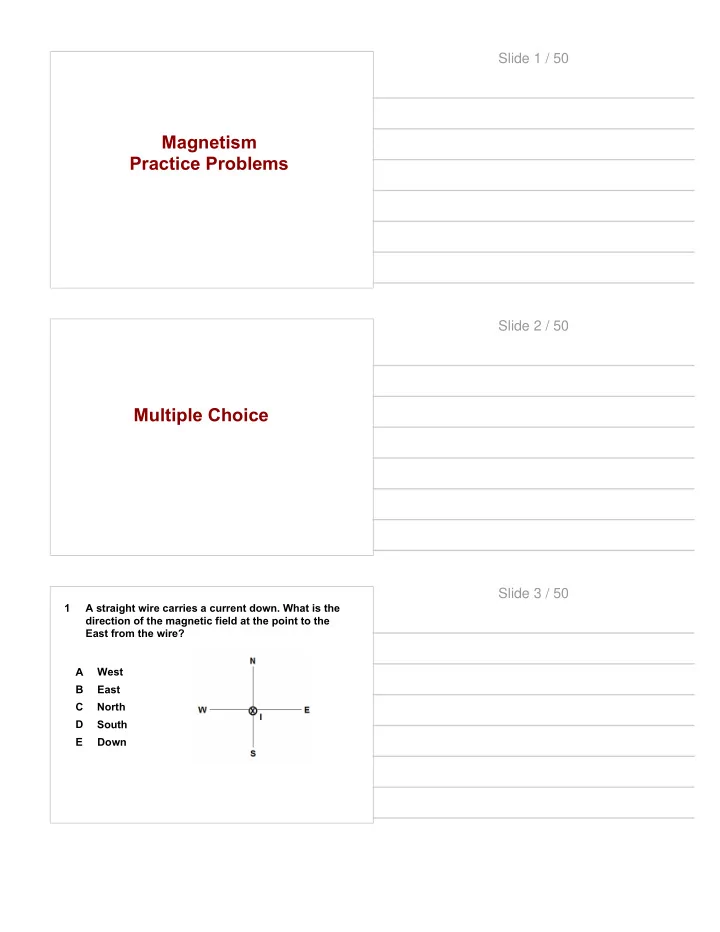
Slide 1 / 50 Magnetism Practice Problems Slide 2 / 50 Multiple Choice Slide 3 / 50 1 A straight wire carries a current down. What is the direction of the magnetic field at the point to the East from the wire? A West B East C North D
2 A loop of wire carries a current in counterclockwise direction. What is the direction
- f the magnetic field inside the loop?
A Point to the left B Points to the right C Points out of the page D Points into the page E Curls in a clockwise direction
Slide 4 / 50
3 A current carrying wire is placed horizontally and has a current flow to the right. What is the direction of the magnetic field at point P? A Points to the right B Points to the left C Points to the top of the page D Points to the bottom of the page E Points out of the page
Slide 5 / 50
4 A vertical wire carries a current straight up in a region of the magnetic field directed north. What is the direction of the magnetic force on the current due to the magnetic field? A East B South C North D West E Applied force is zero
Slide 6 / 50
5 A horizontal thin wire has a mass m and length L. The wire carries a constant current I. What must be the direction of the magnetic field in order to cancel the gravitational force? A Left B Right C Down the page D Out of the page E Into the page
Slide 7 / 50
6 A horizontal thin wire has a mass m and length L. The wire carries a constant current I. What must be the magnitude of the magnetic field in order to cancel the gravitational force? A IL/mg B mg/IL C Ig/mL D Im/gL E Zero
Slide 8 / 50
7 An electron enters a uniform magnetic field directed in –Z. What is the direction of the magnetic force on the electron due to the magnetic field? A +X direction B +Y direction C
- X direction
D –Y direction E Applied force is zero
Slide 9 / 50
8 A proton enters a uniform magnetic field directed in +Z. What is the direction of the magnetic force
- n the proton due to the magnetic field?
A +X direction B +Y direction C
- X direction
D –Y direction E Applied force is zero
Slide 10 / 50
9 A horizontal wire carries a current to the east. A proton moves to the west in the region north from the current. What is the direction of the magnetic force on the proton? A West B North C East D South E Applied force is zero
Slide 11 / 50
10 A circular loop of wire carries a constant current in counterclockwise direction. The loop is placed in a uniform magnetic field directed into the page. What is the effect of the magnetic force on the loop? A Rotates with respect to its axis B Rotates with respect to its diameter C Contracts its size D Expends its size E No effect on the loop
Slide 12 / 50
11 A proton enters a uniform magnetic field perpendicular to the field lines. What is the new path of the proton as it passes the field? A A B B C C D D E E
Slide 13 / 50
12 A magnetic field is created by two parallel currents flowing in opposite directions. At which location the magnetic field is greatest in magnitude? A A B B C C D D E E
Slide 14 / 50
13 Two parallel wires carry currents in opposite
- directions. What is the direction on the net
magnetic field at point P? A Left B Right C Top the page D Bottom the page E Into the page
Slide 15 / 50
14 Two parallel wires carry currents in the same
- direction. What is the direction of the magnetic
force on current I2 due to current I1? A Left B Right C Top the page D Bottom the page E Out of the page
Slide 16 / 50
15 Two parallel wires carry currents in opposite
- directions. What is the direction of the magnetic
force on current I1 due to current I2? A Left B Right C Top the page D Bottom the page E Out of the page
Slide 17 / 50
16 An electron enters a uniform electric field perpendicular to the field lines. What must be the direction of the magnetic field in order to cancel the electric force effect? A Left B Right C Top of the page D Into the page E Out of the page
Slide 18 / 50
17 An electron enters a uniform electric field perpendicular to the field lines. What is the magnitude of the magnetic field if the electric effect completely canceled? A Ev B v/E C zero D E/v E eEv
Slide 19 / 50
18 What is the magnitude of the magnetic field at point B produced by a current I if the magnitude of the field at point A is B0? A B0 B 2B0 C 4B0 D B0/2 E B0/4
Slide 20 / 50
19 Two parallel wires carry currents I1 and I2 in the same direction and separated by a distance d. The magnitude of the magnetic force between the wires is F0. What is the force between the wires if each current is doubled and the separation is quadrupled? A 2F0 B 4F0 C F0 D F0/2 E F0/4
Slide 21 / 50
20 An electron with a mass m and charge e enters at a constant speed v a uniform magnetic field B. What is the radius of the curvature of the electron in the field? A mv/eB B eB/mv C me/vB D mB/ev E zero
Slide 22 / 50
Free Response
Slide 23 / 50
- 1. A long horizontal wire carries an electric current I = 50 A. Point P is located
at a distance 2.5 mm above the current.
- a. What is the direction of the magnetic field at point P?
- b. What is the magnitude of the magnetic field at point P?
A thin horizontal rod has a length L = 1 and mass m = 50 g is connected to a circuit. The circuit contains a battery V = 12 V, a resistor R = 0.06 Ω, a switch, and connecting
- wires. The rod is supported in horizontal position by two
light connecting wires.
- c. What is the direction of the electric current in the rod?
- d. On the diagram show all the applied forces on the rod.
- e. What is the tension force in supporting wires?
Slide 24 / 50
- 1. A long horizontal wire carries an electric current I = 50 A. Point P is located
at a distance 2.5 mm above the current.
- a. What is the direction of the magnetic field at point P?
Out of the page.
Slide 25 / 50
- 1. A long horizontal wire carries an electric current I = 50 A. Point P is located
at a distance 2.5 mm above the current.
- b. What is the magnitude of the magnetic field at point P?
B = (μ0/2π)(I/r) B = (2x10⁷ Tm/A)/(50A/0.0025m) B = 0.004T
Slide 26 / 50
1. A thin horizontal rod has a length L = 1 m and mass m = 50 g is connected to a circuit. The circuit contains a battery V = 12 V, a resistor R = 0.06 Ω, a switch, and connecting wires. The rod is supported in horizontal position by two light connecting wires.
- c. What is the direction of the electric current in the rod?
To the right.
Slide 27 / 50
1. A thin horizontal rod has a length L = 1 m and mass m = 50 g is connected to a circuit. The circuit contains a battery V = 12 V, a resistor R = 0.06 Ω, a switch, and connecting wires. The rod is supported in horizontal position by two light connecting wires.
- d. On the diagram show all the applied forces on the rod.
FB mg
Slide 28 / 50
1. A thin horizontal rod has a length L = 1 m and mass m = 50 g is connected to a circuit. The circuit contains a battery V = 12 V, a resistor R = 0.06 Ω, a switch, and connecting wires. The rod is supported in horizontal position by two light connecting wires.
- e. What is the tension force in supporting wires?
ΣF = ma T + T - FB - mg = 0 2T = FB + mg T = (FB + mg)/2 T = (IlB + mg)/2 T = [(50A)(1m)(0.004T)+(0.05kg)(9.8m/s2)/2 T = 0.35N each
Slide 29 / 50
- 2. Charged particle of mass m and charge q is
released from rest in region between two charged plates M and L. After passing the region of the electric field with an accelerating voltage Va the particle enters another region filled with a magnetic field of magnitude B and directed out of the page.
- a. What is the sign of the charge on the particle?
- b. What is the velocity of the particle as it enters the magnetic field?
- c. What is the direction of the magnetic force on the particle?
- d. Describe the path of the particle in the magnetic field.
- e. What is the radius of the curvature of the particle in the magnetic field?
- f. What is the direction and magnitude of the electric field that can be used
to make the path of the particle straight?
Slide 30 / 50
- 2. Charged particle of mass m and charge q is
released from rest in region between two charged plates M and L. After passing the region of the electric field with an accelerating voltage Va the particle enters another region filled with a magnetic field of magnitude B and directed out of the page.
- a. What is the sign of the charge on the particle?
positive
Slide 31 / 50
- 2. Charged particle of mass m and charge q is
released from rest in region between two charged plates M and L. After passing the region of the electric field with an accelerating voltage Va the particle enters another region filled with a magnetic field of magnitude B and directed out of the page.
- b. What is the velocity of the particle as it enters the magnetic field?
E0 + W = EF E0 = EF qV = ½mv2 qV = ½mv2 v2 = 2qV/m v = (2qV/m)1/2
Slide 32 / 50
- 2. Charged particle of mass m and charge q is
released from rest in region between two charged plates M and L. After passing the region of the electric field with an accelerating voltage Va the particle enters another region filled with a magnetic field of magnitude B and directed out of the page.
- c. What is the direction of the magnetic force on the particle?
Down
Slide 33 / 50
- 2. Charged particle of mass m and charge q is
released from rest in region between two charged plates M and L. After passing the region of the electric field with an accelerating voltage Va the particle enters another region filled with a magnetic field of magnitude B and directed out of the page.
- d. Describe the path of the particle in the magnetic field.
Circular, down, clockwise.
Slide 34 / 50
- 2. Charged particle of mass m and charge q is
released from rest in region between two charged plates M and L. After passing the region of the electric field with an accelerating voltage Va the particle enters another region filled with a magnetic field of magnitude B and directed out of the page.
- e. What is the radius of the curvature of the particle in the magnetic field?
ΣF = ma FB = ma qvB = mv2/r qB = mv/r r = mv/qB r = m(2qV/m)1/2/qB r = (2mVa/qB2)1/2
Slide 35 / 50
- 2. Charged particle of mass m and charge q is
released from rest in region between two charged plates M and L. After passing the region of the electric field with an accelerating voltage Va the particle enters another region filled with a magnetic field of magnitude B and directed out of the page.
- f. What is the direction and magnitude of the electric field that can be used
to make the path of the particle straight? ΣF = ma FE - FB = 0 FE = FB qE = qvB E = vB E = B(2qVa/m)1/2
Slide 36 / 50
- 3. An electron is accelerated by an electric field
produced by two parallel plates M and L. When the electron enters a region filled with a magnetic field of magnitude B = 0.5 T its velocity v = 1.6x10⁷ m/s.
- a. What is the direction of the accelerating
electric field between the plates M and L?
- b. What is the accelerating voltage of the
electric field?
- c. What is the direction of the magnetic
field?
- d. What is the radius of the curvature of the
electron in the magnetic field?
- e. What is the direction of the deflecting
electric field required to make the electron’s path straight?
- f. What is the magnitude of the deflecting
electric field?
Slide 37 / 50
- 3. An electron is accelerated by an electric field
produced by two parallel plates M and L. When the electron enters a region filled with a magnetic field of magnitude B = 0.5 T its velocity v = 1.6x10⁷ m/s.
- a. What is the direction of the accelerating
electric field between the plates M and L? Left
Slide 38 / 50
- 3. An electron is accelerated by an electric field
produced by two parallel plates M and L. When the electron enters a region filled with a magnetic field of magnitude B = 0.5 T its velocity v = 1.6x10⁷ m/s.
- b. What is the accelerating voltage of the
electric field? E0 + W = EF E0 = EF qV = ½mv2 qV = ½mv2 V = mv2/2q V = (9.11x10⁻³¹ kg)(1.6x10⁷ m/s)/(2)(1.6x10-19 C) V = 729 V
Slide 39 / 50
- 3. An electron is accelerated by an electric field
produced by two parallel plates M and L. When the electron enters a region filled with a magnetic field of magnitude B = 0.5 T its velocity v = 1.6x10⁷ m/s.
- c. What is the direction of the magnetic
field? Into the page.
Slide 40 / 50
- 3. An electron is accelerated by an electric field
produced by two parallel plates M and L. When the electron enters a region filled with a magnetic field of magnitude B = 0.5 T its velocity v = 1.6x10⁷ m/s.
- d. What is the radius of the curvature of the
electron in the magnetic field? ΣF = ma FB = ma qvB = mv2/r qB = mv/r r = mv/qB r = (9.11x10⁻³¹ kg)(1.6x10⁻⁷ m/s)/(1.6x10-19 C)(0.5 T) r = 1.8x10⁻¹⁸ m
Slide 41 / 50
- 3. An electron is accelerated by an electric field
produced by two parallel plates M and L. When the electron enters a region filled with a magnetic field of magnitude B = 0.5 T its velocity v = 1.6x10⁷ m/s.
- e. What is the direction of the deflecting
electric field required to make the electron’s path straight? Down
Slide 42 / 50
- 3. An electron is accelerated by an electric field
produced by two parallel plates M and L. When the electron enters a region filled with a magnetic field of magnitude B = 0.5 T its velocity v = 1.6x10⁷ m/s.
- f. What is the magnitude of the deflecting
electric field? ΣF = ma FE - FB = 0 FE = FB qE = qvB E = vB E = (1.6x10⁷ m/s)(0.5 T) E = 8x10⁶ m/s
Slide 43 / 50
- 4. In a mass spectrometer a charged particle is
accelerated to a velocity v = 5.9x10⁷ m/s by an electric field and allowed to enter a magnetic field B, where it is deflected in a semi-circular path of radius R = 10 cm. The magnetic field is uniform of magnitude B = 16 T and oriented out
- f the page.
- a. What is the sign of the charge on the particle?
- b. What is the acceleration of the particle in the
magnetic field?
- c. What is the ratio between the charge and mass
- f the particle q/m?
- d. What is the direction of the accelerating
electric field?
- e. What is the accelerating voltage of the
electric field?
Slide 44 / 50
- 4. In a mass spectrometer a charged particle is
accelerated to a velocity v = 5.9x10⁷ m/s by an electric field and allowed to enter a magnetic field B, where it is deflected in a semi-circular path of radius R = 10 cm. The magnetic field is uniform of magnitude B = 16 T and oriented out
- f the page.
- a. What is the sign of the charge on the particle?
positive
Slide 45 / 50
- 4. In a mass spectrometer a charged particle is
accelerated to a velocity v = 5.9x10⁷ m/s by an electric field and allowed to enter a magnetic field B, where it is deflected in a semi-circular path of radius R = 10 cm. The magnetic field is uniform of magnitude B = 16 T and oriented out
- f the page.
- b. What is the acceleration of the particle in the
magnetic field? a = v2 r (5.9x10⁷ m/s)2 0.1 m = 3.5x10¹⁶ m/s2 =
Slide 46 / 50
- 4. In a mass spectrometer a charged particle is
accelerated to a velocity v = 5.9x10⁷ m/s by an electric field and allowed to enter a magnetic field B, where it is deflected in a semi-circular path of radius R = 10 cm. The magnetic field is uniform of magnitude B = 16 T and oriented out
- f the page.
- c. What is the ratio between the charge and mass
- f the particle q/m?
qvB = mv2/r q/m = v/Br q/m = 3.7x10⁷ C/kg
Slide 47 / 50
- 4. In a mass spectrometer a charged particle is
accelerated to a velocity v = 5.9x10⁷ m/s by an electric field and allowed to enter a magnetic field B, where it is deflected in a semi-circular path of radius R = 10 cm. The magnetic field is uniform of magnitude B = 16 T and oriented out
- f the page.
- d. What is the direction of the accelerating
electric field? to the right
Slide 48 / 50
- 4. In a mass spectrometer a charged particle is
accelerated to a velocity v = 5.9x10⁷ m/s by an electric field and allowed to enter a magnetic field B, where it is deflected in a semi-circular path of radius R = 10 cm. The magnetic field is uniform of magnitude B = 16 T and oriented out
- f the page.
- e. What is the accelerating voltage of the
electric field? qV = 1/2mv2 V = mv2/2q V = (3.7x10⁷)-1 (5.9x10⁷ m/s)2 2 V = 4.7x10⁷ V