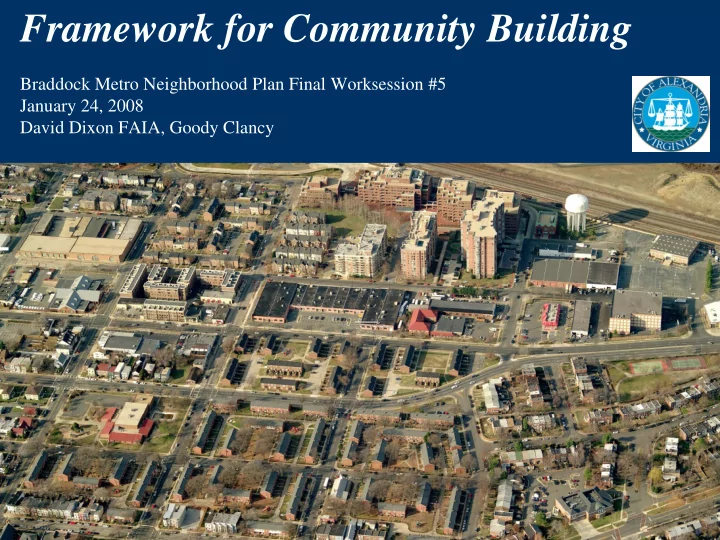
SLIDE 1 Framework for Community Building
Braddock Metro Neighborhood Plan Final Worksession #5 January 24, 2008 David Dixon FAIA, Goody Clancy
SLIDE 2 TONIGHT’S AGENDA
Worksession #4 on January 7
are today
improvements
- Unresolved issues
- Implementation phase
SLIDE 3
OVERVIEW OF WHERE WE ARE TODAY
Worksessions #1 - 4
SLIDE 4 Element 1: A major new neighborhood park
Post Office site Post Office site
A public realm…
SLIDE 5 Jamison Square, Portland, OR
SLIDE 6
Element 2: A network of “walking streets” (Fayette, West, Madison, Wythe)
…connected by w alking streets…
SLIDE 7 Fayette at Wythe Street with a park on the Post Office site
SLIDE 8
Element 3: Retail and community culture
…brought to life by retail…
SLIDE 9 West Street at Madison looking south
SLIDE 10 PRINCIPLES
- Queen Street’s buildings are an
important part of the neighborhood’s history
- A revived Main Street for the African-
American community will enhance livability for all
- To be viable, retail businesses need
more pedestrian and (slow moving) vehicle traffic STRATEGIES
- The Plan intends to reserve some of the
redevelopment-generated dollars for façade and lighting improvements, business development grants, etc.
- “Live/work” renovation efforts could
aid the revival
…that helps to enliven Queen Street…
SLIDE 11 Codman Square, Boston Alberta Street Portland, OR U Street, Washington DC
…to enhance the entire community
SLIDE 12
Height and massing that reflect the neighborhood’s diverse character
SLIDE 13 Element 4: “shoulder” buildings along the “walking streets”
…defined by human-scale edges.
SLIDE 14 Element 5: Transform public housing into mixed-income housing
A new generation of mixed-income housing
SLIDE 15 The Townhomes on Capitol Hill, Washington, DC
SLIDE 16 A neighborhood w here traffic is carefully managed
– Car sharing programs – Improved transit service – Ped/bike improvements
– Carpool-vanpooling – Transit incentives – Parking management
Rte 1
– Preserve curbside parking – …and trucks in the middle lanes – Enhance pedestrian crossways and add street trees
SLIDE 17
Element 6: Recommended alignment of BRT along 1st Street and Braddock Place service road
…a BRT route integrated into the neighborhood
SLIDE 18 FUNDING COMMUNITY IMPROVEMENTS
- What does the plan cost?
- What is the pot of money
available?
proposed public improvements?
worked?
SLIDE 19 Cost of public improvements
$ 3m $ 5m
– Fayette, Madison, West, Wythe, West – 29 “block faces” – Street trees, lighting, paving, signage, etc.
$ 1m $ 2m
$ 1m $ 2m
$ 7m $15m
$ 3m $ 5m
$ 4m $ 6m
– Retail recruitment, façades, etc. – Queen Street
Total $19m $35m
SLIDE 20 “Public value” of development options
– Below-ground parking – Bury utilities – Landscaped edges – Match plan’s height and massing assumptions
– Rental apartments—$0/SF – Townhouses (assume garage parking, not below- ground)—$0-5/SF – Condominiums—$20-30/SF – Office—$30-50/SF
SLIDE 21 Potential public contributions from development
$14m $18m
– Funds collected as development proceeds – Part of approvals process
- TIF-like (tax increment funded bonds) funds
$17m $21m
– Funds collected when city issues bonds – Improvements specified in plan
- Additional funds (rough estimate)
$ 3m $ 5m
– Affordable housing – Green space
Total $34m $44m
SLIDE 22 Examples of other communities that use public benefit contributions
– “Proffer-equivalents” – Public negotiation at planning commission meetings
– Proffers – Open negotiation, moving to standardized contributions
- Various Florida communities
– Impact fees – TIF and TIF-like funds
SLIDE 23 UNRESOLVED ISSUES
- Height and massing on Metro
and Adkins blocks
- Appropriate parking ratios
- Options for Metro Linear
Park
- New Metro entrance on the
west side of the tracks
SLIDE 24
potential 90’ tall buildings on Adkins block and 120’ tall building on the Metro site
??
Height and massing on Metro and Adkins blocks
SLIDE 25
- Scale and design to fit in the
neighborhood
- Mix uses and incomes
- Provide high quality housing
for all income levels
- Improve walkability to and
from the Metro station
- Create a public square, lined
with retail, at Metro
- Accommodate buses and
- ther Metro traffic
Principles for Metro and Adkins blocks
SLIDE 26
Option A
Metro site: plaza location options
Option B Option C
SLIDE 27
OPTION A: Neighborhood square at north end
SLIDE 28
OPTION B: Neighborhood square at south end
SLIDE 29
OPTION C: Neighborhood square at center
SLIDE 30
Adkins site
SLIDE 31 OPTION 1: Wythe Street greenw ay
Tying the two sites together with an open space framework
SLIDE 32
SLIDE 33 Aerial view of Option 1 View from 3rd floor
SLIDE 34 View from Wythe-Fayette intersection View from Wythe from between Fayette and West View from Wythe approaching West
SLIDE 35 View of the Metro site from the corner of West and Wythe streets
SLIDE 36
OPTIONS 2A and B: New public park
Option 2A Option 2B 1 acre 1 acre
SLIDE 37
OPTION 2A
SLIDE 38 Aerial view of Option 2A View from 3rd floor
SLIDE 39 View from Wythe-Fayette intersection
SLIDE 40
OPTION 2B
SLIDE 41 Aerial view of Option 2A View from 3rd floor
SLIDE 42 View from Wythe-Fayette intersection
SLIDE 43
comparable developments
- Adjacent to Metro
- Other developments
- Opportunities for mixed-
use
TDM (car sharing, transit passes)
housing
Right-sizing parking ratios
SLIDE 44
Options for Metro Linear Park
SLIDE 45 Potential Braddock Place w alking route
Existing service road behind Braddock Place looking towards Metro
+/-25’ +/-25’ 4’ 4’
SLIDE 46 Potential Braddock Place w alking route +/-22’ +/-22’ +/-7’
Potential improvement
SLIDE 47 Potential Braddock Place w alking route
View of plaza space
SLIDE 48 New Metro entrance on the w est side of the tracks
Braddock Road Metro station
SLIDE 49 IMPLEMENTATION STRATEGY
- Critical to the success of the plan
- Interagency team
- Neighborhood Implementation
Group – Make recommendations to council re priorities and phasing for spending and project details – Staffed by interagency city team – Participates in annual progress report to council
- Funds earmarked for Braddock
Metro Plan amenities
SLIDE 50 Framework for Community Building
Braddock Metro Neighborhood Plan Final Worksession #5 January 24, 2008 David Dixon FAIA, Goody Clancy