Fractional Gaussian Fields for Modeling and Rendering of - - PowerPoint PPT Presentation

fractional gaussian fields for modeling and rendering of
SMART_READER_LITE
LIVE PREVIEW

Fractional Gaussian Fields for Modeling and Rendering of - - PowerPoint PPT Presentation

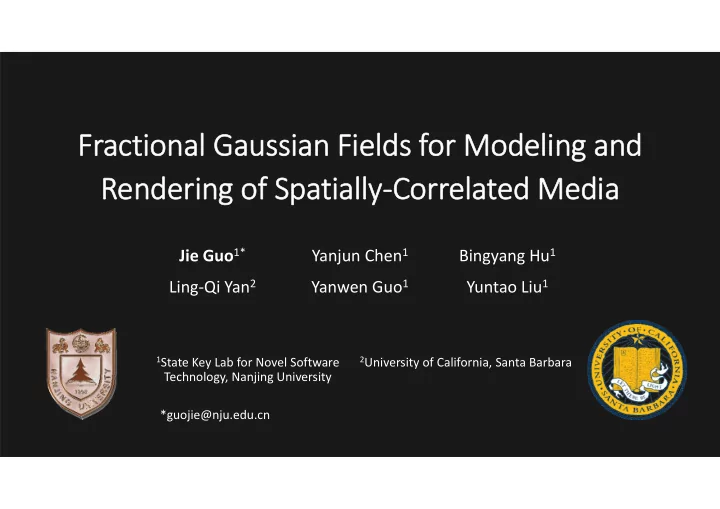
Fractional Gaussian Fields for Modeling and Rendering of SpatiallyCorrelated Media Jie Guo 1* Yanjun Chen 1 Bingyang Hu 1 LingQi Yan 2 Yanwen Guo 1 Yuntao Liu 1 1 State Key Lab for Novel Software 2 University of California, Santa Barbara


slide-1
SLIDE 1

Fractional Gaussian Fields for Modeling and Rendering of Spatially‐Correlated Media

Jie Guo1* Yanjun Chen1 Bingyang Hu1 Ling‐Qi Yan2 Yanwen Guo1 Yuntao Liu1

1State Key Lab for Novel Software

Technology, Nanjing University

2University of California, Santa Barbara

*guojie@nju.edu.cn

slide-2
SLIDE 2

Participating Media

stanschaap.com

slide-3
SLIDE 3

Participating Media

videoblocks.com

slide-4
SLIDE 4

Participating Media

slide-5
SLIDE 5

Participating Media

scattering

slide-6
SLIDE 6

Participating Media

absorption

slide-7
SLIDE 7

Participating Media

Independent Scattering Approximation Classical Radiative Transport Equation

slide-8
SLIDE 8

Related Work

(But, a lot of works have observed correlations in particle distribution)

slide-9
SLIDE 9

Related Work

slide-10
SLIDE 10

Related Work

[Meng et al. 2015] [Müller et al. 2016] [Jarabo et al. 2018] [Bitterli et al. 2018]

slide-11
SLIDE 11

Related Work

[Meng et al. 2015] [Müller et al. 2016] [Jarabo et al. 2018] [Bitterli et al. 2018]

slide-12
SLIDE 12

Our method

 General media  Heterogeneity  Long‐range correlations

slide-13
SLIDE 13

Spatially‐Correlated Media

Uncorrelated Media Correlated Media Uncorrelated Media

slide-14
SLIDE 14

Spatially‐Correlated Media

Correlated Media Uncorrelated Media

slide-15
SLIDE 15

Spatially‐Correlated Media

𝜕

  • 𝑢

𝒚 𝒛 𝜏 𝜏

Transmittance: 𝑈 𝒚, 𝒛 𝑓 𝒚

  • 𝑓 𝒚,

𝜏 𝒚 𝜏 𝒚 𝜏 𝒚 Extinction field:

slide-16
SLIDE 16

Spatially‐Correlated Media

𝜕

  • 𝑢

𝒚 𝒛 𝜏 𝜏

Transmittance: 𝑈 𝒚, 𝒛 𝑓 𝒚

  • 𝑓 𝒚,

We model 𝜏 as a Fractional Gaussian Field (FGF) 𝜏 𝒚 𝜏 𝒚 𝜏 𝒚 Extinction field:

slide-17
SLIDE 17

Fractional Gaussian Fields

Random field A collection of random variables: 𝑌 𝑌 𝑢, 𝜕 , 𝑢 ∈ ℝ, 𝜕 ∈ Ω

𝑢 𝜕

slide-18
SLIDE 18

Fractional Gaussian Fields

𝑌 𝑌 𝑢, 𝜕 , 𝑢 ∈ ℝ, 𝜕 ∈ Ω

𝑢 𝜕 𝑌 𝑢,·

Random field A collection of random variables:

slide-19
SLIDE 19

Fractional Gaussian Fields

𝑌 𝑌 𝑢, 𝜕 , 𝑢 ∈ ℝ, 𝜕 ∈ Ω

𝑢 𝜕 realization 𝑌 ·, 𝜕

Random field A collection of random variables:

slide-20
SLIDE 20

Fractional Gaussian Fields

𝑌 𝑌 𝑢, 𝜕 , 𝑢 ∈ ℝ, 𝜕 ∈ Ω Gaussian (random) field A collection of Gaussian‐distributed random variables.

White Noise

Random field A collection of random variables:

slide-21
SLIDE 21

Fractional Gaussian Fields

Then what is “fractional”?

Let 𝐽 be the integral operator 𝐽 1 𝑦 𝐽 1 𝑦/2 𝐽 𝑦 ? 𝐽 𝑦 ? , 𝑏 0

slide-22
SLIDE 22

Fractional Gaussian Fields

Then what is “fractional”?

Let 𝐽 be the integral operator 𝐽 1 𝑦 𝐽 1 𝑦/2 𝐽 𝑦 ? 𝐽 𝑦 ? , 𝑏 0

slide-23
SLIDE 23

Fractional Gaussian Fields

With the fractional integral operator 𝐽

.[ ]

White Noise

slide-24
SLIDE 24

Fractional Gaussian Fields

.[ ]

White Noise

With the fractional integral operator 𝐽

slide-25
SLIDE 25

Fractional Gaussian Fields

.[ ]

White Noise

With the fractional integral operator 𝐽

slide-26
SLIDE 26

Fractional Gaussian Fields

Fractional Gaussian Fields

slide-27
SLIDE 27

Fractional Gaussian Fields

  • fractional Laplacian

𝑋: white noise

𝑒‐dimensional FGF: 𝑡 0

white noise

1 2 𝑡 3 2 , 𝑒 1

fractional Brownian motion (fBm)

𝑡 1, 𝑒 1

Brownian motion

The FGF family

slide-28
SLIDE 28

Fractional Gaussian Fields

Hurst parameter 𝐼 𝑡

  • 𝑋: white noise

𝑒‐dimensional FGF:

𝐼

Correlation

slide-29
SLIDE 29

Autocovariance Function

  • 𝑋: white noise

𝑒‐dimensional FGF:

Autocovariance function of pink noise: 𝐷 𝐼, 𝑒 Scaling term 𝑇 Power spectral density of white noise

slide-30
SLIDE 30

Autocovariance Function

  • 𝑋: white noise

𝑒‐dimensional FGF:

Autocovariance function of k‐fBm:

slide-31
SLIDE 31

Autocovariance Function

covariance matrix (1D)

Pink noise (H<0) k‐fBm (H>0)

slide-32
SLIDE 32

Autocovariance Function

covariance matrix (1D)

Pink noise k‐fBm Long‐range correlation

slide-33
SLIDE 33

2D Fractional Gaussian Fields

slide-34
SLIDE 34

2D Fractional Gaussian Fields

𝐼

Correlation

Aggregates

slide-35
SLIDE 35

Extinction Field

We model 𝜏 as a FGF :

  • Macro‐scale: Constant

Micro‐scale: FGF

Fixing 𝒚, 𝜏 𝒚 is a random variable with mean 𝜏 and its variance is controlled by the FGF

var𝜏 𝒚 ?

slide-36
SLIDE 36

Extinction Field

We model 𝜏 as a FGF :

The line‐averaged extinction 𝜏 𝒚

𝒚

  • 𝒚,
  • is a

Gaussian‐distributed random variable. var 𝜏 1 𝑢 𝜐 𝒚, 𝑢 𝜐 𝒚, 𝑢

1

𝑢 cov 𝒚, 𝒚 d𝑢d𝑢

  • autocovariance function of the

FGF

slide-37
SLIDE 37

Extinction Field

var 𝜏 1 𝑢 𝜐 𝒚, 𝑢 𝜐 𝒚, 𝑢

1

𝑢 cov 𝒚, 𝒚 d𝑢d𝑢

  • Pink noise

(H<0)

slide-38
SLIDE 38

Extinction Field

var 𝜏 1 𝑢 𝜐 𝒚, 𝑢 𝜐 𝒚, 𝑢

1

𝑢 cov 𝒚, 𝒚 d𝑢d𝑢

  • k‐fBm

(H>0)

slide-39
SLIDE 39

Extinction Field

Numerical verification:

slide-40
SLIDE 40

Extinction Field

Pink noise k‐fBm

One‐point scale‐independence

Numerical verification:

slide-41
SLIDE 41

Extinction Field

The variance of 𝜏 𝒚 :

White noise Pink noise K‐fBm

slide-42
SLIDE 42

Transmittance

Ensemble‐averaged transmittance

Tr 𝑢 𝑓 𝑓𝑞𝑒𝑔 𝜏 d𝜏

slide-43
SLIDE 43

Transmittance

Tr 𝑢 𝑓 𝑓𝑞𝑒𝑔 𝜏 d𝜏

  • Ensemble‐averaged transmittance

characteristic function 𝜒 𝐣𝑢

𝜏 ~ Γ 𝜏 var 𝜏 , 𝜏 var 𝜏

  • Use gamma distribution for non‐negative extinction
slide-44
SLIDE 44

Transmittance

Tr 𝑢 𝑓 𝑓𝑞𝑒𝑔 𝜏 d𝜏

  • Ensemble‐averaged transmittance
slide-45
SLIDE 45

Transmittance

Transparent

slide-46
SLIDE 46

Transmittance

𝐼 0.2 𝐼 0.5 𝐼 0.8

slide-47
SLIDE 47

Rendering Techniques

Energy‐Conserving Volumetric Rendering Equation

Transport kernel:

slide-48
SLIDE 48

Results

slide-49
SLIDE 49

Short‐range correlations Long‐range correlations

slide-50
SLIDE 50
slide-51
SLIDE 51
slide-52
SLIDE 52
slide-53
SLIDE 53

Low density

slide-54
SLIDE 54
slide-55
SLIDE 55

Comparing to the GBE [Jarabo et al. 2018]

slide-56
SLIDE 56

Comparing to the Bitterli model [Bitterli et al. 2018]

slide-57
SLIDE 57

Uncorrelated media

slide-58
SLIDE 58

Correlated media

slide-59
SLIDE 59

Conclusion

  • A mathematical tool for physically‐based modeling spatial correlations in

random media.

  • Using k‐th order fBm to generate long‐range correlations.
  • The usage of the non‐exponential transmittance functions in an energy‐

conserving RTE framework.

slide-60
SLIDE 60

Thank you! Q&A