SLIDE 1
1
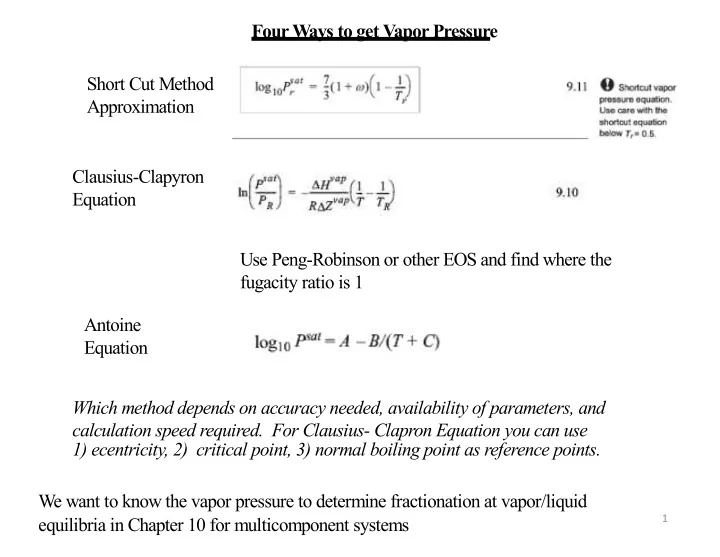
Four Ways to get Vapor Pressure Short Cut Method Approximation Clausius-Clapyron Equation Use Peng-Robinson or other EOS and find where the fugacity ratio is 1 Antoine Equation Which method depends on accuracy needed, availability of parameters, and calculation speed required. For Clausius- Clapron Equation you can use 1) ecentricity, 2) critical point, 3) normal boiling point as reference points. We want to know the vapor pressure to determine fractionation at vapor/liquid equilibria in Chapter 10 for multicomponent systems
SLIDE 2 2
Gibb’s Free Energy decides phase equilibria at constant T and P
H A
dG=-SdT + VdP (depends on T and P) GL = GV at equilibrium dG = VdP (Constant T)
SLIDE 3
3
V apor/Liquid Equilibria From EOS
SLIDE 5
5
SLIDE 6
6
SLIDE 7 7
At 25°C pure liquid G = 105 kJ/kg – 298°K 0.367 kJ/kg°K = -4 kJ/kg pure vapor G = 2547 kJ/kg – 298°K 8.56 kJ/kg°K = -4 kJ/kg
H A
G = H - TS
SLIDE 8 8
H A
dG = VdP – SdT At V/L Equilibria dGL = dGV VVdPsat – SVdT = VLdPsat – SLdT (VV-VL) dPsat = (SV-SL) dT Also G = H - ST At equilibrium DGvap = 0 Tvap = DHvap / DSvap From above dPsat/dT = DHvap/(T(VV-VL))
SLIDE 9
9
SLIDE 10
10
The slope of a plot of lnPsat versus 1/T is -∆Hvap/R (for ideal gas approximation)
SLIDE 11
11
SLIDE 12
12
SLIDE 13
13
SLIDE 14
14
SLIDE 15
15
SLIDE 16
16
SLIDE 17
17
SLIDE 18
18
SLIDE 19
19
Four Ways to get Vapor Pressure Short Cut Method Approximation Clausius-Clapyron Equation Use Peng-Robinson or other EOS and find where the fugacity ratio is 1 Antoine Equation Which method depends on accuracy needed, availability of parameters, and calculation speed required. For Clausius- Clapron Equation you can use 1) ecentricity, 2) critical point, 3) normal boiling point as reference points.
SLIDE 20
20
SLIDE 21
21
SLIDE 22
22
SLIDE 23 23
H A
G = H - ST Pressure Dependent Formulas
SLIDE 24
24
SLIDE 25
25
Arrhenius (1859-1927) Function: Probability = exp(-DE/kT) or = exp(-DE/RT) Gives the probability of an event happening if the event is thermally activated; i.e. if the probability changes with the temperature. Viscosity = Viscosity0 exp(- DEa/kT) Flow happens when atoms thermally move out of the way with an activation energy DEa V apor Pressure = P0 exp(-DEvap/kT) Antoine equation DEvap = DHvap – T DSvap Psat = P0 exp(A – B/(T+C)) A = – DSvap/R B = DHvap C = Temp for no Psat Entropy prob. = exp(S/R) Energy with no enthalpy (Boltzman equation) Fugacity f/P = exp((G-Gig)/RT) = probability of a molecule escaping from a phase G = H - TS is a measure of the balance between enthalpic attractions and thermally driven dispersion of the molecules. So f is a measure of the dispersibility of a phase, the more dispersible the less stable. Lower fugacity is the more stable phase. Arrhenius accurately predicted global warming due to CO2 in a paper published in 1896 which was widely read. His calculations were within 10% of current global temperature rises.
SLIDE 26
26
SLIDE 27
27
SLIDE 28
28
SLIDE 29
29
SLIDE 30
30
SLIDE 31
31
SLIDE 32
32
SLIDE 33
33
SLIDE 34
34
SLIDE 35
35
SLIDE 36
36
SLIDE 37
37
SLIDE 38
38
SLIDE 39
39
SLIDE 40
40
SLIDE 41
41
SLIDE 42
42
SLIDE 43
43
SLIDE 44
44
SLIDE 45
45
SLIDE 46
46
SLIDE 47
47
SLIDE 48
48
P0 = (Pmax+Pmin)/2
SLIDE 49
49
SLIDE 50
50
SLIDE 51
51
SLIDE 52
52
SLIDE 53
53