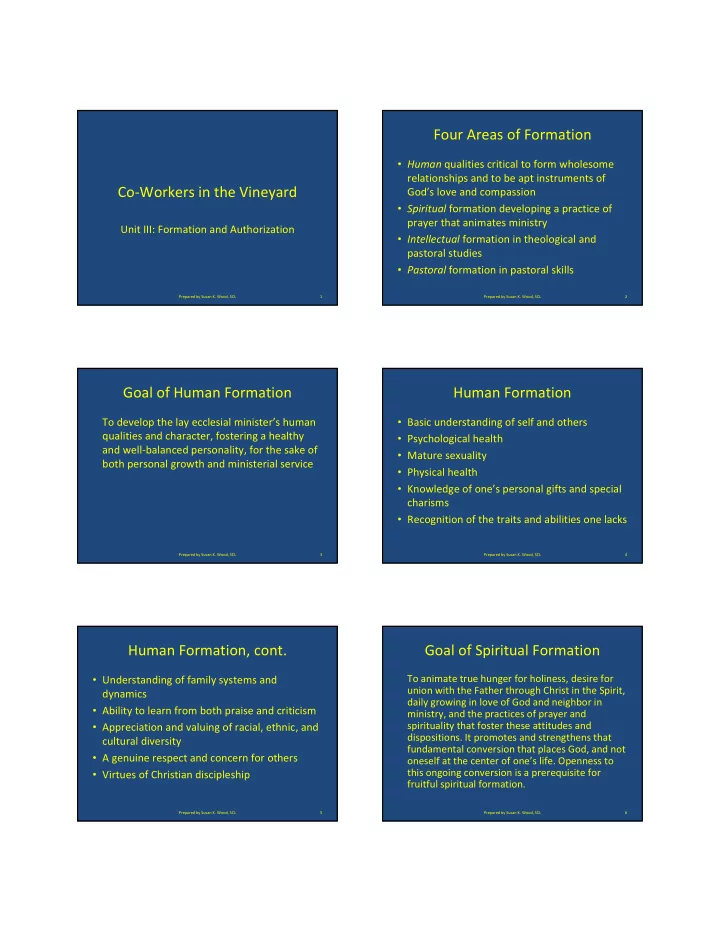
Four Areas of Formation Human qualities critical to form wholesome - - PDF document

four areas of formation
SMART_READER_LITE
LIVE PREVIEW

Four Areas of Formation Human qualities critical to form wholesome - - PDF document

Four Areas of Formation Human qualities critical to form wholesome relationships and to be apt instruments of Co-Workers in the Vineyard Gods love and compassion Spiritual formation developing a practice of prayer that animates


slide-1
SLIDE 1

Co-Workers in the Vineyard

Unit III: Formation and Authorization

Prepared by Susan K. Wood, SCL 1

Four Areas of Formation

  • Human qualities critical to form wholesome

relationships and to be apt instruments of God’s love and compassion

  • Spiritual formation developing a practice of

prayer that animates ministry

  • Intellectual formation in theological and

pastoral studies

  • Pastoral formation in pastoral skills

Prepared by Susan K. Wood, SCL 2

Goal of Human Formation

To develop the lay ecclesial minister’s human qualities and character, fostering a healthy and well-balanced personality, for the sake of both personal growth and ministerial service

Prepared by Susan K. Wood, SCL 3

Human Formation

  • Basic understanding of self and others
  • Psychological health
  • Mature sexuality
  • Physical health
  • Knowledge of one’s personal gifts and special

charisms

  • Recognition of the traits and abilities one lacks

Prepared by Susan K. Wood, SCL 4

Human Formation, cont.

  • Understanding of family systems and

dynamics

  • Ability to learn from both praise and criticism
  • Appreciation and valuing of racial, ethnic, and

cultural diversity

  • A genuine respect and concern for others
  • Virtues of Christian discipleship

Prepared by Susan K. Wood, SCL 5

Goal of Spiritual Formation

To animate true hunger for holiness, desire for union with the Father through Christ in the Spirit, daily growing in love of God and neighbor in ministry, and the practices of prayer and spirituality that foster these attitudes and

  • dispositions. It promotes and strengthens that

fundamental conversion that places God, and not

  • neself at the center of one’s life. Openness to

this ongoing conversion is a prerequisite for fruitful spiritual formation.

Prepared by Susan K. Wood, SCL 6

slide-2
SLIDE 2

Elements of Spiritual Formation

  • Living in union with Christ
  • Build on the word of God
  • Based on liturgy, specially the sacraments
  • Incarnational spirituality of presence and the

paschal spirituality of loving service

  • Awareness of sin
  • Spirituality of suffering
  • Marian spirituality

Prepared by Susan K. Wood, SCL 7

Elements of Spiritual Formation, cont.

  • Love for the Church
  • Devotion to the Eucharist
  • Ecumenical spirit

Prepared by Susan K. Wood, SCL 8

Goal of Intellectual Formation

To develop the lay ecclesial minister’s understanding and appreciation of the Catholic faith that is rooted in God’s revelation and embodied in the living tradition of the Church. It consists chiefly of the study of theology, but draws upon a wide variety of other disciplines: philosophy, literature and the arts, psychology, sociology, medical ethics, business administration, law,

  • rganizational development, etc.

Prepared by Susan K. Wood, SCL 9

Elements of Intellectual Formation

  • Scripture
  • Church doctrine
  • Church history
  • Liturgical and sacramental theology
  • Moral theology and Catholic social teaching
  • Pastoral theology
  • Spiritual theology
  • Canon law

Prepared by Susan K. Wood, SCL 10

Goal of Pastoral Formation

To cultivate the knowledge, attitudes, and skills that directly pertain to effective functioning in ministry settings and that also pertain to pastoral administration that supports direct ministry.

Prepared by Susan K. Wood, SCL 11

Elements of Pastoral Formation

  • Methods for providing formation to others
  • Leading community prayer and preaching
  • Pastoral ministry skills
  • Family mission and family perspective
  • Effective relationship and communication

skills

  • Collaboration
  • Discernment of signs of the times

Prepared by Susan K. Wood, SCL 12

slide-3
SLIDE 3

Elements of Pastoral Formation, cont.

  • Gift discernment and volunteer ministry

management

  • Change and conflict management skills
  • Basic counseling skills
  • Culture and language studies
  • Administration skills
  • Leadership and organizational development
  • Applicable civil law
  • Ministerial code of ethics

Prepared by Susan K. Wood, SCL 13

Authorization

  • By an ecclesiastical authority
  • For certain ministerial tasks in the name of the

local church

  • Occurs after appropriate formation

Prepared by Susan K. Wood, SCL 14

Elements of Authorization

  • Acknowledgement of competence (may require

certification)

  • Appointment to a specific position (possibly by a

commissioning ritual) Emphasizes relationship of diocesan bishop with LEM and underscores importance of the role

  • Delineation of obligations, responsibilities, and

authority of the position

  • Announcement of appointment to the

community served by the LEM

Prepared by Susan K. Wood, SCL 15

Role of the Bishop

  • Oversight
  • Ensures suitability
  • Attentive to proper preparation
  • Identifies those roles essential to collaborating in

pastoral care

  • Reserve the right to review credentials before

appointments

  • Authorization process allows bishop to

demonstrate support for LEM and model collaboration

Prepared by Susan K. Wood, SCL 16

Role of Pastor

  • Responsible for pastoral care of parish
  • Support crucial

Prepared by Susan K. Wood, SCL 17

Certification

  • Process that documents the attainment of

specific standards and competencies required for the fulfillment of a specialized ecclesial ministry.

  • Requires a process for assessing that a given

candidate has the education, formation, and professional skills necessary to serve in a particular role.

Prepared by Susan K. Wood, SCL 18

slide-4
SLIDE 4

Certification

Certification is frequently handled by professional organizations such as The National Association for Lay Ministry, (www.nalm.org) , National Conference for Catechetical Leadership (www.nccl.org), the National Federation for Catholic Youth Ministry (www.nfcym.org). These three organizations published the National Certification Standards for Lay Ecclesial Ministers Serving as Parish Catechetical Leaders, Youth Ministry Leaders, Pastoral Associates, and Parish Life Coordinators and the National Certification Standards for Pastoral Ministers.

Prepared by Susan K. Wood, SCL 19

Last, but not least, The National Association of Catholic Chaplains. This last is an example of extra-parochial LEM. See also the U.S. conference of Catholic Bishops Commission on Certification and Accreditation (USCCB/CCA). The certification handbook has been under revision, so call for current information.

Prepared by Susan K. Wood, SCL 20

Recapitulation

  • Authorization: Ecclesial recognition and

designation by competent ecclesiastical authority

  • Certification: Acknowledgement of

competency by a professional ministerial

  • rganization

Prepared by Susan K. Wood, SCL 21

The Ministerial Workplace

  • Faith community: Gospel values
  • Modern organization: Best organizational

practices

Prepared by Susan K. Wood, SCL 22

Questions?

Prepared by Susan K. Wood, SCL 23