Higher areas Modeling Extrastriate Areas Many higher areas beyond - - PowerPoint PPT Presentation

higher areas modeling extrastriate areas
SMART_READER_LITE
LIVE PREVIEW

Higher areas Modeling Extrastriate Areas Many higher areas beyond - - PowerPoint PPT Presentation

Higher areas Modeling Extrastriate Areas Many higher areas beyond V1 Dr. James A. Bednar Selective for jbednar@inf.ed.ac.uk faces, http://homepages.inf.ed.ac.uk/jbednar self-motion, etc. Not as well understood Macaque visual


slide-1
SLIDE 1

Modeling Extrastriate Areas

  • Dr. James A. Bednar

jbednar@inf.ed.ac.uk http://homepages.inf.ed.ac.uk/jbednar

CNV Spring 2009: Extrastriate models 1

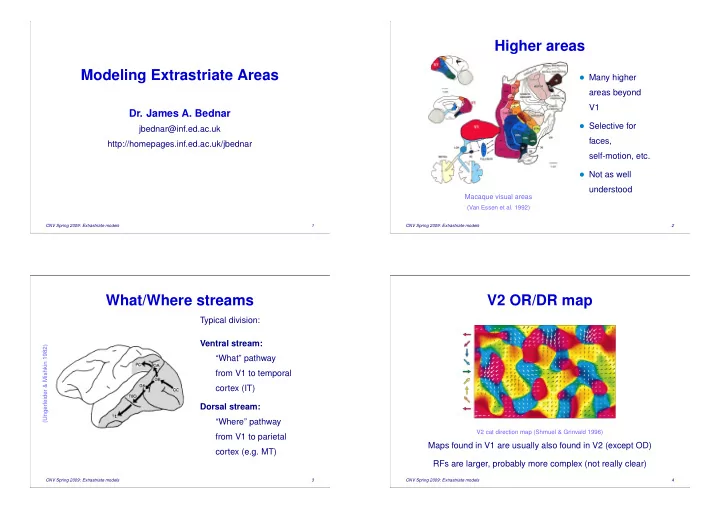
Higher areas

Macaque visual areas

(Van Essen et al. 1992)

  • Many higher

areas beyond V1

  • Selective for

faces, self-motion, etc.

  • Not as well

understood

CNV Spring 2009: Extrastriate models 2

What/Where streams

(Ungerleider & Mishkin 1982)

Typical division: Ventral stream: “What” pathway from V1 to temporal cortex (IT) Dorsal stream: “Where” pathway from V1 to parietal cortex (e.g. MT)

CNV Spring 2009: Extrastriate models 3

V2 OR/DR map

V2 cat direction map (Shmuel & Grinvald 1996)

Maps found in V1 are usually also found in V2 (except OD) RFs are larger, probably more complex (not really clear)

CNV Spring 2009: Extrastriate models 4

slide-2
SLIDE 2

V2 Color map

Xiao et al. 2003 – Macaque; 1.4×1.0mm

  • Like V1, color preferences organized into blobs
  • Rainbow of colors per blob (Xiao et al. 2007: in V1 too?))
  • Arranged in order of human perceptual color charts (CIE/DIN)
  • Feeds to V4, which is also color selective

CNV Spring 2009: Extrastriate models 5

MT/V5

(Xu et al. 2006)

MT has orientation maps, but the neurons are more motion and direction selective Involved in estimating

  • ptic flow

Neural responses in MT have been shown to directly reflect and determine perception of motion direction

(Britten et al. 1992; Salzman et al. 1990)

CNV Spring 2009: Extrastriate models 6

Object selectivity in IT

(Bruce et al. 1981)

Some cells show greater responses to faces than to other classes; others to hands, buildings, etc. Hard to interpret, though.

CNV Spring 2009: Extrastriate models 7

Rapid Serial Visual Presentation

(F¨

  • ldi´

ak et al. 2004)

1000s of images (> 15% faces) presented to neuron for 55 or 110ms

CNV Spring 2009: Extrastriate models 8

slide-3
SLIDE 3

RSVP: Face-selective neurons

(F¨

  • ldi´

ak et al. 2004)

  • Some monkey STSa neurons show clear preferences

– top 50 faces are images

  • Response low to remaining patterns
  • Concern: faces are the only special category

(overrepresented, aligned, blank background)

CNV Spring 2009: Extrastriate models 9

RSVP: Non-face-selective neurons

Other neurons don’t make much sense at all

CNV Spring 2009: Extrastriate models 10

Form expertise

(Gauthier & Tarr 1997)

Most of the “specialness” of faces appears to be shared by

  • ther object categories requiring configural distinctions

between similar examples.

CNV Spring 2009: Extrastriate models 11

Face aftereffects

(Leopold et al. 2001)

Aftereffects are seemingly universal. E.g. face aftereffects: changes in identity judgments; blur/sharpness aftereffects, contrast aftereffects. . .

CNV Spring 2009: Extrastriate models 12

slide-4
SLIDE 4

Invariant tuning

Higher level ventral stream cells have response properties invariant to size, viewpoint, orientation, etc. Similar to complex cells, but higher-order. E.g. can respond to face regardless of its location and across a wide range of sizes and viewpoints.

CNV Spring 2009: Extrastriate models 13

Why is invariance hard?

Simple template-based models won’t provide much invariance, but could build out of many such cells.

CNV Spring 2009: Extrastriate models 14

RF sizes

(Rolls 1992)

CNV Spring 2009: Extrastriate models 15

VisNet

(Wallis & Rolls 1997)

Layer 1 Layer 4 Layer 3 Layer 2

Develops neurons with invariant tuning Assumes fixed V1 area Ignores topographic

  • rganization

CNV Spring 2009: Extrastriate models 16

slide-5
SLIDE 5

Trace learning rule

VisNet uses the trace learning rule proposed by F¨

  • ldi´

ak (1991). Based on Hebbian rule for activity yτ and input

xjτ : ∆wj = αyτxj

τ

(1) but modified to use recent history (“trace”) of activity:

∆wj = α¯ yτxj

τ

(2)

¯ y = (1 − η)yτ + η¯ yτ−1

(3) General technique for invariant responses?

CNV Spring 2009: Extrastriate models 17

HMAX

(Riesenhuber & Poggio 1999)

Top level (only) learns view, position, size invariant recognition Max (C) units: nonlinear pooling, like complex cells Linear (S) units: feature templates, like simple cells No clear topography

CNV Spring 2009: Extrastriate models 18

Koch and Itti saliency maps

(Itti, Koch, & Niebur 1998)

Attention model: most salient feature attended Various feature maps pooled at different scales Single winner: attended location Inhibition of return: enables scanning

CNV Spring 2009: Extrastriate models 19

Other attention models

(Deco & Rolls 2004)

There are a number of

  • ther models of behavior

like attention, most quite complex Hard to tie individual model areas to specific experimental results from those areas Also need to include superior colliculus

CNV Spring 2009: Extrastriate models 20

slide-6
SLIDE 6

Modeling separate streams

Stimulus

Decision

Face Processing Object Processing

??

Mediator Feature Extraction General- Purpose Processing Units (Dailey & Cottrell 1999)

Slight biases are sufficient to make one stream end up selective for faces, the other for objects

CNV Spring 2009: Extrastriate models 21

More complexities

Need to include eye movements, fovea/periphery. At higher levels, neurons become multisensory. Eventually, realistic models will need to include auditory areas, touch areas, etc. Feedback from motor areas is also more important at higher levels. Training data for such models will likely be harder to make than building a robot – will need embodied models.

CNV Spring 2009: Extrastriate models 22

Summary

  • Need to include many areas besides V1
  • Complexity and lack of data are serious problems
  • Eventually: situated, embodied models
  • May be useful to focus on species with just V1 or a few

areas before trying to tackle whole visual hierarchy

  • Lots of work to do

CNV Spring 2009: Extrastriate models 23
References

Britten, K. H., Shadlen, M. N., Newsome, W. T., & Movshon, J. A. (1992). The analysis of visual motion: A comparison of neuronal and psychophysical

  • performance. The Journal of Neuroscience, 12, 4745–4765.

Bruce, C., Desimone, R., & Gross, C. G. (1981). Visual properties of neurons in a polysensory area in superior temporal sulcus of the macaque. Journal of Neurophysiology, 46 (2), 369–384. Dailey, M. N., & Cottrell, G. W. (1999). Organization of face and object recognition in modular neural network models. Neural Networks, 12 (7), 1053–1074. Deco, G., & Rolls, E. T. (2004). A neurodynamical cortical model of visual attention and invariant object recognition. Vision Research, 44 (6), 621–642.

CNV Spring 2009: Extrastriate models 23

slide-7
SLIDE 7

  • ldi´

ak, P . (1991). Learning invariance from transformation sequences. Neural Computation, 3, 194–200. F¨

  • ldi´

ak, P ., Xiao, D., Keysers, C., Edwards, R., & Perrett, D. I. (2004). Rapid serial visual presentation for the determination of neural selectivity in area STSa. Progress in Brain Research, 144, 107–116. Gauthier, I., & Tarr, M. J. (1997). Becoming a ‘Greeble’ expert: Exploring mecha- nisms for face recognition. Vision Research, 37 (12), 1673–1682. Itti, L., Koch, C., & Niebur, E. (1998). A model of saliency-based visual attention for rapid scene analysis. IEEE Transactions on Pattern Analysis and Machine Intelligence, 20 (11), 1254–1259. Leopold, D. A., O’Toole, A. J., Vetter, T., & Blanz, V. (2001). Prototype-referenced

CNV Spring 2009: Extrastriate models 23

shape encoding revealed by high-level aftereffects. Nature Neuroscience, 4 (1), 89–94. Riesenhuber, M., & Poggio, T. (1999). Hierarchical models of object recognition in

  • cortex. Nature Neuroscience, 2 (11), 1019–1025.

Rolls, E. T. (1992). Neurophysiological mechanisms underlying face processing within and beyond the temporal cortical visual areas. Philosophical Trans- actions: Biological Sciences, 335 (1273), 11–21. Salzman, C. D., Britten, K. H., & Newsome, W. T. (1990). Cortical microstimulation influences perceptual judgements of motion direction. Nature, 346, 174– 177, Erratum 346:589. Shmuel, A., & Grinvald, A. (1996). Functional organization for direction of motion

CNV Spring 2009: Extrastriate models 23

and its relationship to orientation maps in cat area 18. The Journal of Neuroscience, 16, 6945–6964. Ungerleider, L. G., & Mishkin, M. (1982). Two cortical visual systems. In Ingle,

  • D. J., Goodale, M. A., & Mansfield, R. J. W. (Eds.), Analysis of Visual Be-

havior (pp. 549–586). Cambridge, MA: MIT Press. Van Essen, D. C., Anderson, C. H., & Felleman, D. J. (1992). Information pro- cessing in the primate visual system: An integrated systems perspective. Science, 255, 419–423. Wallis, G. M., & Rolls, E. T. (1997). Invariant face and object recognition in the visual system. Progress in Neurobiology, 51 (2), 167–194. Xiao, Y., Casti, A., Xiao, J., & Kaplan, E. (2007). Hue maps in primate striate

  • cortex. Neuroimage, 35 (2), 771–786.

CNV Spring 2009: Extrastriate models 23

Xiao, Y., Wang, Y., & Felleman, D. J. (2003). A spatially organized representation

  • f color in macaque cortical area V2. Nature, 421, 535–539.

Xu, X., Collins, C. E., Khaytin, I., Kaas, J. H., & Casagrande, V. A. (2006). Unequal representation of cardinal vs. oblique orientations in the middle temporal visual area. Proceedings of the National Academy of Sciences of the USA, 103 (46), 17490–17495.

CNV Spring 2009: Extrastriate models 23