Forward Contracts A forward contract is an agreement between two - - PowerPoint PPT Presentation

forward contracts
SMART_READER_LITE
LIVE PREVIEW

Forward Contracts A forward contract is an agreement between two - - PowerPoint PPT Presentation

Forward Contracts A forward contract is an agreement between two parties in Lecture 4: Futures and Forwards: which one party, the buyer ( long ), agrees to buy from the other party, the seller ( short ), something (i.e., underlying Markets,


slide-1
SLIDE 1

1

Lecture 4: Futures and Forwards: Markets, Basic Applications, and Pricing Principles

  • Dr. Nattawut Jenwittayaroje, CFA

Faculty of Commerce and Accountancy Chulalongkorn University 01135531: Risk Management and Financial Instrument

2

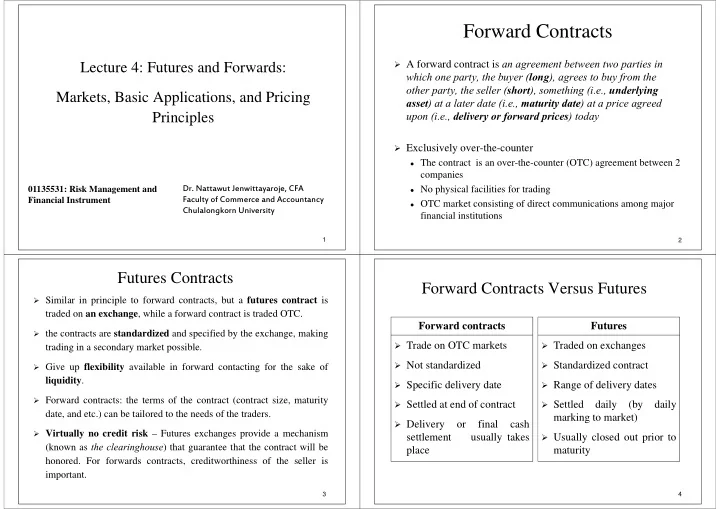
  • A forward contract is an agreement between two parties in

which one party, the buyer (long), agrees to buy from the

  • ther party, the seller (short), something (i.e., underlying

asset) at a later date (i.e., maturity date) at a price agreed upon (i.e., delivery or forward prices) today

  • Exclusively over-the-counter

 The contract is an over-the-counter (OTC) agreement between 2

companies

 No physical facilities for trading  OTC market consisting of direct communications among major

financial institutions

Forward Contracts

3

Futures Contracts

  • Similar in principle to forward contracts, but a futures contract is

traded on an exchange, while a forward contract is traded OTC.

  • the contracts are standardized and specified by the exchange, making

trading in a secondary market possible.

  • Give up flexibility available in forward contacting for the sake of

liquidity.

  • Forward contracts: the terms of the contract (contract size, maturity

date, and etc.) can be tailored to the needs of the traders.

  • Virtually no credit risk – Futures exchanges provide a mechanism

(known as the clearinghouse) that guarantee that the contract will be

  • honored. For forwards contracts, creditworthiness of the seller is

important.

4

Forward Contracts Versus Futures

Forward contracts

  • Trade on OTC markets
  • Not standardized
  • Specific delivery date
  • Settled at end of contract
  • Delivery
  • r

final cash settlement usually takes place Futures

  • Traded on exchanges
  • Standardized contract
  • Range of delivery dates
  • Settled

daily (by daily marking to market)

  • Usually closed out prior to

maturity

slide-2
SLIDE 2

5

Derivatives Markets in Thailand

  • Thailand Futures Exchange pcl. (TFEX)

SET 50 Index Futures

Single Stock Futures

  • For example, ADVANC, PTT, and PTTEP

Gold Futures, Silver Futures, and Brent Crude Oil Futures

USD Futures

Interest Rate Futures

SET 50 Index options

  • Call options
  • Put options
  • Agricultural Futures Exchange of Thailand (AFET)

Futures contracts on Natural Rubber Ribbed Smoked Sheets No 3

Futures contracts on White Rice 5% Both Options

Futures contracts on Tapioca Chip

6

SET50 Index Futures Contract Specifications

www.tfex.co.th at 21 Mar 13

7

www.tfex.co.th at 21 Mar 13

Single Stock Futures Contract Specifications

8

The Specification of Futures Contracts

Underlying asset

  • Particularly for commodity futures, the exchange sets allowable grade
  • f a commodity

Delivery location

  • Place and means of delivery

Contract size, e.g.

  • For a crude oil futures contract, 1,000 barrels
  • For the Dow Jones stock index futures, $10 per index point
  • For the SET50 index futures, Baht1,000 per index point
  • For a Eurodollar futures contract, $1 million of a Eurodollar time

deposit Quotation

  • Specify how a price of a futures is quoted. E.g. for the CBOT’s corn

futures, prices are quoted in cents per bushel

slide-3
SLIDE 3

9

The Specification of Futures Contracts

Delivery months (expiration months)

  • The main delivery months for futures are March, June,

September and December. Deliverable or cash settlement contracts

  • Deliverable contract: settled by delivery of the item
  • Cash settlement: settled by the payment of cash

Daily price movement limits

  • Prevent large price movement from speculators.

Position limits

  • Prevent speculators from having big influence on the market

The max. no. of contracts that an investor may hold.

10 10

TFEX’s SET 50 Index Futures

  • Settlement price (SP): this usually is an average of the prices of the last few

trades of the day. The settlement price is used to mark-to-market the position.

  • Volume: A number of contracts traded
  • Open interest (OI): The number of futures contracts outstanding at any given

in time. www.tfex.co.th at 13 Jan 2014 SET 50 index spot = 880.7

11 11

TFEX’s Gold & Single Stock Futures

Gold spot = 19,450 KTB spot = 16.50

12 12

TFEX’s USD and Brent crude Futures

USD spot = 33.02  www.bot.or.th Brent spot = 106.77*33.02 = 3,525

slide-4
SLIDE 4

13

AFET’s Futures

14

Example of Futures Listing on CBOT

15 16

สินคาอางอิง ทองคําแทงที่มีความบริสุทธิ์ 96.5% ขนาดของสัญญา 1 สัญญามีขนาดเทากับ ทองคําน้ําหนัก 50 บาท เดือนที่สัญญาสิ้นสุดอายุ เดือนคู (ก.พ., เม.ย., มิ.ย., ส.ค., ต.ค., ธ.ค.) ใกลที่สุด 3 ลําดับ ชวงราคาซื้อขายขั้นต่ํา 10 บาท ตอ 1 สัญญา ชวงการเปลี่ยนแปลงของ ราคาสูงสุดแตละวัน ไมเกิน + 20 % ของราคาที่ใชชําระราคาในวันทําการกอนหนา เวลาซื้อขาย Pre-open : 9:15 - 9:45 Morning : 9:45 - 12:30 Pre-open : 14:00 - 14:30 Afternoon: 14:30 - 16:55

ราคาที่ใช้ชําระในวันสุดท้าย

วันทําการกอนวันทําการสุดทายของเดือนที่สัญญาสิ้นสุดอายุ โดย ในวันนั้น สัญญาที่จะหมดอายุจะซื้อขายไดถึงเวลา 16.30 น.

Gold Futures

slide-5
SLIDE 5

17 17

ราคา Gold Spot

13 มค. 2557

ราคา Gold Futures

13 มค. 2557

18

กราฟแสดงราคาทองคําspot กับ ราคาทองคําฟิวเจอร์ส

19

เปรียบเทียบทองคํา (spot) กับ โกลด์ฟิวเจอร์ส (futures)

ทองคํา โกลดฟวเจอรส เงินลงทุน ชําระเงินเต็มมูลคา วางเงินค้ําประกันประมาณ 10% การสงมอบสินคา สงมอบจริง ชําระเปนเงินสด กลยุทธการทํากําไร ทํากําไรไดเฉพาะขาขึ้น ทํากําไรไดทั้งขาขึ้นและขาลง ราคาซื้อขาย ประกาศโดยสมาคมผูคาทอง เปลี่ยนแปลงตลอดวันตามการซื้อขาย ในตลาด ระยะเวลาการลงทุน ระยะกลาง-ยาว ระยะสั้นวันตอวัน

20

การทํากําไรในตลาดขาขึ้น

  • กําไร = 199,000 – 196,000 = 3,000
  • เงินลงทุน 15,000
  • กําไรร้อยละ 20%

ซื้อ มูลคา 196,000 ขาย มูลคา 199,000

เงินประกัน

GFM10

19,600 19,900

slide-6
SLIDE 6

21

การทํากําไรในตลาดขาลง

  • กําไร = 196,000 – 192,500 = 3,500
  • เงินลงทุน 15,000
  • กําไรร้อยละ 23%

ซื้อ มูลคา 192,500 ขาย มูลคา 196,000

GFM10

19,250 19,600

22

Clearinghouse

  • The futures exchange provides a clearing mechanism.
  • Without a clearinghouse, traders will face a counter-party

risk

  • With clearing house, each trader only has an obligation with

the clearinghouse

  • The clearinghouse becomes

 The seller of the contract for the long position  The buyer of the contract for the short position  The clearinghouse’s position nets to zero

23

Clearinghouse

24

Clearinghouse

slide-7
SLIDE 7

25

Margin Account

  • Since each trader has an obligation with the exchange, and futures

contracts expose to risk of loss.

  • To protect the exchange from a possible loss on a futures contract, the

exchange requires each trader to deposit an initial margin.

  • The initial margin (deposit) is usually required between 5% to 15% of

the total value of the contract. For example, for SET50 index futures, the

initial margin is 85,000 per contract, or about 85,000/(1,000*880) = 10.4%.

  • During the life of a contract, the trader must maintain their account

above maintenance margin level, e.g., 5% of the total value of the

  • contract. For SET50 index futures, the maintenance margin is 60,000 per

contract, or about 60,000/(1,000*880) = 6.8%.

  • When falls below the maintenance level, they will receive a margin

call and is requested to top up the margin account to the initial margin level.

26

Daily Settlements (Marking to Market)

  • Furthermore, the profit/loss on a futures contract is settled daily.
  • Winning party

The surplus (above initial margin) from its account can be withdrawn.

Otherwise, interest is paid on the funds left in this account.

  • Losing party

Additional payments if the value of the position falls below maintenance margin

  • Marking to market can be more than one time per day (i.e.,

Intra-day margin call)

  • For a forward contract, the profit/loss is realized and settled only
  • nce at the maturity.

27

Example

  • Suppose that the SFE SPI 200 index futures contract is now

traded at 3,500 index points. Its contract size is $25 per index

  • point. The initial and maintenance margins for each contract

are 10% and 5% of the value of the contract respectively.

  • Initial margin = 10%  $87,500 (3,500$25 ) = $8,750
  • Maintenance margin = 5%  $87,500 (3,500$25 ) = $4,375

28

Day Future Price Daily gain/loss Margin account balance for SHORT positions Margin call 1 2 3 3,500 3,600 3,700 3,650

  • 100×25= -$2,500
  • 100×25= -$2,500

50×25= $1,250

$8,750 $6,250 $3,750 $1,250+$8,750=$10,000

  • $5,000
  • Day Future

Price Daily gain/loss Margin account balance for LONG positions Margin call 1 2 3 3,500 3,600 3,700 3,650 100×25= $2,500 100×25= $2,500

  • 50×25= -$1,250

$8,750 $11,250 $13,750 $12,500

slide-8
SLIDE 8

29

Closing Out Positions (Reversing Trading)

  • A trader can close out a position at anytime before the

settlement date.

  • Closing out a long position

 taking an a short position on the same contract.  A trader bought a June interest rate future contract at 3,200.  If in April, the interest rates futures are traded at 3,300. this

trader can close out the position and realise the profit by selling (shorting) the contract.

  • Closing out a short position

 taking a long position on the same contract.

30

Closing Out Positions and Open Interest

  • The number of contracts outstanding (i.e. number of either

long or short contracts outstanding)

  • Almost all traders (i.e., about 99%), however, liquidate (i.e.,

closeout) their positions before the contract maturity date.

  • Futures contracts rarely result in actual delivery of the

underlying asset.

 The fraction of contracts that result in actual delivery is

estimated to range from less than 1 to 3%, depending on the commodity and the activity in the contract.

31

Day Future Price Daily gain/loss Margin account balance for SHORT positions Margin call 1 2 3 4 3,500 3,600 3,700 3,650 3,600

  • 100×25= -$2,500
  • 100×25= -$2,500

50×25= $1,250 50×25= $1,250

$8,750 $6,250 $3,750 $1,250+$8,750=$10,000 $11,250

  • $5,000
  • Day Future

Price Daily gain/loss Margin account balance for LONG positions Margin call 1 2 3 3,500 3,600 3,700 3,650

100×25 = $2,500 100×25 = $2,500

  • 50×25= - $1,250

$8,750 $11,250 $13,750 $12,500 - $12,500 3 4 3,650 3,600

  • 50×25 = -$1,250

$9,125 $7,875

The old LONG trader sells the futures contract to a new LONG trader.

32

Forward Contracts Versus Futures

Forward contracts

  • Trade on OTC markets
  • Not standardized
  • Specific delivery date
  • Settled at end of contract
  • Delivery
  • r

final cash settlement usually takes place Futures

  • Traded on exchanges
  • Standardized contract
  • Range of delivery dates
  • Settled daily
  • Usually closed out prior to

maturity

The clearinghouse and margin account show how daily settlement and closing-out positions work

slide-9
SLIDE 9

33

Open Interest and Volume

  • Consider the following example on how to compute open interest and volume.

Time Trading Activity Open Interest Volume Who are in the market? Jan 1 A buys 1 futures contract and B sells 1 futures contract 1 1 A(+1) : B(-1) Jan 2 E buys 1 futures contract and A sells 1 futures contract Jan 3 B buys 1 futures contract and E sells 1 futures contract Time Trading Activity Open Interest Volume Who are in the market? Jan 1 A buys 1 futures contract and B sells 1 futures contract 1 1 A(+1) : B(-1) Jan 2 C buys 2 futures contracts and D sells 2 futures contracts Jan 3 B buys 1 futures contract and D sells 1 futures contract

34

Open Interest and Volume

  • Consider the following example on how to compute open interest and

volume.

Time Trading Activity Open Interest Volume Who are in the market? Jan 1 A buys 1 futures contract and B sells 1 futures contract 1 1 A(+1) : B(-1) Jan 2 C buys 10 futures contracts and D sells 5 futures contracts and E sells 5 futures contracts Jan 3 B buys 3 futures contracts and A sells 1 futures contract and C sells 2 futures contracts

35

Speculating using Futures and Leverage

  • A crude oil futures contract calls for delivery of 1,000 barrels of
  • il. The current future price for delivery in May is $67.15 per
  • barrel. Suppose the initial margin requirement for the oil contract

is 10%. Expect crude oil prices are going to increase

  • Long oil futures
  • Initial margin = 10%$67,150 ($67.15  1,000 ) = $6,715
  • If the price of the oil futures increase by $2 ($2/$67.15 = 2.98%)
  • create the gain to the long futures = $21,000 = $2,000 or

2,000/6,715 = 29.8%

Leverage: Ability to take on relatively large exposure to the market using futures and options for a relatively small initial outlay.

The 10-to-1 ratio of % change reflects the leverage inherent in the future position.

36

Hedging using futures

Short hedges

  • It is a hedge that involves a short position in futures

contracts

  • It is used when the hedger already own an asset and

expects to sell it at some time in the future. Long hedges

  • It is a hedge that involves a long position in futures

contracts

  • It is used when the hedger knows it will purchase a certain

asset in the futures.

slide-10
SLIDE 10

37

Example: Hedging using Futures

  • Consider an oil distributor (i.e. hedger) plans to sell 100,000

bbls of oil in May that wishes to hedge against a possible decline in oil prices. Each oil futures contract calls for delivery of 1,000 bbls of oil. F0 = $67.15 per barrel.

  • Hedging strategy: short 100 oil futures contracts
  • Consider 3 possible spot prices (ST) of oil in May.
  • When the spot price (ST) in May is low, the low revenue from spot contract is
  • ffset by the profit from the short futures positions
  • When pt is high, the high revenue is offset by the loss from the short futures.
  • All cases, end up 6,715,000: elimination risk: uncertain of the spot price.

F0 -ST ST ST

38

Example: Hedging using Futures

39

Forwards/Futures – pricing principle

  • Should there be any relationship between spot

and forward/future prices?

  • Is forward/futures price a consensus expected

spot price at maturity?

40

  • 1. Gold: An Arbitrage Opportunity?
  • Suppose that:

 The spot price of gold is US$900  The 1-year futures price of gold is US$960  The 1-year US$ interest rate is 5% per annum

  • Is there an arbitrage opportunity?

Action at time 0 Initial Cash Flow Cash Flow at Maturity

Borrow $900 +900

  • 900(1+0.05)1

Buy gold for $900

  • 900

ST Short gold futures at F0=960 960 - ST TOTAL 960-900(1+0.05)1 = $15

slide-11
SLIDE 11

41

  • 2. Gold: Another Arbitrage Opportunity?
  • Suppose that:

 The spot price of gold is US$900  The 1-year futures price of gold is US$890  The 1-year US$ interest rate is 5% per annum

  • Is there an arbitrage opportunity?

Action at time 0 Initial Cash Flow Cash Flow at Maturity

Sell short gold for $900 +900

  • ST

Lend $900

  • 900

+900(1+1.05)1 Long gold futures at F0=890 ST - 890 TOTAL 900(1+1.05)1-890 = $55

42

The Forward/Futures Price of Gold

  • If the spot price of gold is S and the futures price for a contract deliverable in T

years is F, then F = S (1+r )T where r is the 1-year (domestic currency) risk-free interest rate. The continuous version of cost of carry model  F = SerT where r is the 1-year continuously compounded risk-free interest rate.

  • Future price (relative cost of buying a gold with deferred delivery) = spot

price (cost of buying the gold in the market) and carrying it in inventory.

  • Cost of carrying gold = risk-free rate
  • If this parity is violated, this can be arbitraged as previously shown.
  • Arbitrage: strategy to exploit the mispricing that will produce a riskless

profit. In our examples, S=900, T=1, and r=0.05 so that F = 900(1+0.05)1 = 945

Cost-of-carry relationship

$900 is spot cost, and $45 is the cost-of-carry

43

  • 3. Oil: An Arbitrage Opportunity?

Suppose that:

  • The spot price of oil is US$120
  • The quoted 1-year futures price of oil is US$135
  • The 1-year US$ interest rate is 5% per annum
  • The storage cost of oil is $2 per barrel
  • Is there an arbitrage opportunity?

Action at time 0 Initial Cash Flow Cash Flow at Maturity

Borrow $120 +120

  • 120(1+0.05)1

Buy oil for $120

  • 120

ST Cost of storing oil

  • 2

Short oil futures at F0=135 135 - ST TOTAL 135 - 120(1+0.05)1 - 2 = $7

44

  • 4. Oil: Another Arbitrage Opportunity?

Suppose that:

  • The spot price of oil is US$120
  • The quoted 1-year futures price of oil is US$119
  • The 1-year US$ interest rate is 5% per annum
  • The storage cost of oil is $2 per barrel
  • Is there an arbitrage opportunity?

Action at time 0 Initial Cash Flow Cash Flow at Maturity

Sell short oil for $120 +120

  • ST

Lend $120

  • 120

+120(1+0.05)1 Save cost of storing oil +2 Buy oil futures at F0=119 ST - 119 TOTAL 120(1+0.05)1+2 - 119= $9

slide-12
SLIDE 12

45

The Forward/Futures Price of Asset with Storage Cost

  • If the spot price of asset is S and the futures price for a contract

deliverable in T years is F, then F = S (1+r)T + s where r is the 1-year (domestic currency) risk-free rate of interest, and s is the dollar storage cost The continuous version of cost of carry model  F = Se(r+s)T where r and s is the 1-year continuously compounded risk-free interest rate and storage cost rate.

  • Cost of carrying asset = risk-free rate and storage cost
  • If this parity is violated, this can be arbitraged as previously shown.

In our examples, S=120, T=1, r=0.05, and s=$2 so that F = 120(1+0.05)1 +2 = 128

Cost-of-carry relationship

$120 is spot cost, and $8 is the cost-of-carry

46

  • 5. Stock Index: An Arbitrage Opportunity?

Suppose that:

  • The spot price of SET50 index is 450
  • The quoted 6-month futures price of SET50 is 465
  • The 1-year Thai Baht interest rate is 5% per annum
  • The dividends paid from constituent stocks in the SET50 are Baht 5

in the next 6 months

  • Is there an arbitrage opportunity?

Action at time 0 Initial Cash Flow Cash Flow at Maturity

Borrow $450 +450

  • 450(1+0.05)1/2

Buy SET50 for $450

  • 450

ST Receive dividends +5 Short SET50 futures at F0=465 465 - ST TOTAL 465 - 450(1+0.05) 1/2 + 5 = $8.9

47

  • 6. Stock Index: An Arbitrage Opportunity?

Suppose that:

  • The spot price of SET50 index is 450
  • The quoted 6-month futures price of SET50 is 452
  • The 1-year Thai Baht interest rate is 5% per annum
  • The dividends paid from constituent stocks in the SET50 are Baht 5 per

annum

  • Is there an arbitrage opportunity?

Action at time 0 Initial Cash Flow Cash Flow at Maturity

Sell SET50 for $450 +450

  • ST

Lend $450

  • 450

+450(1+0.05)1/2 Pay dividends

  • 5

Buy SET50 futures at F0=452 ST – 452 TOTAL 450(1+0.05) 1/2 - 5 – 452 = $4.1

48

The Forward/Futures Price of Asset with Dividend

  • If the spot price of asset is S and the futures price for a contract

deliverable in T years is F, then F = S (1+r)T - D where r is the 1-year (domestic currency) risk-free rate of interest, and D is the dollar amount of dividend paid The continuous version of cost of carry model  F = Se(r-d)T where r and d is the 1-year continuously compounded risk-free interest rate and dividend yield.

  • Net Cost of carrying asset = risk-free rate minus dividend paid
  • If this parity is violated, this can be arbitraged as previously shown.

In our examples, S=450, T=0.5, r=0.05, and D=$5 so that F = 450(1+0.05)1/2 - 5 = 456.1

Cost-of-carry relationship

$450 is spot cost, and $6.1 is the net cost-of-carry

slide-13
SLIDE 13

49

  • 7. Currency: An Arbitrage Opportunity?

Suppose that:

  • The spot price of USD is 33 baht
  • The quoted 1-month futures price of USD is 33.8 baht
  • The 1-year Thai Baht interest rate is 5% per annum, and the 1-year US$

interest rate is 4% per annum

  • Is there an arbitrage opportunity?

Action at time 0

Initial Cash Flow Cash Flow at Maturity

Borrow 33 baht +33

  • 33(1+0.05)1/12

Buy USD for 33 baht

  • 33

ST Receive “dividends” +33(1+0.04)1/12 - 33 Short USD futures at F0=33.8 33.8 - ST TOTAL 33.8 – [33(1+0.05) 1/12

  • 33(1+0.04)1/12 + 33] = .77

US risk-free rate of 4% Terms in the bracket can be approximated by 33(1+0.05-0.04)1/12

50

  • 8. Currency: An Arbitrage Opportunity?

Suppose that:

  • The spot price of USD is 33 baht
  • The quoted 1-month futures price of USD is 32.8 baht
  • The 1-year Thai Baht interest rate is 5% per annum, and the 1-year US$

interest rate is 4% per annum

  • Is there an arbitrage opportunity?

Action at time 0

Initial Cash Flow Cash Flow at Maturity

Sell USD for 33 baht +33

  • ST

Lend 33 baht

  • 33

+33(1+0.05)1/12 Pay “dividends”

  • [33(1+0.04)1/12 – 33]

Long USD futures at F0=32.8 ST - 32.8 TOTAL [33(1+0.05) 1/12 -33(1+0.04)1/12 + 33] – 32.8 = .23

US risk-free rate of 4% Terms in the bracket can be approximated by 33(1+0.05-0.04)1/12

51

The Forward/Futures Price of Foreign Currency Assets

  • If the spot price of asset is S and the futures price for a contract

deliverable in T years is F, then F = S (1 + r - ρ )T

The continuous version of cost of carry model  F = Se(r-ρ)T

where r is the 1-year domestic currency risk-free interest rate, and ρ is the foreign currency risk-free interest rate

  • Net Cost of Carrying asset = domestic risk-free rate minus foreign

risk-free rate

  • If this parity is violated, this can be arbitraged as previously shown.

In our examples, S=33, T=1/12, r=0.05, and d=0.04 so that F = 33(1+0.05-0.04)1/12 = 33.03

Cost-of-carry relationship

33 is spot cost, and .03 is the net cost-of-carry

52

Futures Markets: Contango vs Backwardation

  • In a Contango market, the futures price exceeds the spot price, that is,

f0(T) > S0. See Table 9.2.

  • When f0(T) < S0, convenience yield is c , an additional return from holding

asset when in short supply/high demand or a non-pecuniary return (e.g., the utility from living in the house owned).

  • When the commodity has a convenience yield, the futures price may be

less than the spot price plus the cost of carry. In that case, the market is said to be at less than full carry and in Backwardation or inverted (See Table 9.3).

  • Market can be both backwardation and contango --> Table 9.4.
  • The inability to sell short the asset and the reluctance on the part of holders
  • f the commodity to sell it when its price is higher than it should be can

also produce backwardation in commodity markets.

slide-14
SLIDE 14

53 54 54

www.tfex.co.th as of 22 March 2013

55 55

www.set.or.th, www.tfex.co.th, www.goldtraders.or.th as of 29 March 2013