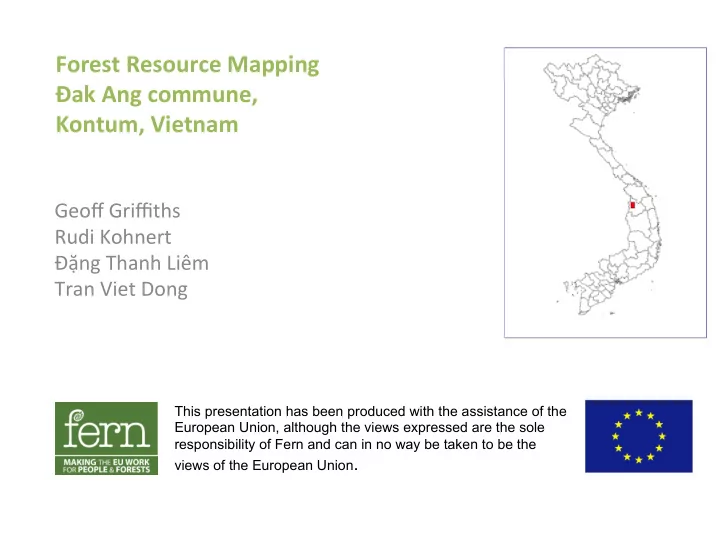
SLIDE 1 Forest Resource Mapping Đak Ang commune, Kontum, Vietnam
Geoff Griffiths Rudi Kohnert Đặng Thanh Liêm Tran Viet Dong
This presentation has been produced with the assistance of the European Union, although the views expressed are the sole responsibility of Fern and can in no way be taken to be the views of the European Union.
SLIDE 2 Objec;ves
Gain insights into the rela<onships between
- Official data on categories of forest land designa<on /
func<on (fit for purpose?)
- Actual forest quality and density of cover
- How different forest land areas are managed, and by
whom
SLIDE 3 Sec<on 1: Methodology
(classifying satellite imagery into land cover types)
Sec<on 2: Comparing satellite land cover with official land cover maps
Does official data of land cover reflect actual land cover?
Sec<on 3: Comparing tree cover and designated forest func<on maps to assess if so-called ‘protected Forest’ is well protected
- r whether ‘produc<on forest’ is produc<ve, degraded or put to other
use
Sec<on 4: Comparing land alloca<on and forest cover maps Do households manage forest land any be[er than other land
managers?
Sec<on 5: Further poten<al of GIS
(household level social data, Agent Orange impact…)
Structure of presenta;on
SLIDE 4
This case study
Official data / sta<s<cs Ground truthing Satellite imagery
SLIDE 5 Satellite image classifica;on - STEP 1 – satellite image A high resolu<on SPOT1 satellite image (right) acquired in February 2016 was classified into the following forest/land cover types: Ø Dark green: forest Ø Light green: planta<ons / tree crops and shrub / grassland Ø Grey: agriculture/bare land
1 Satellite Pour l’Observa4on de la Terre
SLIDE 6 GPS waypoints and photos were collected in the field, August 2016.
Satellite image classifica;on STEP 2 - Ground data collec;on
The ground data were used to develop and validate the satellite image classifica<on
North: Cassava/poor forest South: wet rice East: shrub & recovery forest West: upland rice/cassava
SLIDE 7
Satellite image classifica;on STEP 3 - A resul;ng typology of land cover from classifying the satellite imagery Based on the GPS waypoints and associated ground photos, a typology was assigned to 7 land cover classes: – Rich/’medium’ forest (closed canopy forest) – Poor/’recovery’ forest (more open, disturbed forest) – Agriculture/Bare ground – Planta;on/tree crops – Shrub/grassland – Other land (including roads, buildings) – Water (principally rivers)
SLIDE 8
Satellite image classifica;on – STEP 4: Resul;ng map
Original satellite image Resul<ng classified land cover map
SLIDE 9 Satellite image classifica;on - What this tells us already
Ø About 70% of the commune has some form of tree cover Ø Of this § Rich/medium forest covers a greater area (40%) than § Poor/recovery forest (30%) § Less than a quarter of the commune is bare land or land set aside for agriculture
Rich/medium forest Poor/recovery forest Agriculture/bare land Planta<on/tree crops 40% 30% 21% 5%
SLIDE 10
2: COMPARING SATELLITE LAND COVER MAP WITH OFFICIAL LAND COVER MAP
(Does official data of land cover reflect actual land cover?)
SLIDE 11 STEP 1: Simplifying the original official land cover map (via ‘look-up table’) to convert the
- fficial typology to the same typology used for satellite land cover maps
simplified official land cover map
- riginal official land cover map
Land cover – satellite image vs official data
SLIDE 12
Land cover – satellite image vs official data STEP 2: Taking the simplified official land cover map and juxtaposing onto the classified satellite map …
Simplified official land cover map Classified satellite land cover map
SLIDE 13 Land cover – satellite image vs official data STEP 3: resul;ng difference between official data and satellite land cover image
From pukng together the 2 maps of land cover (official and satellite), we get the following results illustra<ng the discrepancies between official and satellite data
5 10 15 20 25 30 35 40 45
Percent Land cover type
Land cover: classified satellite vs official
Satellite Official
Land cover category Satellite (percent
Official (percent of total) Rich forest 40.17 40.57 Medium/poor forest 30.24 21.57 Agriculture/bare land 20.81 26.97 Planta<on/tree crops 4.69 0.57 Shrub/grass 1.49 6.78 Other land 1.12 2.90 Water 1.48 0.65
SLIDE 14
Land cover – satellite image vs official data
Zoomed image of official land cover over the raw satellite map. Official land cover data (yellow lines) superimposed onto the satellite image to show the discrepancies between official informa<on and satellite data
SLIDE 15
3: COMPARING TREE COVER WITH OFFICIAL DESIGNATED FOREST FUNCTION
Is ‘Protected Forest’ well protected everywhere? Is ‘Produc<on forest’ actually forest at all, and if so, or whether it is produc<ve, degraded or put to other use?
SLIDE 16 Comparing tree cover and designated forest func;on STEP 1: Introducing forest func*on
Forest func<on is how the government designates forest zones for different uses:
- Produc<on forest
- Protec<on forest
- Unplanned
SLIDE 17 Comparing tree cover and designated forest func;on STEP 2: Comparing forest func;on to the satellite land cover map
When we overlay the forest func<on map onto the satellite land cover map, we get a sense
- f the extent to which the supposed func<on of the forest matches the actual quality of the
forest in that same area…
SLIDE 18 Comparing tree cover and designated forest func;on What does this tell us?
When we juxtapose the map of forest func<ons with the map of forest quality (land cover) we see that:
- Almost 40 % of ‘protected forest’ is
in poor condi<on or recovering and 2% is being used for agriculture or is bare land
- Almost a third of what is
designated as ‘produc<on forest’ is actually agriculture, and of the rest almost another third is poor forest or recovering forest
Rich / medium forest Poor / recovery forest Agriculture / bare land Produc*on 31 28 31 Protec*on 56 39 2 Unplanned 7 8 59
SLIDE 19
4: COMPARISON OF SATELLITE LAND COVER WITH WHO USES THE LAND
(Do households manage forest land any be[er than other land managers?)
SLIDE 20 Land alloca;on vs land cover STEP 1: Introducing land users in Đak Ang
Land is allocated to
- households (either formally with
‘red book’ user cer<ficates) or not (yet)
- local government (the commune
People’s Commi[ee)
- a management board responsible
for managing protec<on forest (PFMB)
- companies (Vietnamese and
foreign)
SLIDE 21
Land alloca;on vs land cover STEPS 2 and 3: Comparing the land users map with (a) the satellite map of cover, and (b) the official map of cover
Land users Land cover (satellite) Land cover (official data)
SLIDE 22 Land alloca;on vs land cover
Comparing the land users map with the satellite map of cover, we observe the quality of forest cover being managed by different forest users. Note how this differs from the official view when comparing the land users map to the
A bar chart of difference between two tables follows
slide.
according to satellite image according to
Official data Rich/medium forest Poor/recovery forest Agriculture/bare land Commune People's Commi[ee 4 30 58 Foreign Enterprise 34 66 Households 79 20 People's Forest Management Board 66 29 4 State Enterprise 41 59 Satellite data Rich/medium forest Poor/recovery forest Agriculture/bare land Commune People's Commibee 17 19 46 Foreign Enterprise 24 30 36 Households 63 33 4 People's Forest Management Board 56 39 2 State Enterprise 17 9 62
SLIDE 23
- Zooming into household level social data
- Impact of US military spraying of Agent Orange
- 5. FURTHER POSSIBILITIES OF GIS
(2 examples)
SLIDE 24 Further poten;al of GIS
- Eg. 1: Household level social data
For each household plot we can call up data associated with it…. (eg on land or food security, household size, wealth ranking, ethnicity or gender etc.)
Dak Ro Me Village Gender of head of household Male Ethnicity Xedang Household size 8 Wealth ranking Poor Insufficient food 3 months/yr
3 Sufficient land No Seek more land Yes Red book (land use cer<ficate) Yes
SLIDE 25 Further poten;al of GIS
- Eg. 2: Impact of Agent Orange
Similarly we can assess correla<on between exis<ng land use and areas where forests were destroyed by US chemical weapons (land which remains poisoned decades later)
SLIDE 26
Lessons and summary
Ø How useful are the designa<ons ‘protec<on’ & ‘produc<on’ forest? Ø Maps can raise important ques<ons that need work on-the-ground to interpret Ø Official land cover data is very different to satellite-derived land cover data Ø Requires contextualising in terms of an interna<onally recognised typology (e.g. UN) Ø Improve classifica<on techniques (radar etc.) Ø Protected forest shows high levels of degrada<on and disturbance Ø A large propor<on of produc<on forest appears to have been encroached by agriculture Ø Monitoring change poten<al Ø Far be[er to have a representaive sample of targeted data than an exhaus<ve set of ques<ons from too small a sample.
SLIDE 27 Some benefits of forest mapping
Ø Accurate forest maps are important for planning such as in:
- community use in support of local livelihoods
- FLEGT (VPA)
- global climate change (REDD+)
- commercial forestry
Ø Without monitoring and upda<ng forest maps quickly become outdated (as with paper maps) Ø Promotes need for agreeing coherent classifica<on of forest types
SLIDE 28
Some recommenda;ons…..
Ø Civil Society has a useful tool to explore these ideas…greater awareness Ø Capacity building – poten<al for training and policy-making Ø Provides evidence and confidence…creden<als.. Ø Indicates to donors and policy-makers the pixalls of taking data at face value Ø Replicability issue? Ø Improved awareness leads to right ques<ons…commission the right technical people