Forecasting the Response of Terrestrial Habitats to Climate Change - - PowerPoint PPT Presentation

forecasting the response of terrestrial habitats
SMART_READER_LITE
LIVE PREVIEW

Forecasting the Response of Terrestrial Habitats to Climate Change - - PowerPoint PPT Presentation

Forecasting the Response of Terrestrial Habitats to Climate Change in the Northern Sierra Louis Provencher # , Greg Low & , Dick Cameron & , Kirk Klausmeyer & , Jason Mackenzie & # TNC N EVADA , A PPLIED C ONSERVATION I NC


slide-1
SLIDE 1

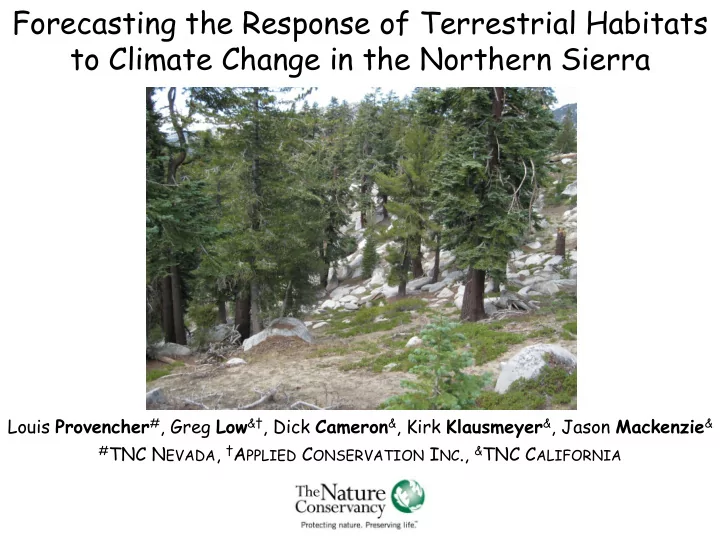
Forecasting the Response of Terrestrial Habitats to Climate Change in the Northern Sierra

Louis Provencher#, Greg Low&†, Dick Cameron&, Kirk Klausmeyer&, Jason Mackenzie&

#TNC NEVADA, †APPLIED CONSERVATION INC., &TNC CALIFORNIA
slide-2
SLIDE 2

Funding:

  • A. Seelenfreund

Resources Legacy Fund

Technical Support:

Kori Blankenship, TNC’s LANDFIRE Liz Rank, The Nature Conservancy’s Fire Learning Network

Acknowledgments #1

slide-3
SLIDE 3
  • Franco Biondi, UNR
  • Dave Conklin, Conservation Biology

Institute

  • David Edelson, TNC CA
  • Jim Gaither, Jr., TNC CA
  • Kyle Merriam, USFS Plumas National

Forest

  • Jason Moghaddas, Feather River Land

Trust

  • Rich Niswonger, U.S. Geological Survey,

NV

  • Robert Nowak, UNR
  • Davis Prudic, retired, U.S. Geological

Survey, NV

  • Hugh Safford, USFS Pacific

Southwest Region

  • Rebecca Shaw, TNC CA
  • Jason Sibold, Colorado State

University

  • Jim Thorne, UC-Davis

Acknowledgments #2 Expertise

slide-4
SLIDE 4

Northern Sierra Partnership (NSP) climate change report:

  • Integrates climate projections, forecasts of the response
  • f major habitat types, and management simulations to

determine:

  • Northern Sierra’s habitats at greatest risk from

projected future climate changes;

  • Coarse conservation strategies that might be most

cost-effective for reducing or adapting to climate risks for selected at-risk ecosystems.

Goals

slide-5
SLIDE 5

Mapping

  • About 5 million acres
  • Base layer: LANDFIRE

 ECOLOGICAL SYSTEMS =

BIOPHYSICAL SETTINGS

(BPS)  SUBSUMED SMALL BPSS  VEGETATION CLASSES

WITHIN BPS

  • Additional geodata:

 NATIONAL WETLAND INVENTORY  USFS NATIONAL FOREST “STAMPED” OVER LF GEODATA  APPLIED CROSSWALK RULES

FOR VEGETATION CLASSES IN NEW BPS

slide-6
SLIDE 6
  • Based on temperature, precipitation, and CO2
  • Directly supported hypotheses:

 More frequent, larger fires  Higher tree mortality during longer growing season droughts  Longer period of low flows  Longer period of groundwater recharge during colder months (more effective recharge)  Increased dispersal of non-native species

Methods Hypotheses of Climate Change #1

slide-7
SLIDE 7

Inferred hypotheses:  Greater conifer and deciduous tree species recruitment and growth in meadows/wetlands/riparian due to drought and CO2 fertilization  Impaired recruitment of willow and cottonwood due to modified hydrology  Faster growth of fast-growing native tree species  Increased recruitment of high-elevation trees  Increased dispersal of pinyon and juniper in shrublands

Methods Hypotheses of Climate Change #2

slide-8
SLIDE 8

 Updated or created 25 state-and-transition models (STM) in VDDT software

Methods Vegetation Forecasting 101

Increasing time since fire

Reference classes Uncharacteristic classes

slide-9
SLIDE 9

 Created time series of parameter variability dependent on climate projections

  • Extended recent past climate 50 years into future
  • Modified current climate using CA PCM A1Fi climate projections

Methods Temporal Multipliers

0.6*e -0.6*PDSI

slide-10
SLIDE 10
  • Reference condition is Natural Range of Variability (NRV)
  • % OF EACH VEGETATION CLASS WITHIN EACH BPS UNDER NATURAL

DISTURBANCE REGIME

  • Ecological Departure (ED) is the dissimilarity between NRV

and current % of vegetation classes per BpS

  • High Risk Vegetation (HRV) is the total % of “bad” classes:

1) expensive to fix, 2) exotics, 3) pathways to 1) or 2).

  • % loss of acres from one BpS to others.

Methods NRV & Metrics

slide-11
SLIDE 11

Which vegetation classes are “out of whack” per BpS

Expected % = Natural Range of Variability (NRV) achieved under post-settlement climate

Ecological Departure

Vegetation Classes Actual % in Class Expected % in Class Class A – Early Development, Open Herbaceous vegetation is dominant; shrub cover is 0 to 10%.

<1% 20%

Class B – Mid Development, Open Mountain big sagebrush cover up to 30%; herbaceous cover typically >50%.

6% 50%

Class C – Mid Development, Closed Shrubs are dominant with canopy cover of 31-50%. Herbaceous cover is typically <50%. Conifer sapling cover is <10%.

49% 15%

Class D – Late Development, Open Conifers are the upper lifeform; conifer cover is 10- 30%, herbaceous cover 10 - 30%, shrub cover 5 - 30%

6% 10%

Class E – Late Development, Closed Conifers are dominant; conifer cover is 31 – 80%, herbaceous cover >10%, shrub cover >5%

<1% 5%

Class U – Uncharacteristic

38%

slide-12
SLIDE 12

Methods Temporal Multipliers & CC

Predicted Green House Gases

2000 2010 2020 2030 2040 2050 2060 2070 2080 2090 1 2 3 4

Year of Prediction

Temporal Multiplier

Predicted Temperature (oC) Northern Sierra Nevada

2000 2010 2020 2030 2040 2050 2060 2070 2080 2090 0.9 1.0 1.1 1.2 1.3 1.4

Year of Prediction

Temporal Multiplier

Predicted Precipitation (mm) Northern Sierra Nevada

2000 2010 2020 2030 2040 2050 2060 2070 2080 2090 2100 1 2 3 4

Year of Prediction Precipitation (mm)

i) Precipitation & temperature from PCM simulations for Northern Sierra Nevada (based on Dettinger et al. 2004) under the “business-as-usual” (A1Fi) climate change scenario. ii) GHG from IPCC (2007) report

slide-13
SLIDE 13

Replacement Fire - NoCC

100 200 300 400 500 1 2 3 4 5 6 7

Time Step Multiplier

Replacement Fire - CC

100 200 300 400 500 1 2 3 4 5 6 7

Time Step Multiplier

Mixed Severity Fire - NoCC

100 200 300 400 500 1 2 3 4 5 6 7

Time Step Multiplier

Mixed Severity Fire - CC

100 200 300 400 500 1 2 3 4 5 6 7

Time Step Multiplier

Surface Fire - NoCC

100 200 300 400 500 1 2 3 4 5 6 7

Time Step Multiplier

Surface Fire - CC

100 200 300 400 500 0.0 0.5 1.0 1.5 2.0 2.5 3.0 3.5 4.0 4.5 5.0 5.5 6.0 6.5

Time Step Multiplier

East Side - Mid-Elevation Forest & Meadow Fire Multipliers

Methods Temporal Multipliers No CC vs. +CC

  • Expressed our

hypotheses of climate change by modifying trends and variability of model parameter(s) using temporal multipliers.

  • No guidance on how to

implement CC algorithms – used common sense and heuristic transformations.

slide-14
SLIDE 14

 Estimated range shifts among BpSs caused by CC and based

  • n historic vegetation changes (Wislander data) and

Maxent projections.

  • Used Thorne’s (UC Davis) conversion matrices of Wislander and new

surveys to estimate vegetation conversion pathways & rates over 80 years after eliminating management-caused shifts (e.g., fire exclusion favoring mixed conifers over ponderosa pine)

  • Used TNC CA’s Maxent bio-climatic estimates of major species

“stress” (i.e., current habitat unsuitable in future) to estimate maximum rates of conversion: %BpS lost/80-year projection

 Assumed that range shifts occur after stand replacing events (e.g., chaparral replaces CA red fir after fire)

Methods Range Shifts

slide-15
SLIDE 15
  • First performed MINIMUM MANAGEMENT scenario using 5

replicates

  • Livestock grazing + fire suppression + no active

management

  • Without CC
  • With CC
  • Compared ED, HRV, % range shifts

Methods Baseline Management Simulations – 50 years

slide-16
SLIDE 16
  • Identified 5 out of 25 BpSs needing future management

because of added effects of CC:

Results Baseline Management Simulations – 50 years

BpS Acres Ecological Departure High-Risk Vegetation Range Shifts

Lodgepole Pine – Dry

8,900

Aspen-Mixed Conifer

12,100

Aspen Woodland

6,400

California Montane Riparian

58,100

Wet Meadow

108,400

  • 3 BpSs “improved” with CC
  • red fir-white pine; red fir-white fir; serpentine woodland & chaparral
slide-17
SLIDE 17
  • All active management scenarios included CC
  • MAXIMUM and STREAMLINED MANAGEMENT scenarios using 5

replicates

  • Livestock grazing + fire suppression + active management
  • Compared ED, HRV, % range shifts
  • MAXIMUM MANAGEMENT scenario = “get rid of the problem

at all costs”

  • STREAMLINED MANAGEMENT scenario = Achieve the best

ecological solution for the least cost (i.e., highest Return on Investment)

Methods Active Management Simulations – 50 years

slide-18
SLIDE 18
  • Desired future condition is not a trivial issue
  • If managers want to preserve BpSs as they are today,

then aggressively manage for the next 30 years

  • If managers are willing to let CC cause range shifts,

then manage whenever as ecological condition degrades

  • We chose the first option: “hold the fort” as much as

possible

Goal Active Management Simulations – 50 years

slide-19
SLIDE 19

Results Baseline Management Simulations – 50 years

Minimum Management Streamlined Management BpS ED HRV Range Shifts ED HRV Range Shifts Cost $/year Lodgepole Pine – Dry

68 7 31 2

40,000 Aspen-Mixed Conifer

86 30 42 26

153,000 Aspen Woodland

48 19 23 6

150,000 California Montane Riparian

74 73 29 26

263,000 Wet Meadow

89 85 4 52 46 5

1,944,000

slide-20
SLIDE 20

Streamlined Management Actions

BpS

Acres Rx Fire Thinning Exotic Weed Inventory Exotic Weed Control Floodplain Restoration Restoration

  • f

Unpalatable Vegetation

Lodgepole Pine – Dry 8,900 800; Aspen- Mixed Conifer 12,100 125; 125; 200 Aspen Woodland 6,400 10; California Montane Riparian 58,100 500; 1,600 250; 1,200 Wet Meadow 108,400 200; 2,000 100; 1,000 2,000; 800;

A; B

=

1st 20 years; Next 30 years

slide-21
SLIDE 21

Conclusions #1

  • Climate change degraded 5 out of 25 BpSs

 Well-known restoration methods need to be implemented in the next 30 years to increase BpS resilience  Cost is high: wet meadow restoration costs $100 million over 50 years

  • 8 BpSs will experience increased HRV with or without CC

due to:

 + cheatgrass in upland forests and shrublands  + exotic forbs in montane riparian systems and wet meadows

  • Climate change “improved” 3 BpSs by returning fire regimes

to more natural state:

  • CA red fir-western white pine & -white fir
  • Ultramafic (serpentine) woodland & chaparral
slide-22
SLIDE 22

Conclusions #2

  • Riparian systems and wet meadows often on private lands
  • NRCS and State agencies will likely be major sources of funding
  • Potential for more rapid actions
  • All systems of concerns found on public lands (USFS & BLM)
  • Major policy and funding challenges due to

 Scale of actions  Litigious public land management in California and Tahoe Basin  Very restrictive management in Tahoe Basin

  • The restoration need is actually larger than presented here
  • We only addressed added effects of CC
  • Many other BpSs require management
slide-23
SLIDE 23

Questions

slide-24
SLIDE 24

Carson City Gardnerville Minden Reno Placerville Quincy Roseville Sacramento Sierraville South Lake Tahoe Tahoe City Truckee Yuba City Genessee Valley Last Chance Creek Middle Yuba River Red Clover Valley Sierra Valley Truckee Donner Area Upper American River Watershed Upper Little Truckee River Humbug Valley Indian Valley Last Chance Middle American and Rubicon Waters* Mountain Meadows Reservoir Mountain Meadows Upper East Fork Carson River Yuba River Watershed Mature Forest Sierra Buttes Sierra Crest Northern Sierra Partnership Region East/West Stratification Five Year Land Transaction Priority T

  • p Priority

Second Priority Other Priority Public and Protected Lands California Department of Fish and Game California Department of Parks and Recreation Other State US Forest Service US Fish and Wildlife Service National Park Service US Bureau of Land Management Other Federal Non Governmental Organization 10 20 30 40 5 Kilometers

Is Portfolio Robust?

  • 1st part of project mostly

done by CA staff

  • Not this presentation
  • Generated future

climate with ensemble approach

  • Robust, but two areas

more resistant to climate change:  Upper East Fork Carson River  Yuba River watershed