Forecasting 7.3 Indicators Michel Bierlaire Solution of the - - PDF document

forecasting 7 3 indicators
SMART_READER_LITE
LIVE PREVIEW

Forecasting 7.3 Indicators Michel Bierlaire Solution of the - - PDF document

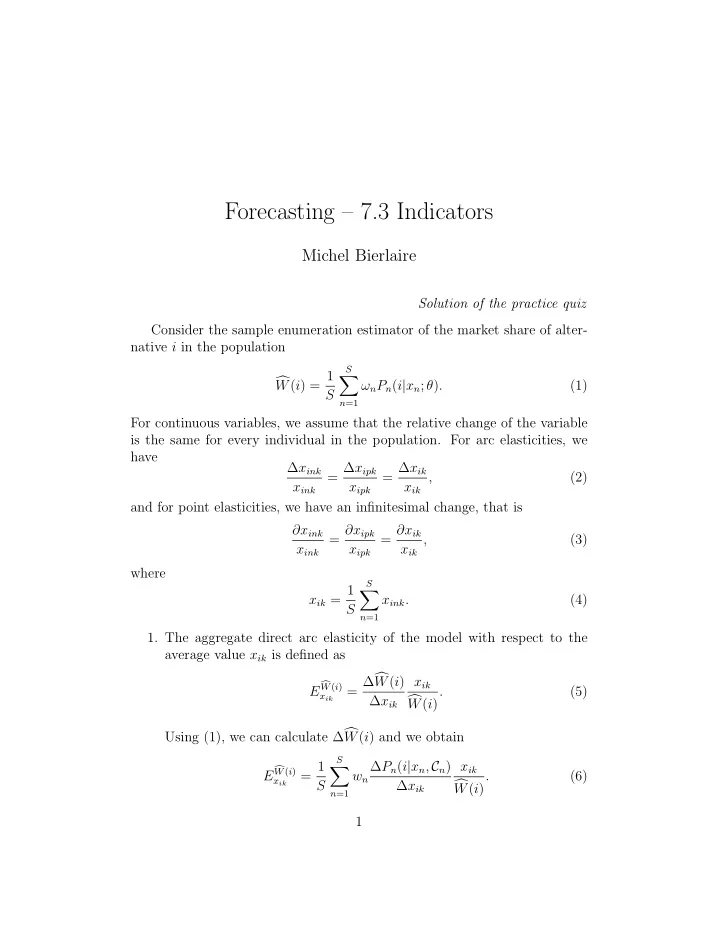
Forecasting 7.3 Indicators Michel Bierlaire Solution of the practice quiz Consider the sample enumeration estimator of the market share of alter- native i in the population S W ( i ) = 1 n P n ( i | x n ; ) . (1) S n =1


slide-1
SLIDE 1

Forecasting – 7.3 Indicators

Michel Bierlaire

Solution of the practice quiz Consider the sample enumeration estimator of the market share of alter- native i in the population

  • W(i) = 1

S

S

  • n=1

ωnPn(i|xn; θ). (1) For continuous variables, we assume that the relative change of the variable is the same for every individual in the population. For arc elasticities, we have ∆xink xink = ∆xipk xipk = ∆xik xik , (2) and for point elasticities, we have an infinitesimal change, that is ∂xink xink = ∂xipk xipk = ∂xik xik , (3) where xik = 1 S

S

  • n=1

xink. (4)

  • 1. The aggregate direct arc elasticity of the model with respect to the

average value xik is defined as E

  • W(i)

xik

= ∆ W(i) ∆xik xik

  • W(i)

. (5) Using (1), we can calculate ∆ W(i) and we obtain E

  • W(i)

xik

= 1 S

S

  • n=1

wn ∆Pn(i|xn, Cn) ∆xik xik

  • W(i)

. (6) 1

slide-2
SLIDE 2

We can now replace the term ∆xik

xik by ∆xink xink (see (2))

E

  • W(i)

xik

= 1 S

S

  • n=1

wn ∆Pn(i|xn, Cn) ∆xink xink

  • W(i)

. (7) By introducing Pn(i|xn,Cn)

Pn(i|xn,Cn), we obtain the definition of the disaggregate

direct arc elasticity: E

  • W(i)

xik

= 1 S

S

  • n=1

wn ∆Pn(i|xn, Cn) ∆xink xink Pn(i|xn, Cn) Pn(i|xn, Cn)

  • W(i)

(8) = 1 S

S

  • n=1

wnEPn(i)

xink

Pn(i|xn, Cn)

  • W(i)

. (9) Finally, applying (1) again we obtain E

  • W(i)

xik

=

S

  • n=1

EPn(i)

xink

wnPn(i|xn, Cn) S

n=1 wnPn(i|xn, Cn)

. (10) This equation shows that the calculation of aggregate elasticities in- volves a weighted sum of disaggregate elasticities. However, the weight is not wn as for the market share, but a normalized version of wnPn(i|xn, Cn).

  • 2. The derivation follows the same logic. The aggregate cross point elas-

ticity of the model with respect to the average value xjk is defined as E

  • W(i)

xjk

= ∂ W(i) ∂xjk xjk

  • W(i)

. (11) Using (1), we can calculate ∂ W(i) and we obtain E

  • W(i)

xjk

= 1 S

S

  • n=1

wn ∂Pn(i|xn, Cn) ∂xjk xjk

  • W(i)

. (12) We can now replace the term ∂xjk

xjk by ∂xjnk xjnk (see (3))

E

  • W(i)

xjk

= 1 S

S

  • n=1

wn ∂Pn(i|xn, Cn) ∂xjnk xjnk

  • W(i)

. (13) 2

slide-3
SLIDE 3

By introducing Pn(i|xn,Cn)

Pn(i|xn,Cn), we obtain the definition of the disaggregate

cross point elasticity: E

  • W(i)

xjk

= 1 S

S

  • n=1

wn ∂Pn(i|xn, Cn) ∂xjnk xjnk Pn(i|xn, Cn) Pn(i|xn, Cn)

  • W(i)

(14) = 1 S

S

  • n=1

wnEPn(i)

xjnk

Pn(i|xn, Cn)

  • W(i)

(15) Finally, applying (1) again we obtain E

  • W(i)

xjk

=

S

  • n=1

EPn(i)

xjnk

wnPn(i|xn, Cn) S

n=1 wnPn(i|xn, Cn)

. (16) 3