SLIDE 1
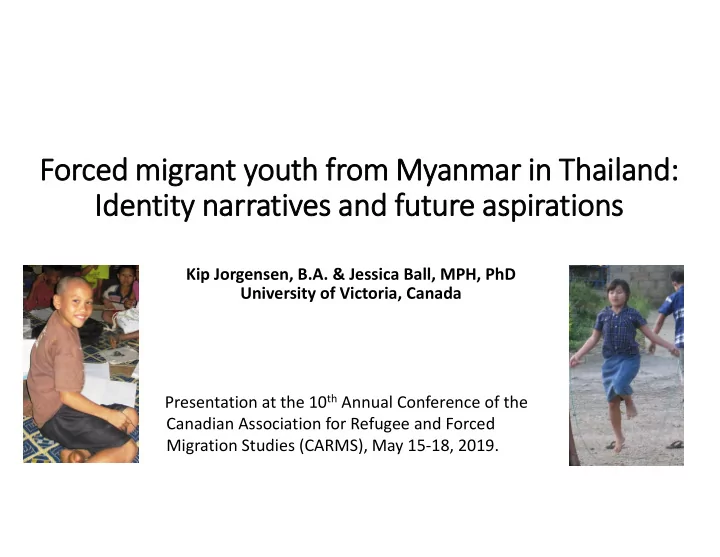
Forced migrant youth fr from Myanmar in Thailand: Id Identity narratives and fu future aspirations
Kip Jorgensen, B.A. & Jessica Ball, MPH, PhD University of Victoria, Canada Presentation at the 10th Annual Conference of the Canadian Association for Refugee and Forced Migration Studies (CARMS), May 15-18, 2019.
SLIDE 2 Ac Acknowledgements ts
- Lekwungen and WSANEC nations
- Recent UVic graduate and learner
- Social Science & Humanities Research Council of Canada
and University of Victoria for research funding
- CARFMS 2017 conference organizers
SLIDE 3 Overv rview
- Contribute to a growing body of child-centered migration studies,
countering dominant, adult-centred discourses in academe, migration and refugee policies, and social interventions
- Explore youth’s agency, resilience, motivation, and coping strategies
within the unique context of forced migration from Myanmar to Thailand, and the effectiveness and limits of child-centered frameworks.
SLIDE 4 Children on th the move
- Estimated 11 million child refugees and asylum seekers globally
- Roughly half of the total refugee population.
- In 2016, Myanmar is the origin country of half million forced migrant
children including a small minority with official refugee status.
- In Thailand there are 108,000 child refugees and 3,913,000 child
migrants from neighbouring countries.
- A large proportion of these are from Myanmar.
1. UNICEF 2016, p.6 2. UNICEF 2016, p. 127 3. UNICEF 2016, p. 129
SLIDE 5 Dominant dis iscourses about chil ildren on th the move
- Invisibility
- Victims/ Threats
- Trafficking
SLIDE 6 In Invisibility dis iscourse
“Children are treated as something transported by adults, as non- persons lacking both feelings and agency of their own.”
(Dobson 2009, 356).
SLIDE 7 Vic ictim/threat dis iscourse
“Children’s pre- and post-migration circumstances, as well as their complex cultural, socioeconomic, and educational needs, tends to be
- ignored. Victimhood is thus seen as universally constitutive of the child
migrant”
(Ensor and Gozdziak 2010, 21).
SLIDE 8 Trafficking dis iscourse
“Anti-trafficking discourses appear to be intrinsically reductive and misrepresentative”
(Howard 2014, 230).
SLIDE 9 Ch Child-centered mig igration research
- Agency
- Resilience
- Coping strategies
- Motivations
- Methods of movement
- Outcomes
SLIDE 10
Ch Child-centered forced migration research in in th the My Myanmar ar-Th Thailand context t
1) Centre forced migrant youth’s diverse narratives in relation to structural migration factors 2) Incorporate changing context and changing forced migrant youth’s perspectives, positions, and aspirations 3) Explore avenues for youth to participate in decision-making that affects them (in accordance with the UN Convention on the Rights of the Child) and in negotiations to resolve barriers to attaining their goals.
SLIDE 11 Typologies of f populations on th the move
Where are re th the ch children?
- Various typologies have been proposed to group and address needs of
populations on the move e.g., South & Joliffe: typology of displaced persons within and from Myanmar No specific attention to various child/youth locations, such as accompanied/unaccompanied; institutionalized within/outside of refugee campus; born in/outside of Myanmar; born in/outside of detention, etc. These circumstances and locations significantly affect child identities, wellness, development, needs, migration aspirations and outcomes
- What typology could encompass the array of situations of forced migrant
youth from Myanmar?
- How do youth move across these categories?
- What do youth understand about how to move across categories?
SLIDE 12 Mig igration causes and goals
Investigators and organizations have proposed various factors that cause migration, propel ongoing mobility, and shape individual future aspirations. e.g., in the Myanmar context: physical security; stable livelihoods; access to services; perceptions of peace process; influence of political actors.
- What are causal factors specific to children’s mobility and migration status?
- i.e., what leads a child to become an accompanied or unaccompanied
forced migrant from Myanmar, living in Thailand or Malaysia?
- (e.g., recruitment into a militia, kidnapping for drug running, lost during
armed conflict, separated when parent detained, etc.)
- What factors drive further movement, towards or further from Myanmar?
- What factors figure in youth decision-making about future movement,
towards repatriation, assimilation, resettlement, or remaining on the move and/or liminal (undocumented/unseen).
SLIDE 13
Mo Mobility within migration
“We see that, in the lives of children and young people, migration and mobility intersect so that migration is not an end state, but is rather one form of movement in lives characterized by different forms of mobility” (Dona & Veale 2014, 2).
SLIDE 14 Te Temporality
“Research on migration is a snapshot in time… it is difficult to capture the ways in which migrant patterns may change and adapt to different circumstances
- ver time” (Punch 2014, 25).
“Multitemporal research enables a more holistic understanding of the complexities of the migration process” (Dona and Veale 2014, 14).
- Temporality can be addressed through longitudinal, case study
research
SLIDE 15 Re Research questions
- How might a typology of forced migrant youth from Myanmar differ from those
- f displaced adults? In terms of locations, motivating factors, agency, and
identity?
- How much mobility is there across typological categories, or migration statuses,
during children’s migration trajectories?
- What implications do these shifts have for youth’s identities and future
aspirations?
- What are goal-driven actions (or coping strategies) of forced migrant youth in
pursuit of their goals on the move?
- What are the impacts of changing contexts in Myanmar and Thailand on forced
migrant youth?
SLIDE 16
Re Research design
Case studies: In-depth conversation and visual methods Unaccompanied and accompanied youth 12-18 years old Identity narratives, future aspirations, and goal-oriented actions Emphasis on youth perspectives Multi-sited: Myanmar (returnees), Thailand, Malaysia Longitudinal: Track changes in decision-making, actions, outcomes over time, mobility within migration, and migration outcomes over 2 years
SLIDE 17
Thank you! We welc lcome your feedback & questions!