for social change for women Social Science Libraries with Women, - - PowerPoint PPT Presentation

for social change for women social science libraries with
SMART_READER_LITE
LIVE PREVIEW

for social change for women Social Science Libraries with Women, - - PowerPoint PPT Presentation

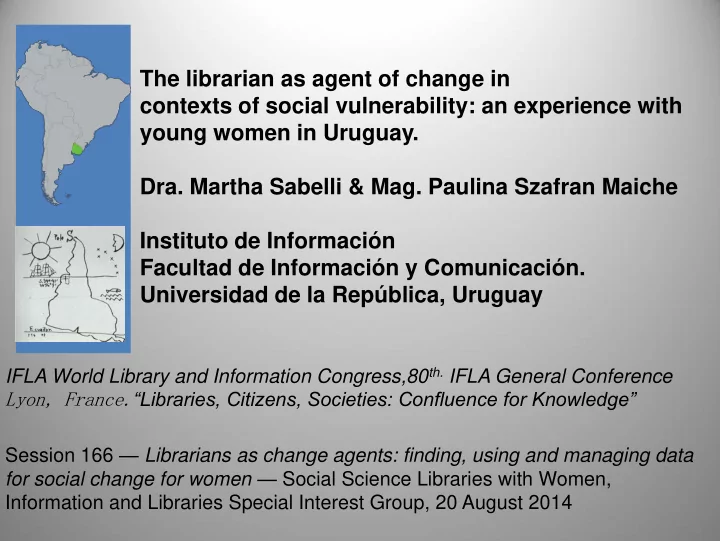
The librarian as agent of change in contexts of social vulnerability: an experience with young women in Uruguay. Dra. Martha Sabelli & Mag. Paulina Szafran Maiche Instituto de Informacin Facultad de Informacin y Comunicacin.

slide-1
SLIDE 1

The librarian as agent of change in contexts of social vulnerability: an experience with young women in Uruguay.

  • Dra. Martha Sabelli & Mag. Paulina Szafran Maiche

Instituto de Información Facultad de Información y Comunicación. Universidad de la República, Uruguay

Lyon, France.“Libraries, Citizens, Societies: Confluence for Knowledge” IFLA World Library and Information Congress,80th. IFLA General Conference Session 166 — Librarians as change agents: finding, using and managing data for social change for women — Social Science Libraries with Women, Information and Libraries Special Interest Group, 20 August 2014

slide-2
SLIDE 2

The project :“Towards the construction of information services for the community: a study of access to and use of information by women in unfavorable environments (Zone 9 of Montevideo)”

  • supported by the University of the Republic’s

CSIC (Sector Commission for Scientific Research) : 2008-2010

  • researc

rch h team: LIS teachers s and researche hers, s, sociologi gists ts

slide-3
SLIDE 3

The project is focuses:

  • on the obstacles, barriers and facilitators to

access, use and appropriation of information by citizens, especially young women in poor or destitute conditions;

  • on the informational and digital divide
slide-4
SLIDE 4

LOCAL SOCIAL SERVICES YOUNG WOMEN AND ADOLESCENTS IN SOCIAL VULNERABILITY

M E D I A T O R S

RESOURCES– PROCESS-FLOW OF INFORMATION

Copyrigjt rigjt Martha ha Sabelli elli

slide-5
SLIDE 5

The research strategy :

  • an interdisciplinary team that worked with social

actors from diverse organizations in the area (centers working closely with the community, e.g.: healthcare centers, youth clubs, education centers, libraries, telecenters, mostly belonging to the "Red Camino Nordeste") as well as with the women themselves.

slide-6
SLIDE 6

The research strategy was designed through qualitat ativ ive methods: methods: in in-depth th interview ews, s, focus groups, workshops ps.

  • 1. At the beginning of our research,

22 in depth interviews to qualified informants selected among social mediators.

  • 2. 101 in-depth interviews with young women and

adolescents users of services in the area.

slide-7
SLIDE 7
  • 4. Two focus groups:

a) young mothers in a Child and Family Care Centre – CAIF b) teenagers in one aula comunitaria (Community Classroom).

  • 3. Analysis of 167 documents and data produced

for the community (billboards, posters, leaflets, newsletters)

slide-8
SLIDE 8
  • 5. 6 interviews to people in charge of

libraries, cyber cafes and free telecentres.

  • 6. 8 in-depth interviews to mediators as information

users (user study).

  • 7. Focus group of mediators at the end of the research

project.

slide-9
SLIDE 9

Conclusions and proposals

  • The investigation presented is the first one

held in our country on the information needs of disadvantaged sectors, and specifically on young women and adolescents;

  • New social policies aimed at these sectors

have appeared in the last ten years.

slide-10
SLIDE 10
  • promotion of access to ICTs by children

and young people in public education;

  • this is not accompanied by policies and

actions aimed at library and information services for citizens;

  • research showed the difference between young and

adolescents – mothers and not mothers.

slide-11
SLIDE 11
  • women are not aware of the resources

and proposals aimed at them, with the exception of healthcare, being the polyclinics the services they are more acquainted with;

  • the main subjects of such activities are

related to maternity and / or domestic violence, with an emphasis on the traditional roles of women;

slide-12
SLIDE 12
  • recreation is limited;
  • women demand visual information, which must be

concrete and of easy access;.

  • the selection of sources is guided by

the attribute of reliability;

  • family context appears as a reference.
slide-13
SLIDE 13
  • information needs are essentially related to healthcare

issues, support related to school tasks and administrative procedures;

  • information is then perceived by the participants:
  • as a “bridge” between the private sphere

and the public one;

  • promoting insertion from outside family background;
slide-14
SLIDE 14
  • generating a favorable environment for labour insertion;
  • facilitating access to training and to the

development of productive skills;

  • information to be able to express themselves;
  • claim for their rights, know where to

go and where to study.

slide-15
SLIDE 15
  • adolescents who are not mothers:
  • information becomes necessary in the case of

those issues and situations which are not dialogued within the family, i.e. «things about the life of women».

  • are generally associated to domestic violence and

to «the men» and male chauvinism.

slide-16
SLIDE 16
  • To conclude we believe that this research
  • contributes to encourage public and social policies

focused on the needs of citizens living in poverty information and embedded in contexts

  • f vulnerability;
  • the creation and redefinition of public libraries

in their areas as their "spaces”;

slide-17
SLIDE 17
  • show the possibility and opportunity to design

and develop local information resources in the most disadvantaged areas;

  • the support for librarians as agents of

change committed to the social role of

  • ur profession, it is an unavoidable debt

in developing countries.

slide-18
SLIDE 18

Publications generated by the research:

  • Sabelli, M. 2012, Information behavior among young women

in vulnerable contexts and social inclusion: the role of social mediators, Information Researh 17(4) [Available at http://InformationR.net/ir/17-4/paper545.html]

  • Sabelli, M. & Rodríguez Lopater, V., comp. 2012, La información y las

jóvenes en contextos desfavorables: construyendo puentes para la inclusión social desde la investigación, Udelar. CSIC, Montevideo.

  • Sabelli, M., Rodríguez Lopater, V., Szafran Maiche, P. & Bercovich, I.

2012, ‘Las brechas informativas y digitales de las mujeres jóvenes y adolescentes en situación vulnerable’, Laboratorio barrial de experiencia, Programa Integral Metropolitano, CSEAM, Montevideo [Available at http://www.extension.edu.uy/sites/extension.edu.uy /files/laboratorio barrial_de_experiencias.pdf ] Thank you very much! martha.sabelli@fic.edu.uy paulina.szafran@fic.edu.uy