FOR IMMEDIATE RELEASE Bank of Montreal Reports Best Quarter Ever - - PDF document

for immediate release bank of montreal reports best
SMART_READER_LITE
LIVE PREVIEW

FOR IMMEDIATE RELEASE Bank of Montreal Reports Best Quarter Ever - - PDF document

FOR IMMEDIATE RELEASE Bank of Montreal Reports Best Quarter Ever LONDON, Ont., February 29, 2000 Bank of Montreal began its 183 rd fiscal year with its strongest quarterly performance ever. Among the highlights for the quarter ended January


slide-1
SLIDE 1

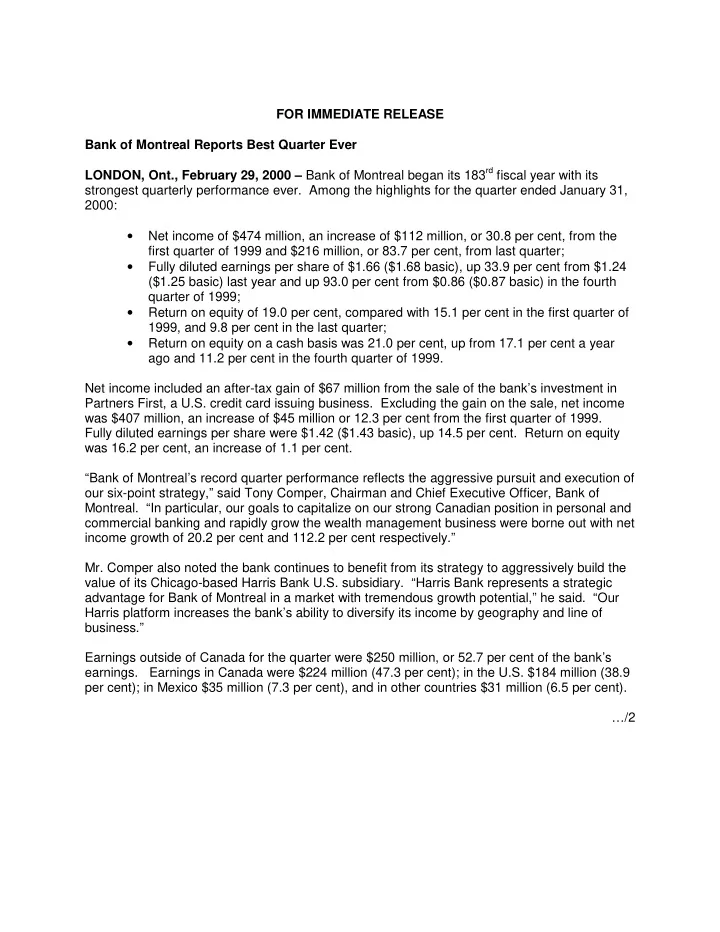
FOR IMMEDIATE RELEASE Bank of Montreal Reports Best Quarter Ever LONDON, Ont., February 29, 2000 – Bank of Montreal began its 183rd fiscal year with its strongest quarterly performance ever. Among the highlights for the quarter ended January 31, 2000:

  • Net income of $474 million, an increase of $112 million, or 30.8 per cent, from the

first quarter of 1999 and $216 million, or 83.7 per cent, from last quarter;

  • Fully diluted earnings per share of $1.66 ($1.68 basic), up 33.9 per cent from $1.24

($1.25 basic) last year and up 93.0 per cent from $0.86 ($0.87 basic) in the fourth quarter of 1999;

  • Return on equity of 19.0 per cent, compared with 15.1 per cent in the first quarter of

1999, and 9.8 per cent in the last quarter;

  • Return on equity on a cash basis was 21.0 per cent, up from 17.1 per cent a year

ago and 11.2 per cent in the fourth quarter of 1999. Net income included an after-tax gain of $67 million from the sale of the bank’s investment in Partners First, a U.S. credit card issuing business. Excluding the gain on the sale, net income was $407 million, an increase of $45 million or 12.3 per cent from the first quarter of 1999. Fully diluted earnings per share were $1.42 ($1.43 basic), up 14.5 per cent. Return on equity was 16.2 per cent, an increase of 1.1 per cent. “Bank of Montreal’s record quarter performance reflects the aggressive pursuit and execution of

  • ur six-point strategy,” said Tony Comper, Chairman and Chief Executive Officer, Bank of
  • Montreal. “In particular, our goals to capitalize on our strong Canadian position in personal and

commercial banking and rapidly grow the wealth management business were borne out with net income growth of 20.2 per cent and 112.2 per cent respectively.”

  • Mr. Comper also noted the bank continues to benefit from its strategy to aggressively build the

value of its Chicago-based Harris Bank U.S. subsidiary. “Harris Bank represents a strategic advantage for Bank of Montreal in a market with tremendous growth potential,” he said. “Our Harris platform increases the bank’s ability to diversify its income by geography and line of business.” Earnings outside of Canada for the quarter were $250 million, or 52.7 per cent of the bank’s

  • earnings. Earnings in Canada were $224 million (47.3 per cent); in the U.S. $184 million (38.9

per cent); in Mexico $35 million (7.3 per cent), and in other countries $31 million (6.5 per cent). …/2

slide-2
SLIDE 2
  • 2-

First Quarter 2000 Compared to First Quarter 1999 The net income increase of $45 million, excluding the after-tax gain of $67 million, was driven by higher revenues and a higher proportion of foreign income resulting in lower taxes, partially offset by an increase in expenses and a higher provision for credit losses. First Quarter 2000 Compared to Fourth Quarter 1999 The net income increase – again excluding the gain – was the result of strong business volume growth in the bank’s retail and commercial businesses, and in the wealth management businesses, particularly full-service and direct investing. The net income from institutional businesses was relatively unchanged as lower volumes and narrower spreads on fixed income and money market securities, and lower cash collections on impaired loans were offset by revenue growth from investment and corporate banking activities. Two one-time charges totaling $113 million after tax were recorded in the fourth quarter of 1999. In addition, the fourth quarter included an extra month of results for Nesbitt Burns as discussed below. Excluding these items and the first quarter 2000 gain on sale of Partners First, net income increased $44 million, or 11.6 per cent, over the fourth quarter of 1999. The increase of $44 million resulted from higher revenues and lower expenses, partially offset by a higher provision for loan losses. The net income improvement over the fourth quarter was largely the result of increases in the bank’s retail, commercial and wealth management businesses. Strategic Highlights In January, Bank of Montreal developed a six-point growth strategy:

  • 1. Continue to aggressively build the value of Harris
  • On a US GAAP basis, Harris Bank earnings were US$58 million,

up US$7 million, or 12.7 per cent from the same quarter a year earlier

  • 2. Rapidly grow the wealth management business
  • Introduced Nesbitt Burns full-service online, Canada’s first full-service
  • nline investment program;
  • Completed the acquisition of Chicago-based discount brokerage Burke,

Christensen & Lewis.

  • 3. Capitalize on the bank’s strong Canadian position in personal and commercial banking
  • The bank’s residential mortgages rose $2.4 billion, or 6.3 per cent,

from a year ago;

  • Credit cards and other personal loans rose $1.2 billion, or 7.4 per cent,

from a year ago;

  • Loans to commercial enterprises, including small and medium-sized

businesses rose $1.2 billion or 6.9 per cent from a year ago;

  • Increased In-Store branches by three to a total of 46 and consolidated two branches.

…/3

slide-3
SLIDE 3
  • 3-
  • 4. Build on the bank’s strong leadership position in investment banking
  • Ranked #1 or #2 in 1999 in corporate underwriting and institutional equity,

and #1 in mergers and acquisitions, research and securitization.

  • 5. Drive e-business opportunities
  • Became first bank in North America to deliver integrated wireless banking and trading

services, in partnership with Toronto-based software company 724 Solutions, which went public in January. Bank of Montreal holds 3.4 million shares of common stock, a 9.4 per cent interest in 724 Solutions, after an initial investment of $2 million.

  • 6. Intensely focus on cost, capital and risk management
  • The bank sold its investment in Partners First, a U.S. credit card issuing

business, to Wachovia Bank Card Services for an after-tax gain of $67 million. Financial Statement Highlights Revenues Revenues for the quarter were $2,123 million, an increase of $189 million, or 9.8 per cent, from $1,934 million a year ago. Excluding the sale of Partners First, revenue increased $77 million, or 4.0 per cent. Other income increased to $1,042 million, an increase of $197 million, or 23.3 per cent, from the first quarter of 1999. Excluding the sale of Partners First, other income increased $85 million, or 10.1 per

  • cent. The increase can be attributed to higher business volumes across most areas of the bank.

Net interest income at $1,081 million was $8 million lower than the first quarter of 1999. Average assets for the total bank were unchanged from the prior period, with 6.3 per cent growth in retail and commercial assets, offset by reductions in the assets of institutional businesses. Net interest margin decreased marginally by 0.01 per cent, to 1.87 per cent. The $8 million reduction in net interest income was the result of a $42 million, or 4.5 per cent, increase in retail, commercial and wealth management businesses which was more than offset by lower cash collections on impaired loans, and lower volumes and narrower spreads on fixed income and money market securities. Revenues increased $115 million or 5.8 per cent, from the fourth quarter of 1999. The fourth quarter

  • f 1999 included a $55 million one-time charge for distressed securities, and $89 million relating to an

additional month of revenues from Nesbitt Burns resulting from its change in year-end. Excluding these items and the first quarter 2000 gain on the sale of Partners First, revenues increased $37 million, or 1.9 per cent. …/4

slide-4
SLIDE 4
  • 4-

The $37 million increase in revenue resulted mainly from business volume growth in retail and commercial businesses and wealth management. Investment banking revenues were essentially unchanged while support revenue declined due to narrower spreads on securitizations and capital funds. Expenses Expenses decreased $247 million, or 16.5 per cent relative to the fourth quarter of 1999. Excluding non-recurring items – the one-time charge and the additional month of expenses from Nesbitt Burns in the last quarter – expenses decreased $34 million, or 2.7 per cent, across the bank. The expense decline of 2.7 per cent was driven by:

  • reduced revenue driven compensation (1.7 per cent);
  • a reduction in on-going business operations, including $50 million in cost reductions (2.1 per cent);
  • partially offset by investment in strategic initiatives (1.1 per cent).

Expense growth, year over year was 1.8 per cent. This was driven by:

  • higher revenue driven compensation (4.4 per cent);
  • continued spending on strategic initiatives (1.1 per cent);
  • largely offset by a favourable foreign exchange rate impact on U.S.-based expenses (1.1 per cent),

and a reduction in on-going business expenses, including $50 million in cost reductions (2.6 per cent). Asset Quality The provision for credit losses for the quarter was $100 million versus $80 million in 1999. This is based on a forecast for the year of $400 million, compared with $320 million in 1999. In line with the methodology established for a number of years, this estimate takes into account several factors including the level of expected loss in the loan portfolio, management’s view of the current economic cycle, the level of impaired loans, as well as the amount of the general allowance for credit losses which is currently $970 million. The amounts required for specific provisions and for the general allowance will be determined by the fourth quarter. Gross impaired loans at the end of the quarter were $1,164 million, up from $902 million a year ago. The allowance for credit losses exceeded the gross amount of impaired loans by $240 million at the end of the first quarter, compared with $319 million at the end of the first quarter of 1999. Capital Management The bank’s Tier 1 capital ratio was 7.84 per cent and the Total Capital ratio was 10.99 per cent at January 31, compared with 7.41 per cent and 10.53 per cent at January 31, 1999. This compares with 7.72 per cent and 10.77 per cent at October 31, 1999. Risk weighted assets on January 31, 2000 were $138 billion, virtually the same as a year ago, and up 1.0 per cent from October 31, 1999. …/5

slide-5
SLIDE 5
  • 5-

Harris Bank On a US dollar/US GAAP basis, Harris Bank earnings were $58 million, up $7 million or 12.7 per cent from the same quarter a year earlier. Excluding gains on sales of securities, earnings increased $11 million, or 23.7 per cent. Earnings growth occurred across Harris’ core businesses – community banking, private banking and mid-market corporate banking. Harris Bank earnings included in the bank’s results above on a Canadian dollar basis were $78 million for the first quarter of 2000, up 3.3 per cent from the same period last year. The net income growth on a Canadian dollar basis was negatively affected by movement in the Canadian $/US$ exchange rate from 1.53 to 1.45. Bank of Montreal, Canada’s first bank, is a highly diversified financial services institution. The bank

  • perates in 32 lines of business within its group of companies, including Nesbitt Burns, one of

Canada’s largest full-service investment firms and Chicago-based Harris Bank, a major U.S. mid-west financial services provider. Bank of Montreal has an equity position in, and a strategic alliance with, Grupo Financiero Bancomer, the largest retail bank in Mexico.

  • 30-

Media Relations Contacts: Investor Relations Contacts: Joe Barbera (416) 927-2740 Bob Wells, (416) 867-4009 Rick Kuwayti (416) 927-2740 Penny Somerville, (416) 867-5320 Lucie Gosselin (514) 877-1101 Susan Payne, (416) 867-6656 Lynn Inglis (416) 867-5452 Internet: http://www.bmo.com Notes: A live Internet broadcast of the first quarter conference call with analysts will take place on February 29, 2000 at 2:30 p.m. E.S.T. at www.bmo.com/investorrelations. The first quarter financial statements, supplemental financial information and a slide presentation to investors are also available on the site. The first quarter conference is available live by calling 1-888-673-1254. A post-play of the conference call can be accessed by calling (416) 626-4100 and entering passcode 14489858. …/6

slide-6
SLIDE 6
  • 6-

Operating Group Review Personal and Commercial Client Group The Personal and Commercial Client Group (P&C) provides financial services including electronic financial services, to households and commercial businesses, in Canada, the U.S. and Mexico. Net income for the first quarter of 2000 was $357 million, an increase of $103 million, or 40.7 per cent, from the comparable period last year. Excluding the gain on the sale of Partners First, net income increased $36 million, or 14.2 per cent. Business growth was driven by increased volumes, partially offset by narrower spreads and an increase in the provision for credit losses. Revenues increased $160 million, or 12.7 per cent, over last year. Excluding the gain on the sale of Partners First, revenues were up $48 million, or 3.8 per cent. Net interest income and

  • ther income growth were driven by volume growth across most lines of business. In Canada,

the bank’s residential mortgages rose $2.4 billion, or 6.3 per cent, from a year ago. Credit card and other personal loans were up $1.2 billion, or 7.4 per cent, and loans to commercial enterprises, including small and medium-sized businesses, were up $1.2 billion, or 6.9 per cent. At Harris Bank, average loan growth was US$ 956 million, or 7.1 per cent, which increased U.S. retail and mid-market banking earnings by 12 per cent. Expenses in the P&C Group decreased $6 million or 0.8 per cent from last year. In Canada, the P&C Group implemented strategies aimed at creating a distinctive high quality experience for clients, regardless of how, when and where they choose to contact the bank. The bank launched bmolending.com, a web site that provides Canadian businesses with the ability to apply for a wide range of lending products on behalf of their customers. Another initiative, the Mortgage Cash Account, offers existing mortgage customers, the flexibility to re- borrow prepaid funds at any given time. Services were enhanced to satisfy customer demands, including the Bank of Montreal MasterCard Wallet, which makes on-line shopping fast, safe and easy, and permits Bank of Montreal merchants to have MasterCard transactions processed in the US and credited to them, in US dollars. Bank of Montreal also opened three in-store branches in the current quarter. …/7

slide-7
SLIDE 7
  • 7-

Chicagoland retail banking provides retail and small business customers with a broad array of products across multiple channels, including an enhanced online banking offering. Survey information highlighted Harris Bank as the only large bank in the Chicago area gaining retail deposit market share, with high retail-customer loyalty and satisfaction. The Hispanic Banking initiative expanded, with two new branches opened during the quarter, and continued focus on money transfer services. Harris mid-market corporate banking and Nesbitt Burns developed an integrated corporate/investment growth strategy for high-potential clients and growth markets. Loan portfolio quality remained very strong. During February, Harris Bank announced the sale

  • f its Corporate Trust business, supporting the bank’s strategy to redirect capital and other

resources to grow and expand its core business. Compared with the fourth quarter of 1999, net income was $104 million, or 40.5 per cent higher. Excluding the gain on the sale of Partners First, net income increased $37 million, or 14.1 per

  • cent. The increase resulted from business growth in Canada and an increase in the

contribution from the bank’s investment in Bancomer, partly offset by an increase in the provision for credit losses. Business growth was driven by increased volumes across most lines of business, increased margins in Canada and a reduction in operating expenses. Private Client Group Bank of Montreal’s Private Client Group brings together all of the bank’s wealth management capabilities in six lines of business: retail investment products, direct and full service investing, Canadian and U.S. private banking and institutional asset management. Net income for the first quarter of 2000 was $33 million, an increase of $18 million or 112.2 per cent from the comparable period last year. Revenues increased $70 million or 28.7 per cent

  • ver last year primarily due to increased volumes in both full service and direct investing, which

benefited from strong equity markets. Expenses increased $44 million or 20.8 per cent due to higher variable compensation driven by the quarter’s increased revenue and expansion of the bank’s wealth management business. …/8

slide-8
SLIDE 8
  • 8-

During the quarter, the Private Client Group implemented key wealth management

  • strategies. A key strategy – placing specialized sales forces in bank

branches to provide quality advice and proactive sales – began to unfold with 62 Resident Investment Advisors and 94 Investment Funds Specialists now located in-branch. Nesbitt Burns full-service investing announced the launch of Research Online (February 7) and Full Service Online (Summer 2000) to provide clients with Web-based services to enhance their advisory relationship. InvestorLine expanded its offering to include wireless access and was ranked second for RRSP service by a Globe and Mail survey. First Canadian Funds launched three new RSP World Funds and CustomSelect, which enables clients to access select third party funds. Maclean's magazine rated seven Matchmaker portfolios "best of class.” During February, expansion of the U.S. private bank continued with the acquisition of Village Banc of Naples, Florida, for $19.3 million. This expands Harris Bank’s

  • perations in the key sunbelt states. During the quarter, the Private Client Group closed its

acquisition of Chicago-based direct brokerage firm Burke, Christensen & Lewis Securities. The combination of the firm with Harris Investors Direct will allow for the expanded reach of direct investing in the U.S. Compared to the fourth quarter of 1999, net income increased $17 million, or 110.2 per cent. During 1999, Nesbitt Burns changed its year-end, resulting in one additional month of results being included in the fourth quarter of 1999. The inclusion of the additional month of results accounted for an additional $56 million in revenue and $53 million in expenses, with a positive net income impact of $2 million. Revenue growth of $55 million, excluding the extra month in the previous quarter, was driven by increased volumes in both full service and direct investing, while expenses increased $28 million due to revenue driven compensation and continued investment in the wealth management line of business. Bank of Montreal's Private Client Group has total assets under management and administration

  • f $171 billion. The Private Client Group is focused on wealth management, which represents

the fastest growing area in the financial services category. It is a cornerstone to providing integrated banking and financial services to meet rapidly changing clients needs. Investment Banking Group The Investment Banking Group services the corporate and investment banking needs of larger corporate and institutional clients. Net income was $106 million for the quarter, unchanged from the prior year. Revenues of $439 million were down $2 million, or 0.5 per cent. Expenses were up $10 million, or 4.3 per cent,

  • ver last year. Lower provisions for credit losses offset these changes.

…/9

  • 9-

Overall, the decline in revenues was primarily due to a $23 million reduction in cash collections

  • n impaired loans as well as lower volumes and narrower spreads on fixed income and money

market securities. These were offset by revenue growth from investment and corporate banking activities. Expense growth was driven by increased revenue driven compensation in trading and investment lines of business.

slide-9
SLIDE 9

During the quarter, the Investment Banking Group developed a major strategic initiative within Investment and Corporate Banking that will capitalize on market opportunities in the U.S. mid- market by combining the operations of the Harris corporate banking businesses with the Chicago investment and corporate banking group of Nesbitt Burns. The new organization will

  • perate under the new name, Harris Nesbitt. In addition, the Canadian Securitization group

structured and co-led the fourth largest Canadian securitization ever completed (Genesis Trust), while the Institutional Equity Group ranked second in Block trading volume and value during the quarter. Net income decreased $31 million, or 22.6 per cent, from the fourth quarter of 1999. Revenues were down $32 million, while expenses were down $14 million. In 1999, Nesbitt Burns changed its year-end, resulting in the inclusion of an additional month of results in the fourth quarter. This inclusion resulted in an additional $37 million of revenues, $20 million of expenses and a positive net income impact of $9 million. Excluding the impact of the extra month’s results, net income for the current quarter was down $22 million, as the revenue increase of $5 million was more than offset by a rise in expenses of $6 million, and an increase in the provision for credit

  • losses. The provision of credit losses returned to normal levels, after a recovery of $32 million

in the fourth quarter of 1999.

  • 30-

Media Relations Contacts: Investor Relations Contacts: Joe Barbera (416) 927-2740 Bob Wells, (416) 867-4009 Rick Kuwayti (416) 927-2740 Penny Somerville, (416) 867-5320 Lucie Gosselin (514) 877-1101 Susan Payne, (416) 867-6656 Lynn Inglis (416) 867-5452 Internet: http://www.bmo.com