Bank of Montreal Reports Continued Strong Performance with Third - - PDF document

bank of montreal reports continued strong performance
SMART_READER_LITE
LIVE PREVIEW

Bank of Montreal Reports Continued Strong Performance with Third - - PDF document

FOR IMMEDIATE RELEASE Bank of Montreal Reports Continued Strong Performance with Third Quarter Results TORONTO , August 22, 2000 Bank of Montreal reported financial results today for the third quarter ended July 31, 2000. The highlights


slide-1
SLIDE 1

FOR IMMEDIATE RELEASE

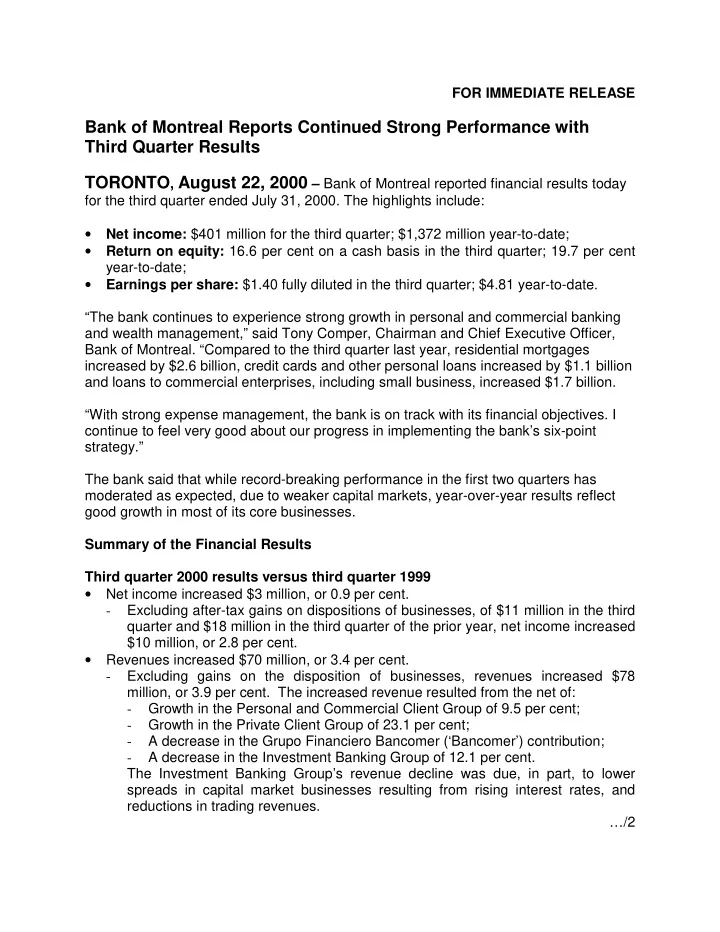
Bank of Montreal Reports Continued Strong Performance with Third Quarter Results TORONTO, August 22, 2000 – Bank of Montreal reported financial results today

for the third quarter ended July 31, 2000. The highlights include:

  • Net income: $401 million for the third quarter; $1,372 million year-to-date;
  • Return on equity: 16.6 per cent on a cash basis in the third quarter; 19.7 per cent

year-to-date;

  • Earnings per share: $1.40 fully diluted in the third quarter; $4.81 year-to-date.

“The bank continues to experience strong growth in personal and commercial banking and wealth management,” said Tony Comper, Chairman and Chief Executive Officer, Bank of Montreal. “Compared to the third quarter last year, residential mortgages increased by $2.6 billion, credit cards and other personal loans increased by $1.1 billion and loans to commercial enterprises, including small business, increased $1.7 billion. “With strong expense management, the bank is on track with its financial objectives. I continue to feel very good about our progress in implementing the bank’s six-point strategy.” The bank said that while record-breaking performance in the first two quarters has moderated as expected, due to weaker capital markets, year-over-year results reflect good growth in most of its core businesses. Summary of the Financial Results Third quarter 2000 results versus third quarter 1999

  • Net income increased $3 million, or 0.9 per cent.
  • Excluding after-tax gains on dispositions of businesses, of $11 million in the third

quarter and $18 million in the third quarter of the prior year, net income increased $10 million, or 2.8 per cent.

  • Revenues increased $70 million, or 3.4 per cent.
  • Excluding gains on the disposition of businesses, revenues increased $78

million, or 3.9 per cent. The increased revenue resulted from the net of:

  • Growth in the Personal and Commercial Client Group of 9.5 per cent;
  • Growth in the Private Client Group of 23.1 per cent;
  • A decrease in the Grupo Financiero Bancomer (‘Bancomer’) contribution;
  • A decrease in the Investment Banking Group of 12.1 per cent.

The Investment Banking Group’s revenue decline was due, in part, to lower spreads in capital market businesses resulting from rising interest rates, and reductions in trading revenues. …/2

slide-2
SLIDE 2
  • 2-
  • Expenses increased $42 million, or 3.1 per cent. Excluding revenue-driven

compensation, expenses decreased by 1.6 per cent.

  • The provision for credit losses of $100 million increased by $20 million.

Third quarter 2000 results versus second quarter 2000

  • Net income declined by $96 million, or 19.2 per cent.
  • Excluding after-tax gains on dispositions of businesses, of $11 million in the third

quarter and $52 million in the second quarter of 2000, net income decreased $55 million, or 12.2 per cent.

  • Revenues decreased $189 million, or 8.2 per cent.
  • Excluding after-tax gains on dispositions of businesses, revenues decreased

$120 million, or 5.4 per cent. The decline in revenues resulted from the net of:

  • A decrease in the Private Client Group of 13.6 per cent;
  • A decrease in the Investment Banking Group of 15.4 per cent;
  • A decrease in the Bancomer contribution;
  • Growth in the Personal and Commercial Client Group of 3.6 per cent.
  • Expenses decreased $22 million, or 1.7 per cent.
  • The provision for credit losses remained unchanged.

Asset quality

  • Asset quality remained sound.
  • Gross impaired loans at the end of the quarter were $1,334 million, up from $1,110

million a year ago and up $145 million from the immediately preceding quarter.

  • The allowance for credit losses exceeded gross impaired loans by $195 million at

the end of the third quarter, compared with a $203 million excess one year earlier and an excess of $283 million in the second quarter. Operating Group Highlights Personal and Commercial Client Group On a year-over-year basis, excluding the contribution from the bank’s investment in Bancomer, net income for the quarter increased $39 million, or 22.2 per cent. Excluding gains on dispositions, net income increased by $46 million, or 29.1 per cent. Revenues, excluding dispositions, increased $101 million, or 9.5 per cent. The increase was driven by volume growth across most lines of business. Expenses increased by $20 million, or 2.8 per cent, due to business growth and strategic initiative spending. The increase was

  • ffset partially by ongoing cost reductions. The provision for credit losses increased by

$7 million. …/3

slide-3
SLIDE 3
  • 3-

Third quarter net income declined $44 million, or 16.7 per cent, from the second quarter. Excluding gains on dispositions, net income decreased $3 million, or 1.1 per cent. Revenues increased $40 million, or 3.6 per cent, excluding gains, as a result of volume

  • growth. Expenses increased by $44 million, or 6.0 per cent, due to extra days in the

current quarter and increased compensation costs. Bancomer On a year-over-year basis, net income for the third quarter from the bank’s investment in Bancomer decreased $16 million. Net income declined $18 million from the second quarter. Private Client Group On a year-over-year basis, net income for the quarter increased $9 million, or 27.0 per

  • cent. Revenues increased by $71 million, or 23.1 per cent, primarily driven by increased

commission revenues earned on higher volumes of client equity trading and by increased sales of retail investment products. The increase was offset partially by lower revenue from institutional asset management. Expenses increased by $51 million, or 20.8 per cent, largely due to increased revenue-driven compensation. Net income declined by $16 million, or 25.6 per cent, from the second quarter. Revenues declined by $61 million, or 13.6 per cent, due to lower volumes of client equity trading. Expenses decreased by $31 million, or 9.6 per cent, largely due to lower revenue-driven compensation. Investment Banking Group On a year-over-year basis, net income for the quarter decreased $31 million, or 18.0 per

  • cent. Revenues decreased $76 million, or 12.1 per cent, partially due to lower spreads

in capital markets businesses resulting from rising interest rates. The decrease in revenues was also due to reductions in trading revenues, primarily in the commodities area, partially offset by higher securitization revenues and securities gains. Expenses decreased by $14 million, or 4.5 per cent, primarily because of higher 1999 expenses associated with Y2K projects. Net income declined by $30 million, or 17.1 per cent, from the second quarter. Revenues declined by $100 million, or 15.4 per cent, due to lower spreads and trading

  • revenues. Expenses declined by $39 million, or 11.9 per cent, due to lower revenue-

driven compensation. Corporate Support Net income for the quarter in Corporate Support areas increased $2 million from the previous year and $12 million from the second quarter. …/4

slide-4
SLIDE 4
  • 4-

Financial Highlights

Q3 2000 B/(W) * Q3 1999 Q3 2000 B/(W) * Q2 2000 Q3 2000 YTD B/(W) * 1999 Q3 2000 $ % $ % Q3 2000 YTD $ % Reported Net income ($ millions) $401 3 0.9 (96) (19.2) $1,372 248 22.1 Fully diluted EPS $1.40 0.03 2.2 (0.35) (20.0) $4.81 0.95 24.6 Basic EPS $1.41 0.03 2.2 (0.35) (19.9) $4.85 0.96 24.7 Return on equity (%) 15.0% (1.2) (4.8) 17.9% 2.3 Return on equity – cash basis (%) 16.6% (1.5) (5.2) 19.7% 2.2 Reported results – excluding gains ** Net income ($ millions) $390 10 2.8 (55) (12.2) $1,242 136 12.3 Fully diluted EPS $1.36 0.06 4.6 (0.20) (12.8) $4.34 0.55 14.5 Basic EPS $1.37 0.06 4.6 (0.20) (12.7) $4.37 0.55 14.4 Return on equity (%) 14.5% (0.9) (3.1) 16.1% 0.8 Return on equity – cash basis (%) 16.2% (1.9) (3.3) 17.8% 0.6 * Better/(Worse) ** After-tax gains included $11 million from the sale of branches in the third quarter of 2000. The second quarter of the current year included after-tax gains of $44 million from the sale of the bank’s U.S. corporate trust businesses and $8 million from the sale of branches. The third quarter of the prior year included $18 million of after-tax gains from the sale of the bank’s global custody business. Current year- to-date after-tax gains totalled $130 million and included $67 million from the sale of Partners First in the first quarter. The prior year-to-date after-tax gains totalled $18 million.

Third Quarter 2000 Compared with Third Quarter 1999 Revenues increased by $70 million, or 3.4 per cent, year-over-year. Revenue gains on the sale of branches were $19 million in the third quarter. Revenue gains on the sale of the bank’s global custody business were $27 million in the third quarter of 1999. Revenues increased by $78 million, or 3.9 per cent, excluding gains. The increases were driven by strong loan and fee growth in retail and commercial banking, and by growth in trading commission revenue, retail investment products and loans in wealth

  • management. Results also benefited from higher investment securities gains. Improved

results were partly offset by lower trading revenues, as explained above, and by lower net interest income due to lower spreads in capital markets businesses. Revenues were also reduced by a $16 million decline in the contribution from Bancomer. Expenses increased by $42 million, or 3.1 per cent, as a result of higher revenue-driven

  • compensation. The provision for credit losses increased $20 million year-over-year.

…/5

slide-5
SLIDE 5
  • 5-

Third Quarter 2000 Compared with Second Quarter 2000 Third quarter revenues decreased by $189 million, or 8.2 per cent, from the second

  • quarter. Revenue from gains on the sale of branches was $19 million in the third
  • quarter. Revenue from gains on the sales of the bank’s corporate trust business and

branches was $88 million in the second quarter. Revenues, excluding gains, decreased $120 million, or 5.4 per cent. The decrease was driven by lower securities commissions, due to a return to a more normal level of equity market activities, and by a decline in trading revenues in the third quarter, as explained above. Particularly strong trading results in the prior quarter also affected comparatives, together with the decline in the contribution from Bancomer. Expenses were reduced by $22 million, or 1.7 per cent, from the previous quarter as a result of reduced revenue-driven compensation. 2000 Year-to-date Compared with 1999 Year-to-date Year-to-date net income was $1,372 million, an increase of $248 million over the prior

  • year. Excluding the gains on sales in the current and 1999 year-to-date results, net

income increased $136 million, or 12.3 per cent, driven by revenue growth of $390 million, or 6.6 per cent. Expenses increased by $141 million, or 3.7 per cent. The provision for credit losses increased by $60 million, or 25.0 per cent. Improved results were driven by widespread volume growth. Strategic Highlights Bank of Montreal continued to make progress in implementing its six-point growth strategy:

  • 1. Continue to aggressively build the value of Harris
  • On a U.S. dollar/U.S. GAAP basis, Harris Bank earnings were $60 million, an

increase of $4 million, or 6.9 per cent, from the same quarter a year earlier. Excluding securities gains, earnings increased 11.1 per cent from the prior year.

  • Harris Bank earnings included in the bank’s consolidated results, on a Canadian

dollar/Canadian GAAP basis, were $88 million, an increase of 9.5 per cent from the same period last year.

  • The earnings increase was driven by continued double digit earnings growth in

community banking, private client banking and mid-market businesses, sustained cost control and top-tier asset quality.

  • Small business, consumer and mortgage loans in Harris Bank Community

Banking increased 8.9 per cent over last year, with particularly strong consumer loan growth of 12.6 per cent. …/6

slide-6
SLIDE 6
  • 6-
  • 2. Rapidly grow the wealth management business
  • Private Client Group net income increased by 27.0 per cent and revenues by

23.1 per cent, from the comparable quarter in the prior year.

  • Assets under Management and Administration and term deposits have increased

approximately $26 billion, or 13.0 per cent, over the prior year.

  • Private Client Group’s specialized investment salesforce, trained to provide

quality advice and proactive sales, was established this year and has now grown to 321 specialists.

  • The bank enhanced its direct brokerage capabilities in North America with the

purchase of Seattle-based direct brokerage firm Freeman Welwood. The acquisition allows the bank to extend its service to key locations in the Northwest and West Coast.

  • BMO InvestorLine, the bank’s direct investing line of business, introduced fixed

income trading through Fixed Income Online.

  • The bank launched BMO Harris Private Banking, its new Private Banking
  • peration, to provide seamless North American delivery of customized wealth

management solutions.

  • 3. Capitalize on the bank’s strong Canadian position in personal and commercial

banking

  • Residential mortgages increased by $2.6 billion, or 6.9 per cent, after adjusting

for securitizations; credit cards and other personal loans increased by $1.1 billion, or 6.4 per cent; and loans to commercial enterprises, including small business, increased $1.7 billion, or 8.4 per cent, from the third quarter of the prior year.

  • The bank continued transforming its distribution channels by arranging for the

purchase of 12 Ontario TD/Canada Trust branches from TD Financial Group and by opening seven in-store branches in large supermarkets.

  • The bank enhanced its Air Miles program by introducing the only Line of Credit to
  • ffer bonus reward miles on new accounts and monthly rewards based on the

average monthly balance.

  • 4. Build on the bank’s strong leadership position in investment banking
  • On a year-to-date basis, Investment Banking Group ranked first among Canadian

brokers in institutional equity, research and securitizations, and second in corporate underwriting.

  • BMO Nesbitt Burns co-led the initial debt offering of Hydro One Inc. This $1

billion deal was the third largest ever in Canada. …/7

slide-7
SLIDE 7
  • 7-
  • 5. Drive e-business opportunities
  • The bank enhanced its leadership position through Veev wireless financial

services with the addition of news reports from Canadian Press, full-service capability in French, an Air Miles collector card balance feature and a first-time user Air Miles bonus.

  • E-post, the bank’s joint venture with Canada Post Corporation, delivered the first

Canadian municipal government e-bill, for the City of Toronto.

  • During the third quarter, plans were announced to launch a new merchant

processing company with Royal Bank of Canada. The new company will provide merchants, retailers and e-tailers across North America with one-stop card-based transaction processing, including credit cards, debit cards and stored-value

  • payments. The new company will be owned equally by Bank of Montreal and

Royal Bank. The transaction is subject to approval from Canadian and U.S. regulators.

  • Harris Wireless was launched in Chicago, making Harris the first bank in the U.S.

to provide banking services to its customers via digital mobile phones.

  • The bank has increased its investment and ownership in Symcor Services Inc.

from 28.0 per cent to 33.3 per cent. Symcor Services Inc. delivers technology- driven solutions to meet the items processing and information delivery needs of major financial institutions in North America and is the largest company of its kind in Canada.

  • 6. Intensely focus on cost, capital and risk management
  • The bank completed the sale of another 31 branches to a group of credit unions,

for an after-tax gain of $11 million, and has now completed 48 branch sales for year-to-date gains of $19 million. During the third quarter, the bank announced the sale of three additional branches to local credit unions in Alberta. Recently another 13 branches were sold to credit unions in British Columbia. Most of these transactions are expected to close by the end of the year.

  • On May 24, 2000, the bank announced a program to purchase up to 10 million

common shares, or approximately 3.7 per cent, of the then-issued and

  • utstanding common shares of the bank, through a normal-course issuer bid

expiring October 31, 2000. To July 31, 2000, the bank had purchased approximately 6.1 million shares at a cost of $385 million.

  • The Tier 1 Capital ratio improved from 7.87 per cent last year to 8.44 per cent at

July 31, 2000.

  • Cost reduction initiatives totalled $67 million for the quarter, $182 million year-to-

date, and were on track to achieve the year’s $250 million objective. Year-to-date expenses, excluding revenue-driven compensation, declined by $89 million, or 1.7 per cent. …/8

slide-8
SLIDE 8
  • 8-

Financial Statement Review Revenues Total revenues for the quarter were $2,095 million, an increase of $70 million, or 3.4 per cent, from a year ago. Excluding $19 million of revenues on the sale of branches in the current period and $27 million of revenues on the sale of the bank’s global custody business in the third quarter of the prior year, revenues increased $78 million, or 3.9 per cent. Net interest income for the quarter was $1,090 million, a decrease of $2 million from the prior year. Net interest income included volume increases across most lines of business, offset by lower spreads in capital markets businesses, a decline in the contribution from Bancomer and reduced cash collections on impaired loans. Other income was $1,005 million for the quarter, an increase of $72 million from the prior year. Excluding gains on disposal of businesses, other income increased $80 million, or 8.8 per cent. The increase, a result of greater volumes across most lines of business and higher investment securities gains, was offset partially by lower trading revenues and lower custodial fees due to the sale of our trust business. Revenues for the quarter decreased $189 million, or 8.2 per cent, from the second quarter of 2000. The second quarter included $88 million of revenues related to the gains on sales of branches and the corporate trust business. The third quarter included $19 million of gains on the sale of branches. Excluding these gains, revenues decreased $120 million, or 5.4 per cent. Net interest income increased $6 million, or 0.6 per cent, as a result of volume growth, and was offset partially by a lower net interest margin in capital markets and the reduced contribution from Bancomer. Other income decreased $195 million, or 16.2 per cent. Excluding gains of $88 million in the second quarter and $19 million in the third quarter, other income declined by $126 million, or 11.2 per cent, driven primarily by lower capital market activities and reduced trading revenues. Expenses Expenses for the quarter increased $42 million, or 3.1 per cent, from the third quarter of the prior year. Excluding an increase in revenue-driven compensation of $60 million, expenses declined by $18 million, or 1.6 per cent. This decline reflected a reduction in

  • ngoing business-operations expenses, including $67 million of cost reduction

initiatives, partially offset by $50 million of spending on strategic initiatives. …/9

slide-9
SLIDE 9
  • 9-

Expenses for the quarter decreased $22 million, or 1.7 per cent, from the second quarter of 2000. Excluding decreased revenue-driven compensation of $46 million, expenses increased $24 million, or 1.7 per cent. In part, the increase was due to higher spending on strategic initiatives. Asset Quality The provision for credit losses was $100 million for the quarter, versus $80 million in

  • 1999. The quarterly provision is based on an annual forecast of $400 million, compared

with $320 million in 1999. The annual forecast is based on a methodology used for a number of years and considers the level of expected loss in the loan portfolio, management’s view of the economic cycle, the level of impaired loans, and the balance

  • f the general allowance for credit losses, which is currently $970 million. The split of

the specific and general provision will be determined in the fourth quarter. Gross impaired loans at the end of the quarter were $1,334 million, up from $1,110 million a year ago and from $1,189 million at April 30, 2000. The allowance for credit losses continues to exceed the gross amount of impaired loans and was $195 million higher at the end of the third quarter, compared with a $203 million excess a year earlier and a $283 million excess at April 30, 2000. Capital Management At July 31, 2000, the bank’s Tier 1 and Total Capital ratios were 8.44 per cent and 12.33 per cent respectively, up from 7.87 per cent and 10.84 per cent at July 31, 1999, and up from 8.06 per cent and 11.13 per cent at April 30, 2000. Risk-weighted assets were $132.8 billion, a decrease of 2.8 per cent from a year ago and a decrease of 5.5 per cent from April 30, 2000. Operating Group Review Personal and Commercial Client Group The Personal and Commercial Client Group provides financial services, including electronic financial services, to households and commercial businesses in Canada and the U.S. Net income for the quarter, excluding the contribution from the bank’s investment in Bancomer, was $217 million, an increase of $39 million, or 22.2 per cent, from the comparable period last year. Excluding the $11 million after-tax gains on sales of branches in the third quarter and the $18 million of after-tax gains on sale of the global custody business in the corresponding quarter of the prior year, net income increased $46 million, or 29.1 per cent. …/10

slide-10
SLIDE 10
  • 10-

Revenues for the quarter increased $93 million, or 8.5 per cent, over last year. Excluding branch sales and the sale of the global custody business, revenues increased $101 million, or 9.5 per cent, driven by volume growth across most business lines. Expenses for the quarter increased by $20 million, or 2.8 per cent, from last year, mainly due to strategic initiatives spending, partly offset by ongoing cost reductions. Net income declined $44 million, or 16.7 per cent, from the second quarter. Excluding gains on disposition, net income decreased $3 million, or 1.1 per cent. Revenues, excluding gains on dispositions of businesses, increased $40 million, or 3.6 per cent, as a result of volume growth. Expenses increased by $44 million, or 6.0 per cent, due to increased compensation costs and to the fact that there were more days in the current quarter. Bancomer Net income for the third quarter from the bank’s investment in Bancomer was $3 million, a decrease of $16 million from the comparable period last year. Net income declined $18 million from the second quarter. As of June 30, 2000, the shareholders approved Bancomer’s merger with Grupo Financiero Probursa. With this event, as previously announced, the bank adopted the cost basis of accounting, replacing the equity basis of accounting for the investment. Private Client Group The Private Client Group encompasses all of the bank’s wealth management capabilities in six lines of business: retail investment products (including term deposits), direct and full-service investing, BMO Harris private banking, U.S. private banking and institutional asset management. Net income for the quarter was $45 million, an increase of $9 million, or 27.0 per cent, from the comparable period last year. Revenues for the quarter increased $71 million,

  • r 23.1 per cent, over 1999, primarily due to increased volumes in full-service and

direct-investing client equity trading. Increased deposit volumes also contributed to higher revenues, partially offset by reduced trading returns in the managed futures

  • program. Expenses increased $51 million, or 20.8 per cent, due to higher revenue-

driven compensation, expenses associated with higher business volumes and initiative spending. …/11

slide-11
SLIDE 11
  • 11-

Net income for the quarter decreased $16 million, or 25.6 per cent, from the second quarter of 2000. Revenues decreased $61 million, or 13.6 per cent, due to a reduction in the high volume of equity trading that was experienced in prior quarters and, due to weaker institutional asset management revenues. This was offset partially by higher mutual fund management fees. Expenses decreased $31 million, or 9.6 per cent, primarily due to lower revenue-driven compensation. Investment Banking Group The Investment Banking Group provides a full range of financial products and services to institutional investors and corporate, government and institutional client segments. Net income for the quarter was $145 million, a decrease of $31 million, or 18.0 per cent, from the comparable period in 1999. Revenues decreased by $76 million, or 12.1 per

  • cent. The decrease in revenue was driven by lower spreads in capital markets

businesses, which resulted from rising interest rates, and lower trading revenues, primarily in the commodities area. These items were partly offset by higher securitization revenues and securities gains. Expenses declined by $14 million, or 4.5 per cent, from the previous year, primarily because of higher 1999 expenses associated with Y2K projects. Net income for the quarter decreased $30 million, or 17.1 per cent, from the second quarter of 2000. Revenues declined $100 million, or 15.4 per cent, driven by lower trading revenues due to weaker secondary capital markets. Expenses decreased $39 million, or 11.9 per cent, mainly due to lower revenue-driven compensation. Corporate Support The net loss for the quarter was $9 million, an improvement of $2 million from the third quarter of the prior year. This increase was due to gains from sales of securities and was offset partially by higher loan loss provisions. The net loss for the quarter improved by $12 million from the second quarter of 2000 because of securities gains in the current quarter. …/12

slide-12
SLIDE 12
  • 12-

Bank of Montreal (TSE, NYSE: BMO), Canada’s first bank, is a highly diversified financial services institution. The bank operates in more than 30 lines of business within its group of companies, including BMO Nesbitt Burns, one of Canada’s largest full-service investment firms and Chicago-based Harris Bank, a major U.S. mid-west financial institution.

  • 30-

Media Relations Contacts: Investor Relations Contacts: Joe Barbera (416) 927-2740 Bob Wells (416) 867-4009 Ronald Monet (514) 877-1101 Susan Payne (416) 867-6656 Lynn Inglis (416) 867-5452 Internet: http://www.bmo.com Notes: A live Internet broadcast of the third quarter conference call with the investor community and media will take place on August 22, 2000, at 2:30 p.m. E.S.T. at www.bmo.com/investorrelations. The third quarter financial statements, supplemental financial information and a slide presentation to investors are available on the site. The live third quarter conference call can be accessed by calling 1-877-871-4065. A replay

  • f the conference call can be accessed by calling (416) 626-4100 and entering the

passcode 15875497.