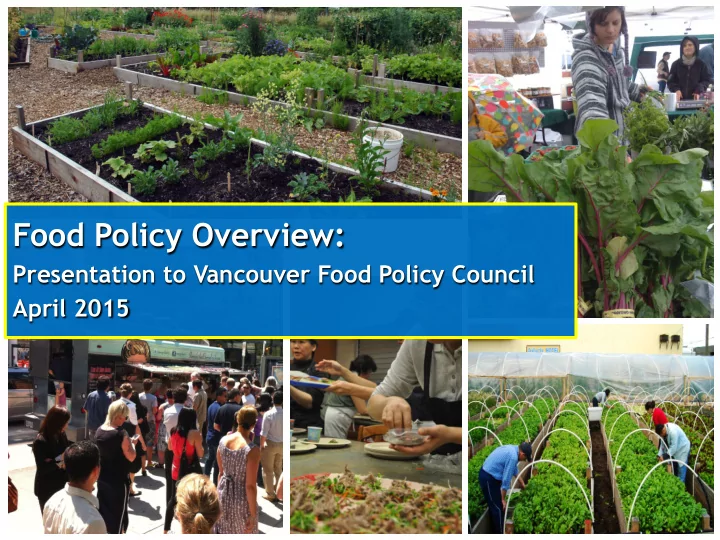
Food Policy Overview: Presentation to Vancouver Food Policy Council - - PowerPoint PPT Presentation
Food Policy Overview: Presentation to Vancouver Food Policy Council April 2015 Role of Local Government What local Governments Do: Engineering Services (Street, Water, Sewers, Garbage, and Recycling) Parks and Recreation Police and
Role of Local Government
What local Governments Do:
- Engineering Services (Street, Water, Sewers, Garbage,
and Recycling)
- Parks and Recreation
- Police and Fire Services
- Planning and Development Services
- Licenses and Inspections
- Libraries
- Sustainability
- Community Services (Housing, Culture, and Social
Policy)
“Food is a tool for re-thinking cities and the way we live in them” Carolyn Steel, 2008
Food Systems Examples and Concerns
Global
Climate Change/ Greenhouse Gas Loss of biodiversity in food system World food prices Genetically Modified Organisms
National
Loss of farmland and fisheries Food labeling Food transportation
Provincial Migrant workers issues
Erosion of Agricultural Land Reserve Health and wellness programs
City
(Vancouver)
Uneven food accessibility Urban agriculture Waste management
Table modified from Zsuzsi Fodor, 2011
Municipal Planning Framework
- Regional Growth Strategies
- Agricultural Land Protection
- Official Community Plans and Local Area
Plans
- Zoning and Land Use Regulations
- Business Licenses
Broad Food Policy Context
- Food Action Plan (2003)
- Vancouver Food Policy Council (2004)
- Food Charter (2007)
- Greenest City Action Plan (2011)
- Vancouver Food Strategy (2013)
- Healthy City Strategy (2014)
Purpose:
- Integration and
alignment of food policy
- Provide goals and
specific actions
- Provide road map
for action
Vancouver Food Strategy
Park Board: Local Food Action Plan
Foci:
- Land
- Facilities
- Capacity and
Programs
Components of Vancouver’s Food Strategy
Vision and Principles 5 Goals 71 Actions
Food Charter Food Strategy
Goal 1: Create Food Friendly Neighbourhoods
Goal ¡1: ¡Support ¡food-‑friendly ¡neighbourhoods ¡
Key ¡focus: ¡ ü Food ¡assets ¡/ ¡ infrastructure ¡ ü Built ¡ environment ¡ ü Scaling ¡up ¡ ü Build ¡on ¡unique ¡ context ¡of ¡each ¡ neighbourhood ¡
Goal 2: Empower residents to take action in their
- wn neighbourhoods
Key focus: ü Human capacity ü Community development ü Access to resources, skills and knowledge ü Participation and inclusion
Goal 3: Improve access to healthy, affordable, culturally diverse food for all residents
Key focus: ü Vulnerable populations ü Affordability ü Healthy food
- ptions
Key focus: ü Localizing food supply chain ü Economic multiplier effect of local food ü Innovative models: e.g. social enterprises, food hub, food business incubator ü Green food jobs
Goal 4: Make food a centrepiece of Vancouver’s green economy
- Community garden plots continue to increase
Goal 5: Advocate for a just and sustainable food system with partners and all levels of government
Key focus: ü Advocacy at all levels of government ü Partnerships ü Leverage tools
Actions contribute to all aspects of food systems
Highlights from 2014
Highlight Result
- Community garden plots continue to increase
- 452 plots were built on city and non-city
land (total 4166)
- Revised farmers market policy
- 3 new farmers markets (total 11)
- Fostered community food markets
- Developed CFM bulletin outlining process
- 5 new Curbside Fresh pilot location from
Greater Vancouver Food Bank
- Established and secured the Sustainable Food
Systems Grants
- Annual financial support to food related
- rganizations and projects
- Development of food business incubator between
VCC, Save on Meats ; CoV contributing $100K
- Opening of Vancouver Incubator Kitchen
(VIK) at Save On Meats
- Incorporate food systems assets into community
plans and large developments
- Sustainable Large Development Policy to
require food systems plan and assets
- Working on urban farming policy to further
enable commercial food production
- Emerging urban farming policy directions
Priorities for 2015 and beyond
Highlights
- Continue to increase community garden plots, while
improving opportunities for capacity building, ethno- cultural representation, and infrastructure upgrades, etc
- Adoption of urban farming policy to further enable
commercial food production
- Support local food infrastructure (processing,
distribution, kitchens)
- Continue to advance opportunities to increase
percentage of local and sustainable food purchased by city
- Continue to support food related organizations and
projects through Sustainable Food Systems Grants