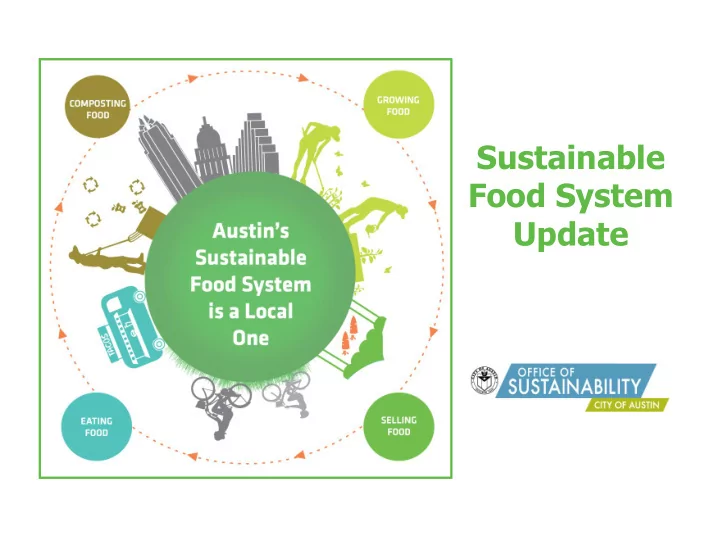
Sustainable Food System Update Agenda Role a Food Policy Manager - - PowerPoint PPT Presentation

sustainable
SMART_READER_LITE
LIVE PREVIEW

Sustainable Food System Update Agenda Role a Food Policy Manager - - PowerPoint PPT Presentation

Sustainable Food System Update Agenda Role a Food Policy Manager Progress Update Metrics Development Gap Analysis Food Portal Launch State of the Food System Report Whats Next Role a Food Policy Manager Cities impact


slide-1
SLIDE 1

Sustainable Food System Update

slide-2
SLIDE 2

Agenda

Role a Food Policy Manager Progress Update

  • Metrics Development
  • Gap Analysis
  • Food Portal Launch

State of the Food System Report What’s Next

slide-3
SLIDE 3

Role a Food Policy Manager

 Cities impact and

influence on a food system

 Coordinating inter-

departmental activity

 Leadership to achieve

goals stated in 30 year comprehensive plan

slide-4
SLIDE 4

Progress Update

  • More than 150 meetings

with stakeholders

  • Conducted a survey to

identify metrics:

  • Growing food
  • Selling food
  • Eating food
  • Food recovery
  • Collected data for selected

metrics

Metrics Development:

slide-5
SLIDE 5

Progress Update

  • Access
  • Competition
  • Demand
  • Regulations
  • Policies
  • Costs

Gap Analysis:

slide-6
SLIDE 6

Progress Update

  • Educational materials
  • How to donate food
  • How to compost
  • Ways to eat healthy
  • Codes and regulations
  • Starting a business
  • Starting a community garden
  • Organizations
  • Helping with hunger
  • Ways to donate food
  • Where to buy local food

Food Portal Launch:

slide-7
SLIDE 7

Input and Discussion

State of the Food System Report

slide-8
SLIDE 8

State of the Food System Report

Purpose:

  • Educate
  • Snapshot of current food system
  • Identifies trends
  • Easily understood – highly graphic
  • Links to existing goals
  • Imagine Austin/ CHIP
  • COA programs and initiatives
  • Organize priorities and action
  • Creates a common framework
  • Engages community partners
  • Identifies a path to change
slide-9
SLIDE 9

Limits to Food System Report

  • This is a only starting point
  • Challenges:
  • Metrics cover different

geographical areas

  • Trends are difficult to track
  • COA has a limited direct

impact

  • Complexity of global food

system / City boundaries

slide-10
SLIDE 10

Growing Food

Metrics:

Vacant Land in Austin

  • 11 year farmland loss = 25%
  • 9.3 acres/ day
  • Total community gardens = 52
  • Available plots = 0 (wait lists)
  • AISD Schools with gardens = 77%
  • Supply of food at any time = 3 days
  • Average age of farmers = 62
  • Average farm worker income = $11K
slide-11
SLIDE 11

Growing Food

  • Preserving farmland requires

innovative approach

  • Products grown in Central

Texas are a small percentage

  • f what we eat
  • School, community, and urban

gardens are in high demand

  • Farmer demographics must be

addressed

Takeaways:

slide-12
SLIDE 12

Growing Food

COA Profile

 Parks and Recreation

 Community Garden

guidelines

 Austin Water

 Rainwater Rebate  Community Garden water-

taps

 Planning and

Development

 Urban Farm Ordinance -

Certificate of Compliance

Private Sector Profiles

 Multi-cultural Refugee

Center’s Community Garden

 Agua Dulce

 Impact of UFO COC

slide-13
SLIDE 13

Selling Food

Travis County

Metrics:

  • Selling local food is a significant

part of Austin’s economy:

  • Total economic impact = $4.1B (.45% of

GDP in Austin MSA)

  • Food manufacturing = $737M
  • Food distribution = $331M
  • Grocery sales = $449M
  • Farm direct sales = $1.3M
  • COA sales tax revenue = $63M (43% of

total COA income)

Crops sold in $ millions Acres of farmland in thousands

slide-14
SLIDE 14

Selling Food

Takeaways:

  • Buying local food benefits:
  • Producers
  • Consumers
  • Local economy
  • Environment
  • More local processing &

manufacturing is needed

  • Local selling mechanisms need

evaluation & improvement:

  • # of farmers markets & fee structure
  • Demand exceeds supply for institutional

buyers

  • Geographical distribution of grocery stores
slide-15
SLIDE 15

Selling Food

COA Profile

 Health and Human

Services

 Farmers Market

Regulations

 Human Resource

 Farm to Work program

 Economic Development

 Economic Impact study

Private Sector Profiles

 Sustainable Food Center

 Farmers Market Double

Dollar programs

 Odd Duck – Bryce

Gilmore

 Transformation from a food

truck to a brick and mortar restaurant

slide-16
SLIDE 16

Eating Food

Austin Food Desert Map

Metrics:

  • Food insecure = 17.6%
  • Only 57% of eligible residents

receive SNAP

  • Food insecurity costs Texas $9B

per year

  • Eligible School Lunch program:
  • Free and Reduced = 63%
  • Obesity rate = 25.5%
  • Diabetes rate = 7.4%
  • Food retail = over 6,000 restaurants

and 85 full service grocery stores

slide-17
SLIDE 17

Eating Food

Takeaways:

  • Food insecurity

disproportionately impacts:

  • Children
  • Minorities
  • Elderly
  • Many Austinites do not have

healthy eating habits

  • Priorities for improvement:
  • Increased access to healthy food
  • Improve planning for healthy food
  • Addressing affordability
  • Education and outreach
slide-18
SLIDE 18

Eating Food

COA Profile

 Transportation

 Access to healthy food

 Health and Human

Services

 WIC Programs

Private Sector Profiles

 CAP Metro

 Grocery Store routes

 Capital Area Food Bank

 SNAP outreach

slide-19
SLIDE 19

Food Recovery

Metrics:

  • Food waste = 421,500,000 lbs.

per year / $208M

  • Households with access to

curbside composting = 14,322

  • Organic material diverted =

1,837 tons

  • Keep Austin Fed recovers

360,000 pounds/year

  • ARR composting classes = 50
slide-20
SLIDE 20

Food Recovery

Takeaways:

  • Benefits of food recovery:
  • Reduces food insecurity
  • Achieves Zero Waste goal
  • Saves money
  • Conserves resources
  • Reduces climate change impacts
  • 25% food waste = 25% food

insecurity

  • Specific strategies should be

developed for:

  • Residents, businesses, schools &

institutions

  • Neighborhood-scale solutions
  • Providing compost to local farms
slide-21
SLIDE 21

Food Recovery

COA Profile

 Austin Resource Recovery

 Residential and business

pilots

Private Sector Profiles

 Eastside Compost

Peddlers

 Keep Austin Fed

 Food Recovery

 UT Arlington/ Eco-

Network

 Food Waste Charter

slide-22
SLIDE 22
  • Gather data on 4 sectors of

the food system

  • Select food system metrics

with ties to Imagine Austin

  • Develop City of Austin

internal Food System Roundtable

  • Develop external food

system stakeholder groups

Austin State of the Food System Report

  • Establish best-practices
  • Develop Pilot Projects (Dove

Springs/Rundberg/ Seaholm Eco District)

  • Identify food system metrics

for neighborhoods

  • Work with neighborhood

stakeholders to identify priorities

  • Develop neighborhood food

system plans

  • Develop tool-kit to assist in

achieving desired changes

Neighborhood Food Planning

  • Aggregate data from

Neighborhood Food Plans

  • Integrate Food Plan with

Imagine Austin and CHIP

  • Evaluate impact and
  • pportunities for future

collaboration

Austin Food System Strategic Plan

Austin’s Local, Healthy and Sustainable Food System

2015 2015/2016 2017/2018

What’s Next?

slide-23
SLIDE 23

Edwin Marty, Food Policy Manager

edwin.marty@austintexas.gov