Focus Mismatch Detection in stereoscopic content Frdric Devernay, - - PowerPoint PPT Presentation

focus mismatch detection in stereoscopic content
SMART_READER_LITE
LIVE PREVIEW

Focus Mismatch Detection in stereoscopic content Frdric Devernay, - - PowerPoint PPT Presentation

Focus Mismatch Detection in stereoscopic content Frdric Devernay, Sergi Pujades and Vijay Ch.A.V. INRIA Grenoble, France Stereoscopic Displays and Applications 2012 Motivation: stereoscopic visual quality For best visual quality and visual

slide-1
SLIDE 1

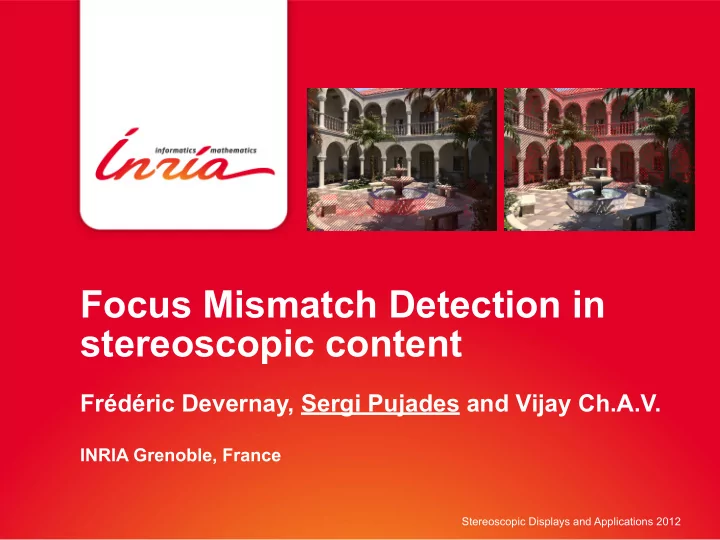
Focus Mismatch Detection in stereoscopic content

Frédéric Devernay, Sergi Pujades and Vijay Ch.A.V.

INRIA Grenoble, France

Stereoscopic Displays and Applications 2012

slide-2
SLIDE 2

Devernay, Pujades, Ch.A.V. “Focus Mismatch Detection” Stereoscopic Displays and Applications 2012

Motivation: stereoscopic visual quality

For best visual quality and visual comfort stereoscopic image pairs should:

2

slide-3
SLIDE 3

Devernay, Pujades, Ch.A.V. “Focus Mismatch Detection” Stereoscopic Displays and Applications 2012

Motivation: stereoscopic visual quality

For best visual quality and visual comfort stereoscopic image pairs should:

  • 1. be geometrically aligned

2

slide-4
SLIDE 4

Devernay, Pujades, Ch.A.V. “Focus Mismatch Detection” Stereoscopic Displays and Applications 2012

Motivation: stereoscopic visual quality

For best visual quality and visual comfort stereoscopic image pairs should:

  • 1. be geometrically aligned
  • 2. be color-balanced

2

slide-5
SLIDE 5

Devernay, Pujades, Ch.A.V. “Focus Mismatch Detection” Stereoscopic Displays and Applications 2012

Motivation: stereoscopic visual quality

For best visual quality and visual comfort stereoscopic image pairs should:

  • 1. be geometrically aligned
  • 2. be color-balanced
  • 3. have same depth of field and focus distance

2

slide-6
SLIDE 6

Devernay, Pujades, Ch.A.V. “Focus Mismatch Detection” Stereoscopic Displays and Applications 2012

Motivation: stereoscopic visual quality

For best visual quality and visual comfort stereoscopic image pairs should:

  • 1. be geometrically aligned
  • 2. be color-balanced
  • 3. have same depth of field and focus distance

2

solved by post-processing

slide-7
SLIDE 7

Devernay, Pujades, Ch.A.V. “Focus Mismatch Detection” Stereoscopic Displays and Applications 2012

Motivation: stereoscopic visual quality

For best visual quality and visual comfort stereoscopic image pairs should:

  • 1. be geometrically aligned
  • 2. be color-balanced
  • 3. have same depth of field and focus distance

2

solved by post-processing post-processing would degrade image quality

slide-8
SLIDE 8

Devernay, Pujades, Ch.A.V. “Focus Mismatch Detection” Stereoscopic Displays and Applications 2012

Motivation: stereoscopic visual quality

For best visual quality and visual comfort stereoscopic image pairs should:

  • 1. be geometrically aligned
  • 2. be color-balanced
  • 3. have same depth of field and focus distance

2

solved by post-processing post-processing would degrade image quality avoid it: detect while shooting

slide-9
SLIDE 9

Devernay, Pujades, Ch.A.V. “Focus Mismatch Detection” Stereoscopic Displays and Applications 2012

Our goal

Given a stereoscopic pair of images, we want to answer :

3

slide-10
SLIDE 10

Devernay, Pujades, Ch.A.V. “Focus Mismatch Detection” Stereoscopic Displays and Applications 2012

Our goal

Given a stereoscopic pair of images, we want to answer :

  • Are focal distances and depth of field the same?

3

slide-11
SLIDE 11

Devernay, Pujades, Ch.A.V. “Focus Mismatch Detection” Stereoscopic Displays and Applications 2012

Our goal

Given a stereoscopic pair of images, we want to answer :

  • Are focal distances and depth of field the same?
  • Which manual adjustment can solve it: aperture? focus?

3

slide-12
SLIDE 12

Devernay, Pujades, Ch.A.V. “Focus Mismatch Detection” Stereoscopic Displays and Applications 2012

Our goal

Given a stereoscopic pair of images, we want to answer :

  • Are focal distances and depth of field the same?
  • Which manual adjustment can solve it: aperture? focus?

3

slide-13
SLIDE 13

Devernay, Pujades, Ch.A.V. “Focus Mismatch Detection” Stereoscopic Displays and Applications 2012

Our goal

Given a stereoscopic pair of images, we want to answer :

  • Are focal distances and depth of field the same?
  • Which manual adjustment can solve it: aperture? focus?

3

slide-14
SLIDE 14

Devernay, Pujades, Ch.A.V. “Focus Mismatch Detection” Stereoscopic Displays and Applications 2012

Our goal

Given a stereoscopic pair of images, we want to answer :

  • Are focal distances and depth of field the same?
  • Which manual adjustment can solve it: aperture? focus?

3

slide-15
SLIDE 15

Devernay, Pujades, Ch.A.V. “Focus Mismatch Detection” Stereoscopic Displays and Applications 2012

Method outline

  • 1. Detecting per-pixel focus mismatch.
  • 2. Give feedback to operator

4

slide-16
SLIDE 16

Devernay, Pujades, Ch.A.V. “Focus Mismatch Detection” Stereoscopic Displays and Applications 2012

Detecting per-pixel focus mismatch

5

Detecting per-pixel focus mismatch

1

slide-17
SLIDE 17

Devernay, Pujades, Ch.A.V. “Focus Mismatch Detection” Stereoscopic Displays and Applications 2012

Focal Blur Model

Assuming parallel (or near parallel) cameras, optics imply:

  • Stereo disparity depends on depth.
  • Focal blur size is linear with the stereo disparity.

6

1 depth of field disparity focus distance focal blur size In Focus Out

  • f Focus

(Rajagopalan et al. 2004, Schechner et al. 1988)

slide-18
SLIDE 18

Devernay, Pujades, Ch.A.V. “Focus Mismatch Detection” Stereoscopic Displays and Applications 2012

Focal Blur Model

Assuming parallel (or near parallel) cameras, optics imply:

  • Stereo disparity depends on depth.
  • Focal blur size is linear with the stereo disparity.

6

1 depth of field disparity focus distance focal blur size In Focus Out

  • f Focus

2 parameters

(Rajagopalan et al. 2004, Schechner et al. 1988)

slide-19
SLIDE 19

Devernay, Pujades, Ch.A.V. “Focus Mismatch Detection” Stereoscopic Displays and Applications 2012

Measuring focal blur size is ill-posed

We would like to measure focal blur size We only have access to the observed images = ⨂

Focal Blur Size

All-in-focus image Observed image

7

slide-20
SLIDE 20

Devernay, Pujades, Ch.A.V. “Focus Mismatch Detection” Stereoscopic Displays and Applications 2012

Measuring focal blur size is ill-posed

We would like to measure focal blur size We only have access to the observed images = ⨂

Focal Blur Size

All-in-focus image Observed image

7

slide-21
SLIDE 21

Devernay, Pujades, Ch.A.V. “Focus Mismatch Detection” Stereoscopic Displays and Applications 2012

Measuring focal blur size is ill-posed

We would like to measure focal blur size We only have access to the observed images = ⨂

Focal Blur Size

All-in-focus image Observed image

7

Problem: non-textured scene

slide-22
SLIDE 22

Devernay, Pujades, Ch.A.V. “Focus Mismatch Detection” Stereoscopic Displays and Applications 2012

Measuring focal blur difference is possible

8

  • More focal blur causes more image blur
  • Less focal blur causes less image blur
slide-23
SLIDE 23

Devernay, Pujades, Ch.A.V. “Focus Mismatch Detection” Stereoscopic Displays and Applications 2012

Measuring focal blur difference is possible

The sign of focal blur difference is the same as the sign of image blur difference.

8

  • More focal blur causes more image blur
  • Less focal blur causes less image blur
slide-24
SLIDE 24

Devernay, Pujades, Ch.A.V. “Focus Mismatch Detection” Stereoscopic Displays and Applications 2012

Focal Blur Difference

9

d σ

Right Focus Model Left Focus Model Difference

slide-25
SLIDE 25

d σ

Devernay, Pujades, Ch.A.V. “Focus Mismatch Detection” Stereoscopic Displays and Applications 2012

Sign of Focal and Image Blur Difference

10

Right Focus Model Left Focus Model Difference Sign of Difference

slide-26
SLIDE 26

d σ

Devernay, Pujades, Ch.A.V. “Focus Mismatch Detection” Stereoscopic Displays and Applications 2012

Sign of Focal and Image Blur Difference

10

Right Focus Model Left Focus Model Difference Sign of Difference

Reminder: Sign of focal blur size difference = Sign of image blur difference.

slide-27
SLIDE 27

Devernay, Pujades, Ch.A.V. “Focus Mismatch Detection” Stereoscopic Displays and Applications 2012

All Configurations: Focal Blur Size Difference

FDl < FDr FDl = FDr FDl > FDr DOFl < DOFr

d σ d σ σ d

DOFl = DOFr

d σ d σ d σ

DOFl > DOFr

d σ d σ d σ

11

slide-28
SLIDE 28

Devernay, Pujades, Ch.A.V. “Focus Mismatch Detection” Stereoscopic Displays and Applications 2012

FDl < FDr FDl = FDr FDl > FDr DOFl < DOFr

d σ

L = (−, +, −)

d σ

L = (−, −)

σ d

L = (−, +, −) DOFl = DOFr

d σ

L = (+, −)

d σ

L = ()

d σ

L = (−, +) DOFl > DOFr

d σ

L = (+, −, +)

d σ

L = (+, +)

d σ

L = (+, −, +)

12

All Configurations: Sign of Focal/Image Blur Difference

slide-29
SLIDE 29

Devernay, Pujades, Ch.A.V. “Focus Mismatch Detection” Stereoscopic Displays and Applications 2012

Algorithm Outline

From two images: Compute sign of image blur difference The curve shape gives the focus configuration.

13

slide-30
SLIDE 30

Image blur measurement: state of the art

Devernay, Pujades, Ch.A.V. “Focus Mismatch Detection” Stereoscopic Displays and Applications 2012

Depth from focus: “Given N images of one object with known different focus distances, compute depth.” For each pixel decide which image is more in focus. Depth from defocus: “Given two images of one object with known different apertures, compute depth.” For each pixel quantify the focus difference. In our case: Focus mismatch detection : detect a difference.

Photostereosynthesis Lumière, 1920.

14

slide-31
SLIDE 31

Image blur measurement: state of the art

Devernay, Pujades, Ch.A.V. “Focus Mismatch Detection” Stereoscopic Displays and Applications 2012

Depth from focus: “Given N images of one object with known different focus distances, compute depth.” For each pixel decide which image is more in focus. Depth from defocus: “Given two images of one object with known different apertures, compute depth.” For each pixel quantify the focus difference. In our case: Focus mismatch detection : detect a difference.

Photostereosynthesis Lumière, 1920.

14

⇒ use Depth from focus tools

slide-32
SLIDE 32

SML(i) =

x+1

X

i=x−1 y+1

X

j=y−1

r2

MLI(i, j), for r2 MLI(i, j) T

|2I(x, y) − I(x − 1, y) − I(x + 1, y)| r2

MLI(x, y) = |2I(x, y) − I(x − 1, y) − I(x + 1, y)| +

Devernay, Pujades, Ch.A.V. “Focus Mismatch Detection” Stereoscopic Displays and Applications 2012

Image blur measurement : Sum of Modified Laplacian

Modified Laplacian at a pixel: captures “textureness” Sum of Modified Laplacian

15

  • T = 5 (for 8-bits images),

From Nayar & Nakagawa, 1994 “Depth from focus” Threshold discards sensor noise:

slide-33
SLIDE 33

Devernay, Pujades, Ch.A.V. “Focus Mismatch Detection” Stereoscopic Displays and Applications 2012

Image blur difference measurement: Sign of left and right SML image difference

Mapping from left to right: Dense disparity map.

M(i) > 0 M(i) = 0 M(i) < 0

M(i) = sign (SMLl(i) SMLr(i))

16

Example: Left Far - Right Near

slide-34
SLIDE 34

Devernay, Pujades, Ch.A.V. “Focus Mismatch Detection” Stereoscopic Displays and Applications 2012

Mean Sign of SML difference wrt. disparity

wrt: with respect to

M(i) > 0 M(i) = 0 M(i) < 0

17

  • 1

+1 Mean Sign Disparity

slide-35
SLIDE 35

Devernay, Pujades, Ch.A.V. “Focus Mismatch Detection” Stereoscopic Displays and Applications 2012

Finding a simple blur model

From the Mean sign curve we find simple blur model

18

  • 1

+1 Disparity Disparity

details in the paper

Mean Sign Mean Sign

  • 1

+1

slide-36
SLIDE 36

Devernay, Pujades, Ch.A.V. “Focus Mismatch Detection” Stereoscopic Displays and Applications 2012

Section 1 summary

19

From two images: Compute sign of image blur difference The curve shape gives the focus configuration.

slide-37
SLIDE 37

Devernay, Pujades, Ch.A.V. “Focus Mismatch Detection” Stereoscopic Displays and Applications 2012

Give feedback to operator

2

20

slide-38
SLIDE 38

Zebras on images

Devernay, Pujades, Ch.A.V. “Focus Mismatch Detection” Stereoscopic Displays and Applications 2012 21

⨁ →

Disparity Mean Sign

  • 1

+1

slide-39
SLIDE 39

Zebras on images

Devernay, Pujades, Ch.A.V. “Focus Mismatch Detection” Stereoscopic Displays and Applications 2012 21

⨁ →

Disparity Mean Sign

  • 1

+1

slide-40
SLIDE 40

Devernay, Pujades, Ch.A.V. “Focus Mismatch Detection” Stereoscopic Displays and Applications 2012

Manual adjustement hints

  • Answers to the questions:
  • Are both focal distances and depth of field perfectly matched?
  • Are both focal distances equal? Which one is bigger?
  • Are both depths-of-field equal? Which one is bigger?

22

slide-41
SLIDE 41

Devernay, Pujades, Ch.A.V. “Focus Mismatch Detection” Stereoscopic Displays and Applications 2012

Manual adjustement hints

  • Answers to the questions:
  • Are both focal distances and depth of field perfectly matched?
  • Are both focal distances equal? Which one is bigger?
  • Are both depths-of-field equal? Which one is bigger?
  • Obtained by shape classification

22

slide-42
SLIDE 42

Devernay, Pujades, Ch.A.V. “Focus Mismatch Detection” Stereoscopic Displays and Applications 2012

Manual adjustement hints

  • Answers to the questions:
  • Are both focal distances and depth of field perfectly matched?
  • Are both focal distances equal? Which one is bigger?
  • Are both depths-of-field equal? Which one is bigger?
  • Obtained by shape classification
  • Sometimes, some questions cannot be answered

22

slide-43
SLIDE 43

Devernay, Pujades, Ch.A.V. “Focus Mismatch Detection” Stereoscopic Displays and Applications 2012

Manual adjustement hints

  • Answers to the questions:
  • Are both focal distances and depth of field perfectly matched?
  • Are both focal distances equal? Which one is bigger?
  • Are both depths-of-field equal? Which one is bigger?
  • Obtained by shape classification
  • Sometimes, some questions cannot be answered
  • details in the paper

22

slide-44
SLIDE 44

Devernay, Pujades, Ch.A.V. “Focus Mismatch Detection” Stereoscopic Displays and Applications 2012

CONCLUSION

3

23

slide-45
SLIDE 45

Devernay, Pujades, Ch.A.V. “Focus Mismatch Detection” Stereoscopic Displays and Applications 2012

Conclusion and Future Work

Conclusion

  • We presented a novel method to detect focus mismatch
  • Evaluation on synthetic data is very promising: (details in the paper)
  • “Are both focus distances and depth of field perfectly matched?”
  • 100% accuracy
  • Always capable of accurately telling at least which camera is less

in focus.

  • All steps run in real-time

Future Work

  • Validate proposed method with real footage from actual cameras.
  • Quantification of the differences.
  • Detect astigmatism? A non-flat mirror in a mirror rig?

24

slide-46
SLIDE 46

Thank you.

INRIA - Grenoble

www.inria.fr

Focus Mismatch Detection in stereoscopic content Frédéric Devernay, Sergi Pujades and Vijay Ch.A.V.

This work was done within the 3DLive project supported by the French Ministry of Industry http://3dlive-project.com/