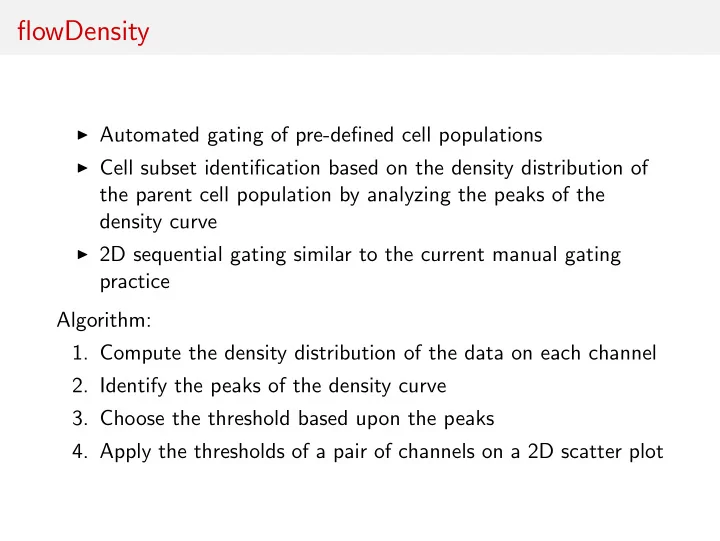
SLIDE 1 flowDensity
◮ Automated gating of pre-defined cell populations ◮ Cell subset identification based on the density distribution of
the parent cell population by analyzing the peaks of the density curve
◮ 2D sequential gating similar to the current manual gating
practice Algorithm:
- 1. Compute the density distribution of the data on each channel
- 2. Identify the peaks of the density curve
- 3. Choose the threshold based upon the peaks
- 4. Apply the thresholds of a pair of channels on a 2D scatter plot
SLIDE 2 Threshold Selection
- a. If there are exactly two peaks, the
threshold is the minimum intersection between these two peaks
HIP-C PBMC data, T cell panel, Blomberg
SLIDE 3 Threshold Selection
- b. If there are three or more peaks, a
score is calculated based on the height and distance of the peaks for each pair of adjacent peaks. The score then determines the place of the threshold by picking a pair of peaks.
HIP-C PBMC dataset, T cell panel, Stanford
SLIDE 4 Threshold Selection
- c. If there is only one peak, the
threshold is determined by one of the following approaches:
SLIDE 5
Threshold Selection, contd.
c.1. Identifying of inflection or flex points
HIP-C PBMC dataset, T cell, Stanford
SLIDE 6
Threshold Selection, contd.
c.1. Identifying of inflection or flex points c.2. Tracking the slope (derivative) of the curve
HIP-C PBMC dataset, T cell, Stanford
SLIDE 7
Threshold Selection, contd.
c.1. Identifying of inflection or flex points c.2. Tracking the slope (derivative) of the curve c.3. Setting a percentile threshold
HIP-C PBMC dataset, B cell, Blomberg
SLIDE 8
Threshold Selection, contd.
c.1. Identifying of inflection or flex points c.2. Tracking the slope (derivative) of the curve c.3. Setting a percentile threshold c.4. peak +/− a multiplier of standard deviation
HIP-C PBMC dataset, B cell, Blomberg
SLIDE 9 Threshold Selection, contd.
Parameters of each of the four approaches for the single-peak distribution:
◮ can be set optionally by user ◮ otherwise is set by flowDensity based upon the the statistics
- f the density distribution
SLIDE 10
Results: HIP-C Lyoplate Panel
20 seconds to run all samples (up to 5,000)
SLIDE 11
Mouse Knockout Results
SLIDE 12
Mouse Knockout Results
SLIDE 13
Acknowledgements
BCCA
◮ Jafar Taghiyar, Radina Droumeva, Mehrnoush Malekesmaeili
Funding
◮ NIH (NIBIB) & HIP-C Supplement (PI: Raphael Gottardo)