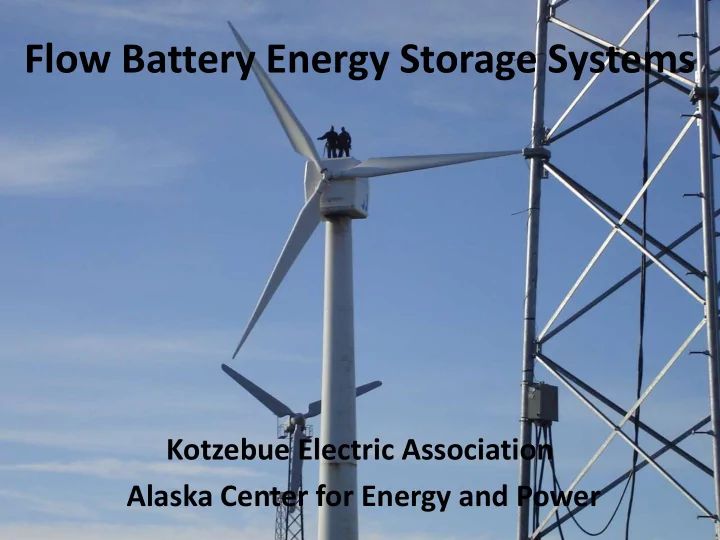
Flow Battery Energy Storage Systems Kotzebue Electric Association - - PowerPoint PPT Presentation
Flow Battery Energy Storage Systems Kotzebue Electric Association Alaska Center for Energy and Power Kotzebue Isolated community of 3500 people Not connected to roads or grid Electric power from diesel generators Started
Kotzebue
- Isolated community of 3500 people
- Not connected to roads or grid
- Electric power from diesel generators
- Started testing wind power to reduce diesel
consumption
- First demonstrations of commercial utility scale
wind turbines in Alaska
Kotzebue
►
Average Load 2500kW
►
Installed Wind Capacity 1.14MW
►
Plans to increase wind capacity to 4 MW
►
Vanadium Red-ox Flow Battery from Prudent Energy
►
Phase One: Battery Power 600kW and Battery Storage 1800kWh
►
Phase Two: Battery Power 1800kW and Battery Storage 2700kWh
►
Waste Heat Recovery with 150kW Ammonia Power Cycle Power Plant
An average of 8% of Kotzebue’s electricity
comes from the wind plant.
Installed capacity of 1.14 MW: 15 Entegrity (66kW) 1 North Wind 100 (100kW) 1 Vestas (65 kW)
Kotzebue Energy Profile
The Future
Vision Statement
KEA will hold a statewide
leadership role in energy innovation and environmental stewardship while providing secure and reliable power to its members is a manner that is sustainable economically, socially, and environmentally. Affordable electricity is essential to the economic viability of Alaska
- villages. KEA will:
Provide reliable electricity at the
lowest cost possible to its members
Provide employment opportunities
and job training to Alaskans
Promote research, development,
and demonstration of clean and renewable energy technologies
Promote energy efficiency and
conservation
Mission Statement
Wind Expansion: Summer 2010 Increase Wind Capacity from 1.14 MW to 2.94
- MW. Almost tripling the wind capacity will
increase the average penetration from 10 to 30% and the instantaneous penetration could exceed 100%. Funding $4 million through AEA Round One CREBS
Need for Energy Storage
- Need to stabilize the power coming out of wind
turbines (second by second stability, flywheels and super capacitors might also work)
- Ability to operate system in diesel off mode
- Ability to store energy from high wind events to
use later (increased fuel savings—only batteries will work)
- Also allow operation of diesel generators in zones
- f maximum efficiency
Why do this in Kotzebue?
- Commitment of KEA to testing and developing new
technologies
- KEA small and isolated enough to be typical of
Alaskan villages, but large enough to support testing activities
- KEA already has wind farm and SCADA system, ideal
site for testing batteries
- Experience learned in wind projects—Alaska needs
to invest in these technologies to prove that it is a viable market- – willing to try new things, and take risks – Willing to work with manufactures to address issues that arise – Can provide an adequate market for these products (like the Northwind 100 experience)
Battery Evaluations
Cons Pros
New Battery Systems That Might Work
- Vanadium Flow batteries
– VRB test at UAF, discussions with KEA about larger battery system – Prudent Energy has replaced VRB – CellStrom is the European supplier of same technology
- Zinc Bromide Flow batteries
– Premium Power is marketing units – ZBB also, but not currently shipping units
- Sodium Sulfur Battery
– NGK developed battery in Japan, now shipping units to US for testing
D
Energy Storage (kWh) Comparison
Method $/kWh Power (MW) Efficiency Lifetime (hours) Discharge Time (hrs) Pumped Hydro 250-260 20-2,400 76-83% 11,000+ 10 Compressed Air 550-650 110-290 50-75% 11,000+ 10 NaS (NGK) 2,500-4,500 .05-50 70-80% 3,000+ 7 Ni-Cad 610-1,700 .01-27 60-65% 1,000+ 4 Premium Power 350-400 .5 70% 30 years 5 ZBB 1,070 .5 77-78% +2,000 cycles varies Prudent Energy 1637 Varies 85% 10,000+ cycles varies
Power Stability (kW) Comparison
Method $/kW Power (MW) Efficiency Lifetime (hours) Discharge Time (min) Lead Acid 1,050-1,890 .01-10 70-75% 250+ 15 Flywheels 2,500-4,000 .5-1 90-95% 500,000+ 15 Super Capacitors n/a .003-.01 90-98% 500,000+ Seconds NaS Batteries 3,000-4,000 .05-50 70-80% 3,000+ 300 Li-Ion Batteries 1,000-4,500 .005-1 90-95% 20,000+ 15 Lead Acid 1,050-1,890 .01-10 70-75% 250+ 15
Zinc Bromide Technology
Premium Power
Premium Power-Zinc Bromide
Vanadium Red-Ox Technology
Prudent Energy Vanadium Red-ox Flow Battery
Sodium Sulfur Batteries, NGK
www.ngk.com
Sodium Sulfur Batteries, NGK
Is this a good investment?
- If wind or other renewable energy is to be used in
Alaska’s remote communities, energy storage is an important part of the system
- New batteries are being developed, but they are not
yet truly commercial
– Performance is not well understood, especially issues of lifetime and degradation – Capital and installation costs are not yet completely defined (they might go down, they might go up) – O&M Costs are not known
- The only way we can understand these issues is by
purchasing and testing these batteries
Which battery should we buy?
- Every battery we can get our hands on