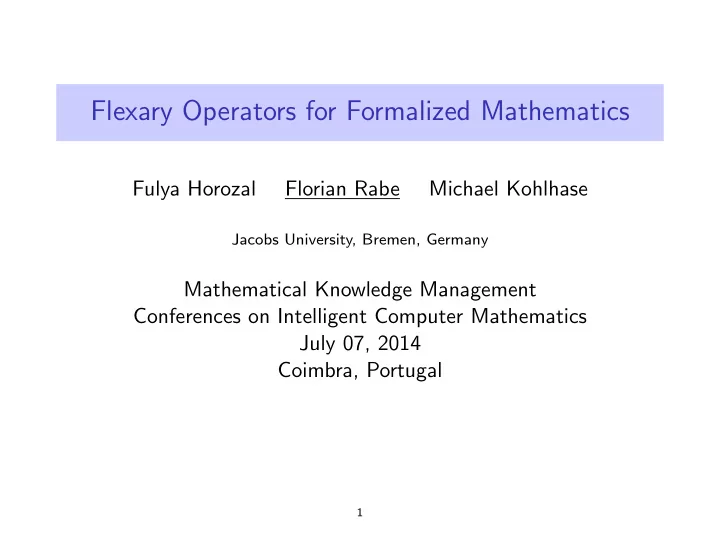
Flexary Operators for Formalized Mathematics Fulya Horozal Florian - - PowerPoint PPT Presentation

flexary operators for formalized mathematics
SMART_READER_LITE
LIVE PREVIEW

Flexary Operators for Formalized Mathematics Fulya Horozal Florian - - PowerPoint PPT Presentation

Flexary Operators for Formalized Mathematics Fulya Horozal Florian Rabe Michael Kohlhase Jacobs University, Bremen, Germany Mathematical Knowledge Management Conferences on Intelligent Computer Mathematics July 07, 2014 Coimbra, Portugal 1


slide-1
SLIDE 1

Flexary Operators for Formalized Mathematics

Fulya Horozal Florian Rabe Michael Kohlhase

Jacobs University, Bremen, Germany

Mathematical Knowledge Management Conferences on Intelligent Computer Mathematics July 07, 2014 Coimbra, Portugal

1

slide-2
SLIDE 2

Motivation

Flexary Operators

◮ flexary = flexible arity

compare unary, binary, etc.

◮ Many operators naturally flexary

pervade mathematics

◮ associative operators

a1 + . . . + an = +(a1, . . . , an)

◮ collection constructors

{a1, . . . , an} = set(a1, . . . , an)

◮ vector, matrix, polynomial constructors

◮ Not commonly supported in content representation languages

surprising

2

slide-3
SLIDE 3

Motivation

Flexary Binders

◮ Binder = operator that binds some variables in a scope ◮ Arity = number of bound variables ◮ Flexary binders very common

actually, hard to find a fixed-arity binder

◮ Define: binder B is associative if

Bx, y.E = Bx.By.E

◮ Most binders not only flexary but also associative

◮ associative: ∀, ∃ ◮ associative up to currying:

  • , λ

◮ not associative (but still naturally flexary): ∃1

◮ Support for flexary binders equally desirable

3

slide-4
SLIDE 4

Motivation

Standard Solution (1)

Use (some incarnation of) lists a1 + . . . + an = +(list(a1, . . . , an)) But

◮ awkward

even more so for a mathematician

◮ introduces foundational dependency

what if there are no lists in my language?

4

slide-5
SLIDE 5

Motivation

Standard Solution (2)

Use notations

◮ only fixed arity in content ◮ parser and printer adapted to mimic flexible arity

a1 + . . . + an parsed as +(a1, . . . , +(an−1, an) . . .) But

◮ flexary representation often more natural ◮ requires choice between right- and left-associative notations

no-canonical choice for non-associative flexary operators

◮ requires domain=codomain

cannot make the {. . .} operator right-associative

◮ no flexary reasoning

would be nice to quantify over the number of arguments

5

slide-6
SLIDE 6

Motivation

Ellipses

◮ Flexary operators naturally lead to ellipses ◮ Sequential ellipsis

define [ai]n

i=1

as a1, . . . , an example: +[ai]n

i=1 = +(a1, . . . , an) ◮ No standardized formalization

dot-dot-dot notation fine on paper

6

slide-7
SLIDE 7

Motivation

Ellipses

◮ Flexary operators naturally lead to ellipses ◮ Sequential ellipsis

define [ai]n

i=1

as a1, . . . , an example: +[ai]n

i=1 = +(a1, . . . , an) ◮ No standardized formalization

dot-dot-dot notation fine on paper

◮ Nested ellipsis

f1(. . . fn(x) . . .) special case of sequential ellipsis via flexary function composition: f1(. . . fn(x) . . .) = ◦[fi]n

i=1(x)

6

slide-8
SLIDE 8

Motivation

Where to Formalize Flexible Arities?

◮ Theory level: not good

◮ amounts to creating a theory of lists ◮ must be imported into any theory with flexary operators

e.g., monoids

◮ Logic level: better but

◮ logics becomes more complicated ◮ flexible arities logic-independent feature

◮ Logical framework level

  • ur approach

◮ once-and-for-all formalization ◮ corresponds to mathematical practice

flexible arity and ellipses are assumed at the meta-level

7

slide-9
SLIDE 9

Motivation

Overview

  • 1. Define logical framework LFS

extends Edinburgh Logical Framework (LF) with

◮ sequences ◮ ellipses ◮ flexible arities

  • 2. Use LFS to define flexary logics

◮ flexary connectives ◮ flexary quantifiers ◮ with corresponding flexary inference rules

concretely: flexary FOL, flexary λ-calculus

  • 3. Use flexary logics to formalize mathematical examples

8

slide-10
SLIDE 10

A Flexary Logical Framework

LF with Sequences (LFS)

◮ LF = dependently-typed λ-calculus ◮ LF primitives

◮ terms, types, and kinds ◮ Π-types, λ, and application ◮ typing judgment ⊢ E : E ′

◮ Very simple, but just right as logical framework ◮ New primitives in LFS

◮ term, type, and kind sequences ◮ natural numbers

needed for indices in ellispes

◮ sequence ellipsis [E(i)]n

i=1

◮ flexary function composition

needed for nested ellipses

9

slide-11
SLIDE 11

A Flexary Logical Framework

LFS Syntax

LF Grammar

E ::= type | Πx : E. E | λx : E. E | E E

  • live

10

slide-12
SLIDE 12

A Flexary Logical Framework

LFS Syntax

LFS Grammar

E, n ::= typen | Πx : E. E | λx : E. E | E E · | E, E | En

◮ Empty sequence · ◮ Concatenation E, E ′ ◮ Index En

n-th element of E

  • live

10

slide-13
SLIDE 13

A Flexary Logical Framework

LFS Syntax

LFS Grammar

E, n ::= typen | Πx : E. E | λx : E. E | E E · | E, E | En | [E]n

x=1 | ◦ E ◮ Empty sequence · ◮ Concatenation E, E ′ ◮ Index En

n-th element of E

◮ Sequence ellipses [E(x)]n x=1

reduces to E(1), . . . , E(n)

◮ Flexary function composition ◦ f

  • (f1, . . . , fn) s reduces to f1(. . . (fn s) . . .)
  • live

10

slide-14
SLIDE 14

A Flexary Logical Framework

Flexary Interpretation of LF Primitives

◮ LF primitives retained but now flexary ◮ Flexary application = sequence arguments

f · = f f (E, E ′) = (f E) E ′

◮ Flexary binding = sequence variables

λx : ·. E = E[x/·] λx : (E, E ′).F = λx1 :E. λx2 :E ′. F[x/(x1, x2)] accordingly for Π

◮ LF typing rules can be reused without change

11

slide-15
SLIDE 15

A Flexary Logical Framework

Type System: Natural Numbers

Axiomatized as LF declarations nat : type ≤ : nat → nat → type : nat 1 : nat + : nat → nat → nat with appropriate axioms

12

slide-16
SLIDE 16

A Flexary Logical Framework

Type System: Introduction of Sequences

Kind sequences Σ ⊢ n : nat : type Σ ⊢ typen Kind Type sequences ⊢ Σ Sig Σ ⊢ · : type0 Σ ⊢ U : typem Σ ⊢ V : typen Σ ⊢ U, V : typem+n Term sequences ⊢ Σ Sig Σ ⊢ · : · : type0 Σ ⊢ S : U : typem Σ ⊢ T : V : typen Σ ⊢ S, T : U, V : typem+n

13

slide-17
SLIDE 17

A Flexary Logical Framework

Type System: Elimination of Sequences

Term sequences Σ ⊢ S : U : typen Σ ⊢ x∗ : 1 ≤ x : type Σ ⊢ x∗ : x ≤ n : type Σ ⊢ Sx : Ux : type accordingly for type sequences Static bound checking:

◮ Only valid indices within bounds well-typed ◮ 2 implicit arguments for 1 ≤ x and x ≤ n

14

slide-18
SLIDE 18

A Flexary Logical Framework

Type System: Ellipses

Ellipsis for sequence of terms Σ ⊢ n : nat : type Σ, x :nat, x∗ :1 ≤ x, x∗ :x ≤ n ⊢ S : U : type Σ ⊢ [S]n

x=1 : [U]n x=1 : typen

accordingly for sequence of types Static bound checking:

◮ Actually binds 3 variables ◮ Bounds 1 ≤ x and x ≤ n passed as assumptions

15

slide-19
SLIDE 19

A Flexary Logical Framework

Flexary Function Composition

Σ ⊢ U : typen+1 Σ ⊢ F : [Ui+1 → Ui]n

i=1

Σ ⊢ ◦ F : Un+1 → U1

Example: Folding

If S : A, . . . , A : typen and f : A → A → A and a : A then i : nat ⊢ λx : A. f x Si : A → A and we define foldl S f a = (◦ [λx : A. f x Si]n

i=1) a

(here Ui = A for 1 ≤ i ≤ n + 1)

16

slide-20
SLIDE 20

Flexary Logics

Flexary Connectives

LFS type form : type of FOL formulas Notation: Write formn for [form]n

i=1

Binary conjunction ∧ : form → form → form Flexary conjunction ∧∗ : Πn : nat. formn → form = λn : nat. λF : formn. foldl F ∧ true Thus, ∧∗n F1, . . . , Fn = (. . . (true ∧ F1) . . .) ∧ Fn ∧∗ 0 · = true

◮ Flexary proof rules also definable in terms of rules for binary

conjunction

◮ Other flexary connectives defined accordingly

17

slide-21
SLIDE 21

Flexary Logics

Flexary Quantifiers

LFS type term : type of FOL terms Unary universal quantifier ∀ : (term → form) → form Flexary universal quantifier ∀∗ : Πn : nat. (termn → form) → form = λn : nat. λF : termn → form.

  • [λf : termi → form. λy : termi−1. ∀λx : term. f (y, x)
  • (termi→form)→(termi−1→form)

]n

i=1 F ◮ Flexary proof rules definable accordingly ◮ Other flexary quantifiers definable accordingly

18

slide-22
SLIDE 22

Flexary Mathematics

Powers

◮ Signature of monoids in FOL

a : type

  • : a → a → a

e : a

◮ Power operator routinely used in informal mathematics

  • ften introduced in same paragraph

but not definable in FOL

◮ Now: flexary monoid operator definable in flexary FOL

  • ∗ : Πn : nat. an → a = λn. λx : an. foldl • x e

and thus power operator definable power : a → nat → a = λx. λn. •∗ xn

19

slide-23
SLIDE 23

Flexary Mathematics

Multirelations

◮ Multi-relations routinely used in informal mathematics

e.g., a ∈ b ⊆ c

◮ But cannot be defined as single operators within a fixary logic ◮ In flexary FOL:

multirel : Πn : nat. termn+1 → (term → term → form)n → form = λn.λx. λr. ∧∗ [ri xi xi+1]n

i=1 ◮ Example:

a ∈ b ⊆ c = multirel (a, b, c) (∈, ⊆)

20

slide-24
SLIDE 24

Conclusion

◮ Sequences and ellipses meta-level operators of informal

mathematics

◮ But a challenge for formalized mathematics ◮ Logical framework approach permits clean solution

◮ LFS = LF with sequences and ellipses ◮ flexary logics defined in LFS ◮ natural formalizations in flexary logics

◮ Key properties

◮ flexary operators take natural number argument

arity polymorphism

◮ LFS retains semantics of LF primitives

no new type constructors, no change to typing rules

◮ length of sequences known to type system static bounds check 21