FLAVOUR IN THE ERA OF THE LHC andries van der schaaf a workshop on - - PowerPoint PPT Presentation

flavour in the era of the lhc
SMART_READER_LITE
LIVE PREVIEW

FLAVOUR IN THE ERA OF THE LHC andries van der schaaf a workshop on - - PowerPoint PPT Presentation

FLAVOUR IN THE ERA OF THE LHC andries van der schaaf a workshop on the interplay of flavour and collider physics http://mlm.home.cern.ch/mlm/FlavLHC.html goal of the workshop outline and document a programme for flavour physics for the next


slide-1
SLIDE 1

FLAVOUR IN THE ERA OF THE LHC

andries van der schaaf

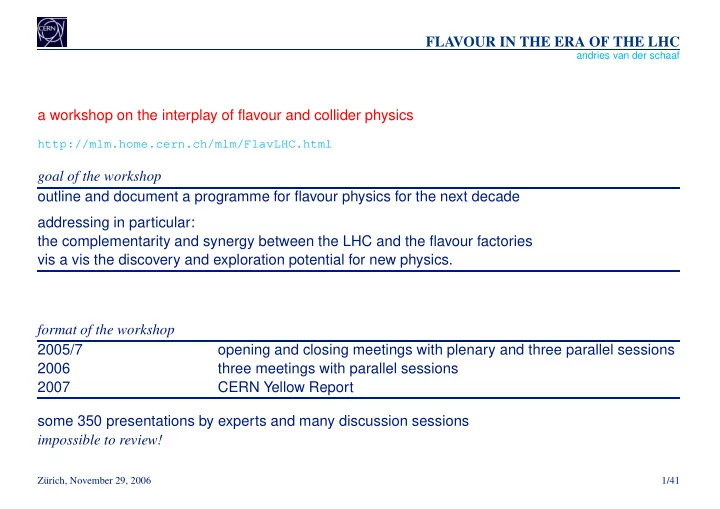
a workshop on the interplay of flavour and collider physics

http://mlm.home.cern.ch/mlm/FlavLHC.html

goal of the workshop

  • utline and document a programme for flavour physics for the next decade

addressing in particular: the complementarity and synergy between the LHC and the flavour factories vis a vis the discovery and exploration potential for new physics. format of the workshop 2005/7

  • pening and closing meetings with plenary and three parallel sessions

2006 three meetings with parallel sessions 2007 CERN Yellow Report some 350 presentations by experts and many discussion sessions impossible to review!

Z¨ urich, November 29, 2006 1/41

slide-2
SLIDE 2

FLAVOUR IN THE ERA OF THE LHC

andries van der schaaf

Programs of the three working groups:

  • WG1: Collider aspects of flavour physics at high Q

. Explore/document the potential of ATLAS/CMS for BSM flavour studies. . Identify observables which discriminate between different models.

  • WG2: B/D/K decays

. Compare experiments for which input parameters are similar or differences are understood. . Go beyond the existing Tevatron-B/SuperBelle/SuperBaBar working reports: . Investigate new approaches.

  • WG3: Flavour in the lepton sector, EDMs, g-2

. Review the status of, and address the complementarity between, neutrino physics, cosmologi- cal observations and low energy lepton flavour experiments on one hand, and LHC experiments

  • n the other hand.

Z¨ urich, November 29, 2006 2/41

slide-3
SLIDE 3

FLAVOUR IN THE ERA OF THE LHC

andries van der schaaf

WG1: Collider aspects of flavour physics at high Q Flavour phenomena in top Physics anomalous charged Top couplings (tbW) FCNC corrections to tt and single Top productions electroweak precision tests (Top, W, Higgs) SUSY ’flavour’ identification of squarks and sleptons at the LHC impact of lepton flavour violation on flavour conserving observables find observables useful to identify the flavour structure of squark and sleptons lepton number and R-parity violation work out in detail the connections to low energy physics, e.g. µ → eγ, b → sγ, Bs → µ+µ− can flavour observables discriminate between SUSY and other models ? non SUSY are there flavour signals from new states consistent with the bounds from low energy experiments ? work out in detail the correlations between these signals to low energy physics are there flavour observables which discriminate between the various models ? Tools plans to extend existing tools these to investigate flavour aspects extension of the SUSY Les Houches Accord (SLHA) to include flavour, CP and R-parity violation investigate possibilities to create a SLHA equivalent for other BSM models than SUSY needs of experimentalists

Z¨ urich, November 29, 2006 3/41

slide-4
SLIDE 4

FLAVOUR IN THE ERA OF THE LHC

andries van der schaaf

WG2: B/D/K decays New Physics Scenarios model-independent approach, discussions on MFV/nonMFV SUSY models non-SUSY Hadronic Uncertainties charmless two-body B decays Light-cone QCD sum rules Lattice QCD New Physics in Benchmark Channels benchmark channels: radiative penguin decays, electroweak penguin decays, neutrino modes, very rare decays, UT angles (tree-dominated), Bs − Bs mixing, b → s and b → d, K decays, charm decays Prospects for existing and future facilities: SuperB, LHCb-upgrade, ... Assessments flavour benchmark points NMFV points close to SPS1a MFV large tan β SUSY-GUT including lepton physics collider phenomenology with flavor benchmarks (studies at CMS, ATLAS) discrimination of models

Z¨ urich, November 29, 2006 4/41

slide-5
SLIDE 5

FLAVOUR IN THE ERA OF THE LHC

andries van der schaaf

WG3: Flavour in the lepton sector (theoretical part) Theoretical framework and observables Effective operators in the Standard Model Low scale observables in terms of effective operators LFV and CPV observables at colliders Leptogenesis and cosmological observations Correlations and complementarity between low and high scale observables Theory of flavour Phenomenological parametrizations of quark and lepton Yukawa couplings Minimal LFV Implications of GUTs on Yukawa flavour structure Models of flavour Higher-dimensional approaches Phenomenology of theories beyond the Standard Model FV in Non-SUSY extensions of the SM Multi-Higgs doublet, Low-scale singlet seesaw, Low-scale triplet seesaw, Extra dimensions FV in SUSY extensions of the SM Sources of LFV and CPV in SUSY, Mass insertion approximation, LFV and CPV in SUSY seesaw, Split SUSY, R-parity violation, Higgs-mediated LFV, Lepton universality, LFV, CPV and Leptogenesis, Correlations between EDMs and LFV observables SUSY GUTs Minimal SU(5) + NR, Minimal SU(5) + triplet, Minimal SO(10), LFV, QFV and CPV observables in GUTs and their correlations

Z¨ urich, November 29, 2006 5/41

slide-6
SLIDE 6

FLAVOUR IN THE ERA OF THE LHC

andries van der schaaf

WG3: Flavour in the lepton sector (experimental part) LFV rare µ decays µ → eγ, µ − e conversion, µ → 3e τ decays Babar/Belle, LHC B → µe in flight conversions EDM’s and g-2 EDM’s neutron, electron, deuteron, nuclei g-2 µ, electron Symmetry tests µ decay τ decay positronium decay e+e− → τ +τ − lepton universality π decay K decay τ decay

Z¨ urich, November 29, 2006 6/41

slide-7
SLIDE 7

FLAVOUR IN THE ERA OF THE LHC

andries van der schaaf

Contents

1 Violation of lepton family number 8 µ decay . . . . . . . . . . . . . . . . . . . . . . . . . . . . . . . . . . . . . . . . . . . . . . . 8 τ decay . . . . . . . . . . . . . . . . . . . . . . . . . . . . . . . . . . . . . . . . . . . . . . . 12 B → µe . . . . . . . . . . . . . . . . . . . . . . . . . . . . . . . . . . . . . . . . . . . . . . . 16 in flight µ → τ conversions . . . . . . . . . . . . . . . . . . . . . . . . . . . . . . . . . . . . . 18 2 EDM’s 19 neutron . . . . . . . . . . . . . . . . . . . . . . . . . . . . . . . . . . . . . . . . . . . . . . . 20 deuteron . . . . . . . . . . . . . . . . . . . . . . . . . . . . . . . . . . . . . . . . . . . . . . 24 3 Lepton universality 26 π decay . . . . . . . . . . . . . . . . . . . . . . . . . . . . . . . . . . . . . . . . . . . . . . . 28 K decay . . . . . . . . . . . . . . . . . . . . . . . . . . . . . . . . . . . . . . . . . . . . . . . 37

Z¨ urich, November 29, 2006 7/41

slide-8
SLIDE 8

FLAVOUR IN THE ERA OF THE LHC

andries van der schaaf

1 Violation of lepton family number

µ decay

µ → eγ

  • present limit 1.2 × 10⁻¹¹ (90% C.L.)
  • MEG at PSI aims at an improvement by ≈ 100
  • limited by accidental coincidences
  • waiting for cryostat of Xe detector
  • time resolution 0.15 ns fwhm
  • e+ spectrum from µ → eνν flat
  • angular resolution by scattering in tar-

get 19 mrad fwhm

  • Eγ resolution 4.8% fwhm

Z¨ urich, November 29, 2006 8/41

slide-9
SLIDE 9

FLAVOUR IN THE ERA OF THE LHC

andries van der schaaf

µ − 3e

  • old SINDRUM result: B < 10−12
  • background free
  • factor 100 should be possible
  • usually less constraining than µ → eγ

total momentum versus total energy accidentals mainly involve Bhabha e+e− pairs additional constraints from vertex

Z¨ urich, November 29, 2006 9/41

slide-10
SLIDE 10

FLAVOUR IN THE ERA OF THE LHC

andries van der schaaf

µ − e conversion

Z¨ urich, November 29, 2006 10/41

slide-11
SLIDE 11

FLAVOUR IN THE ERA OF THE LHC

andries van der schaaf

  • background from decay in orbit and pions in

the beam

  • pions stop 10 m before the spectrometer but

still some background is seen radiative π− capture followed by e− and e+ scattering off the target

  • MECO planned to reach 10−16 using pulsed beam and large acceptance transport solenoids
  • project is presently considered at Fermilab

Z¨ urich, November 29, 2006 11/41

slide-12
SLIDE 12

FLAVOUR IN THE ERA OF THE LHC

andries van der schaaf

τ decay

Babar/Belle

  • e+e− → τ +τ −
  • one tau used as tag, the other to search for

the decay

  • signal is searched in invariant mass and

missing energy

Z¨ urich, November 29, 2006 12/41

slide-13
SLIDE 13

FLAVOUR IN THE ERA OF THE LHC

andries van der schaaf

background sets in at the level of 10−7

Z¨ urich, November 29, 2006 13/41

slide-14
SLIDE 14

FLAVOUR IN THE ERA OF THE LHC

andries van der schaaf Z¨ urich, November 29, 2006 14/41

slide-15
SLIDE 15

FLAVOUR IN THE ERA OF THE LHC

andries van der schaaf

LHC

CMS simulation of a τ → 3µ event

Z¨ urich, November 29, 2006 15/41

slide-16
SLIDE 16

FLAVOUR IN THE ERA OF THE LHC

andries van der schaaf

B → µe

  • has been studied by LHCb
  • could be mediated by Pati-Salam leptoquarks which treats lepton number as a fourth color.
  • kinematically similar to the well studied decay B → µ+µ−

Z¨ urich, November 29, 2006 16/41

slide-17
SLIDE 17

FLAVOUR IN THE ERA OF THE LHC

andries van der schaaf Z¨ urich, November 29, 2006 17/41

slide-18
SLIDE 18

FLAVOUR IN THE ERA OF THE LHC

andries van der schaaf

in flight µ → τ conversions

  • has been studied within MSSM:
  • S. Kanemura, Y. Kuno, M. Kuze and T. Ota,

Search for lepton flavor violating mu µ → τX reactions with high energy muons

  • Nucl. Phys. Proc. Suppl. 144 (2005) 268.
  • experimentally it looks challenging in the

negative neaning of the word:

  • 1011µ s−1 with low duty cycle on the detec-

tor

Z¨ urich, November 29, 2006 18/41

slide-19
SLIDE 19

FLAVOUR IN THE ERA OF THE LHC

andries van der schaaf

2 EDM’s

permanent EDM’s

  • violate P and T invariance and thus CP
  • may be sizeable in many models beyond the SM
  • affect the spin precession frequency in external fields:

hν = 2(µ · B + edm · E) when reversing E the frequency shifts: h∆ν = 4 · edm · E present limits sensitivities for same model parameters

Z¨ urich, November 29, 2006 19/41

slide-20
SLIDE 20

FLAVOUR IN THE ERA OF THE LHC

andries van der schaaf

neutron

Improved Experimental Limit on the Electric Dipole Moment of the Neutron

  • C. A. Baker,1 D. D. Doyle,2 P. Geltenbort,3 K. Green,1,2 M. G. D. van der Grinten,1,2 P. G. Harris,2 P. Iaydjiev,1,*
  • S. N. Ivanov,1,† D. J. R. May,2 J. M. Pendlebury,2 J. D. Richardson,2 D. Shiers,2 and K. F. Smith2

1Rutherford Appleton Laboratory, Chilton, Didcot, Oxon OX11 0QX, United Kingdom 2Department of Physics and Astronomy, University of Sussex, Falmer, Brighton BN1 9QH, United Kingdom 3Institut Laue-Langevin, BP 156, F-38042 Grenoble Cedex 9, France

(Received 9 February 2006; revised manuscript received 29 March 2006; published 27 September 2006) An experimental search for an electric dipole moment (EDM) of the neutron has been carried out at the Institut Laue-Langevin, Grenoble. Spurious signals from magnetic-field fluctuations were reduced to insignificance by the use of a cohabiting atomic-mercury magnetometer. Systematic uncertainties, including geometric-phase-induced false EDMs, have been carefully studied. The results may be interpreted as an upper limit on the neutron EDM of jdnj < 2:9 1026e cm (90% C.L.).

DOI: 10.1103/PhysRevLett.97.131801 PACS numbers: 13.40.Em, 07.55.Ge, 11.30.Er, 14.20.Dh

PRL 97, 131801 (2006) P H Y S I C A L R E V I E W L E T T E R S

week ending 29 SEPTEMBER 2006 Z¨ urich, November 29, 2006 20/41

slide-21
SLIDE 21

FLAVOUR IN THE ERA OF THE LHC

andries van der schaaf

N S

Four-layer µ-metal shield High voltage lead Quartz insulating cylinder Magnetic field coil Upper electrode Storage cell Hg u.v. lamp PMT for Hg light Vacuum wall Mercury prepolarizing cell Hg u.v. lamp RF coil to flip spins Magnet UCN polarizing foil UCN guide changeover Ultracold neutrons (UCN) UCN detector Approx scale 1 m

Hz

Z¨ urich, November 29, 2006 21/41

slide-22
SLIDE 22

FLAVOUR IN THE ERA OF THE LHC

andries van der schaaf

ultracold neutron production in superfluid 4He 1

  • cold (meV) neutrons are cooled to ultra-cold (below

0.25 µeV) neutrons by creating phonons

  • production rate is 1 neutron per cm3.s
  • these neutrons have very long interaction length tem-

peratures below 0.7 K wavelength selector

Z¨ urich, November 29, 2006 22/41

slide-23
SLIDE 23

FLAVOUR IN THE ERA OF THE LHC

andries van der schaaf Z¨ urich, November 29, 2006 23/41

slide-24
SLIDE 24

FLAVOUR IN THE ERA OF THE LHC

andries van der schaaf

deuteron

PRL 96, 214802 (2006) P H Y S I C A L R E V I E W L E T T E R S

week ending 2 JUNE 2006

Resonance Method of Electric-Dipole-Moment Measurements in Storage Rings

Yuri F. Orlov,1,2 William M. Morse,1 and Yannis K. Semertzidis1

1Brookhaven National Laboratory, Upton, New York 11973, USA 2Laboratory for Elementary-Particle Physics, Cornell University, Ithaca New York 14853, USA

(Received 12 December 2005; published 1 June 2006) A ‘‘resonance method’’ of measuring the electric dipole moment (EDM) of nuclei in storage rings is described, based on two new ideas: (1) Oscillating particles’ velocities in resonance with spin precession, and (2) alternately producing two sub-beams with different betatron tunes—one sub-beam to amplify and thus make it easier to correct ring imperfections that produce false signals imitating EDM signals, and the

  • ther to make the EDM measurement.

DOI: 10.1103/PhysRevLett.96.214802 PACS numbers: 29.20.Dh, 13.40.Em

  • FIG. 1 (color online).

An EDM ring.

Z¨ urich, November 29, 2006 24/41

slide-25
SLIDE 25

FLAVOUR IN THE ERA OF THE LHC

andries van der schaaf

Letter of Intent (August 2006): Resonance Method to Search for a Deuteron Electric Dipole Moment using a Charged Particle Storage Ring

  • A new experiment is being prepared by the muon g-2 community

to measure the deuteron EDM with a precision of 10−29 e·cm.

  • Longitudinally polarized 1.5 GeV/c deuterons are injected in a

storage ring and the polarization perpendicular to the plane of the ring is observed: PV = P · ωedm

· sin(Ωt) Ω =

  • ω2

edm + ω2 a

ωa describes the effect arising from the magnetic moment.

  • d

SV dt = edm ×v × B

When modulating the particle velocity (1% using RF) in phase with the g-2 oscillation the edm rotation will no longer cancel over one g-2 period so PV grows linearly in time and deuterons live forever!

  • For a dipole moment of 10−29 e·cm ωedm = 10−6 rad in 1000 s.

no velocity modulation with velocity modulation

Z¨ urich, November 29, 2006 25/41

slide-26
SLIDE 26

FLAVOUR IN THE ERA OF THE LHC

andries van der schaaf

3 Lepton universality

  • lepton interactions do not depend on family number except through masses and mixings
  • violations may occur in interactions with W and Z bosons
  • violations could either be at the level of the lνlW and llZ couplings,
  • r only apparent through non-SM contributions

Apparent violations discussed in the literature are mostly motivated by hints from experiment:

  • in W and Z decay resulting from R-parity violating extensions to the MSSM
  • in K decay resulting from LFV contributions in SUSY
  • in W decay resulting from charged Higgs bosons
  • in Υ decay resulting from a light Higgs boson

Z¨ urich, November 29, 2006 26/41

slide-27
SLIDE 27

FLAVOUR IN THE ERA OF THE LHC

andries van der schaaf

Generalize the lνlW coupling to L =

l=e,µ,τ gl √ 2Wµνlγµ(1−γ5 2 )l + h.c.

a) b) c) d)

Experimental limits on violations of lepton universality from a) W decay b) τ decay c) π and K decay d) the combination of a) - c) gl ≡ g(1 − ǫl/2) ∆ll′ ≡ ǫl − ǫl′

Z¨ urich, November 29, 2006 27/41

slide-28
SLIDE 28

FLAVOUR IN THE ERA OF THE LHC

andries van der schaaf

π decay

Allowing for violations of universality of the couplings gl between W and a liνi pair: Γtree

π→eν = g2 eg2 udV 2 ud

256π f2

π

M 4

W

m2

emπ(1 − m2 e

m2

π

)2 Γtree

π→µν = g2 µg2 udV 2 ud

256π × f2

π

M 4

W

m2

µmπ(1 − m2 µ

m2

π

)2 leading to a branching ratio: Rtree

e/µ ≡ Γtree π→eν

Γtree

π→µν

= (ge gµ × me mµ × 1 − m2

e/m2 π

1 − m2

µ/m2 π

)2 Radiative corrections lower this value by 3.74(1)% 2. Within the SM ge = gµ = 1 which leads to: RSM

e/µ = 1.2350(5) × 10−4

Two experiments 3 contribute to the present world average for the measured value: Rexp

e/µ = 1.230(4) × 10−4

As a result µe universality has been tested at the level: gµ/ge=1.0021(16)

  • 2R. Decker and M. Finkemeier, Nucl. Phys. B 438, 17 (1995).
  • 3G. Czapek et al., Phys. Rev. Lett. 70, 17 (1993).

D.I. Britton et al., Phys. Rev. Lett. 68 (1992) 3000.

Z¨ urich, November 29, 2006 28/41

slide-29
SLIDE 29

FLAVOUR IN THE ERA OF THE LHC

andries van der schaaf

The PSI experiment

  • Virginia
  • PSI
  • Dubna
  • Swierk
  • Tbilisi
  • Zagreb
  • Zurich

Z¨ urich, November 29, 2006 29/41

slide-30
SLIDE 30

FLAVOUR IN THE ERA OF THE LHC

andries van der schaaf

  • stopped π+ beam
  • active target
  • 240 element pure CsI crystal ball
  • MWPC tracker

AT MWPC1 MWPC2 PV AD AC1 AC2 BC CsI

pure

π+

beam

Z¨ urich, November 29, 2006 30/41

slide-31
SLIDE 31

FLAVOUR IN THE ERA OF THE LHC

andries van der schaaf

Target waveforms for

  • (left) π → eν events
  • (right) π → µν followed

by µ → eνν

Z¨ urich, November 29, 2006 31/41

slide-32
SLIDE 32

FLAVOUR IN THE ERA OF THE LHC

andries van der schaaf

runs 60342 - 60366

October 2005 πE1

1 10 10 2 10 3 10 4 500 1000

delayed energy π → µν µ → e2ν pile-up π → eν ?

  • Secondary (black) and tertiary (red) target signals.
  • The secondary signals are totally dominated by muons

from pion decay at rest.

  • The very low background left of the peak is close to the

level expected from π → eν.

Z¨ urich, November 29, 2006 32/41

slide-33
SLIDE 33

FLAVOUR IN THE ERA OF THE LHC

andries van der schaaf

The TRIUMF experiments

  • ld setup

new setup

  • The new setup will have additional CsI crys-

tals which will reduce the low-energy tail of the positron response function.

  • Statistics will be improved by a factor 30.
  • Goal is a precision for the branching ratio <0.1%.

Arizona - BNL - Caltech - Carleton - Kurchatov - Osaka - TRIUMF - UBC

Z¨ urich, November 29, 2006 33/41

slide-34
SLIDE 34

FLAVOUR IN THE ERA OF THE LHC

andries van der schaaf

Ee+ v.s. ∆tπe The electron and muon final states are separated

  • n the basis of their different distributions of
  • positron energy
  • positron time delay w.r.t. the pion stop

Enhancing π → eν

Z¨ urich, November 29, 2006 34/41

slide-35
SLIDE 35

FLAVOUR IN THE ERA OF THE LHC

andries van der schaaf

  • The π → eν decay can be 105× en-

hanced relative to π → µ → e with the help of timing cuts and target analysis.

  • The resulting spectrum can be used

to study the π → eν response function which is the main source of systematic error.

Z¨ urich, November 29, 2006 35/41

slide-36
SLIDE 36

FLAVOUR IN THE ERA OF THE LHC

andries van der schaaf

Comparing the two experiments

Main parameters PSI TRIUMF beam momentum (MeV/c) 70 - 75 70 - 75 resolution 0.5% 1% π rate ≈3000 5 − 10 × 104 π/µ/e 1:1:1 100:10:1 Ω 3π π ∆Ee/Ee 13% 5% tail fraction 0.8% 1.4% final error ¡0.05% 0.1% Time table preliminary data 2006 2006 engineering run 2006 2007 production run 2007/8 2008

Z¨ urich, November 29, 2006 36/41

slide-37
SLIDE 37

FLAVOUR IN THE ERA OF THE LHC

andries van der schaaf

K decay

NA48/2 at CERN

Z¨ urich, November 29, 2006 37/41

slide-38
SLIDE 38

FLAVOUR IN THE ERA OF THE LHC

andries van der schaaf Z¨ urich, November 29, 2006 38/41

slide-39
SLIDE 39

FLAVOUR IN THE ERA OF THE LHC

andries van der schaaf

interpretation 4

  • SM contribution in K → eν is strongly helicity suppressed
  • non-SM contributions might thus become significant
  • LFV contributions within MSSM involving charged Higgs may give rise to O(10−2) effects thanks

to the large τ Yukawa coupling

  • 4A. Masiero, P. Paradisi and R. Petronzio, Phys. Rev. D 74 (2006) 011701.

Z¨ urich, November 29, 2006 39/41

slide-40
SLIDE 40

FLAVOUR IN THE ERA OF THE LHC

andries van der schaaf

Summary

  • a systematic study has been started of the interplay between collider and flavour factories
  • this is primarily a question to model builders but requires detailed understanding of the experi-

mental (im)possibilities

  • whenever signals of new physics appear detailed information will be required to discriminate

between models

  • within a few years we should know more!

Z¨ urich, November 29, 2006 40/41