
SLIDE 1
1
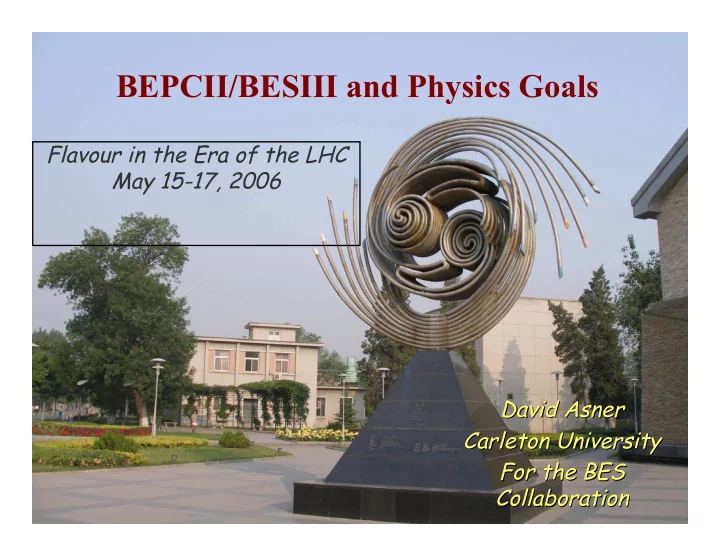
David David Asner Asner Carleton University Carleton University For the BES For the BES Collaboration Collaboration
BEPCII/BESIII and Physics Goals
Flavour in the Era of the LHC May 15-17, 2006
BEPCII/BESIII and Physics Goals Flavour in the Era of the LHC May - - PowerPoint PPT Presentation
BEPCII/BESIII and Physics Goals Flavour in the Era of the LHC May 15-17, 2006 David Asner Asner David Carleton University Carleton University For the BES For the BES Collaboration Collaboration 1 The Beijing Electron Positron Collider
1
David David Asner Asner Carleton University Carleton University For the BES For the BES Collaboration Collaboration
Flavour in the Era of the LHC May 15-17, 2006
L ~ 5 ×1030 /cm2⋅s at J/ψ Ecm~ 2 - 5 GeV A unique e+e- machine in the τ-charm energy region after CLEO-c.
3
SC RF Two rings tunnel
Government approved, and started construction at end of 2003
4
Energy range 1 – 2.1 GeV Optimum energy 1.89 GeV Luminosity 1 x 10 33 cm-2s-1 @ 1.89 GeV Injection Full energy injection: 1.55 1.89 GeV Positron injection speed > 50 mA/min Synchrotron mode 250 mA @ 2.5 GeV
Dual purpose machine
5
6
1029 1030 1031 1032 1033 1034 1035 1036 1037 1 10 100 1000
GLC ADONE VEPP2000 KEK B and PEP II KEK B PEP II CESR DAFNE DAFNE2 BEPCII CESRc E
cm (GeV)
L (cm
VEPP2M LEP TRISTAN PETRA VEPP4M DORIS SPEAR BEPC
COLLIDERS FACTORIES SUPER FACTORIES
L (cm-2 s-1) E (GeV)
– Upgrade of Linac; – Moved BES from beam line, and dismounted; – Improve infrastructure, including the power station。
water pipe and power outlets。finished。
later, Some synchrotron run.
8
new position source; new rf power (klystrons and modulators); and others. Most design specifications reached at 1st test run.
note:1)Two rf power stations were not in operation at the time. 2)The values for 1.89 GeV is extrapolated from those of 1.30 GeV,should be measured when the energy is at 1.89 GeV.
± 0.55 @ 1.89 GeV 2) ± 0.5(0.8) e- ± 0.50 @ 1.89 GeV 2) ± 0.5(0.8) e+ Energy spread
(%)
0.30 @ 1.89 GeV 2) 0.20(0.58) e- 0.93 @ 1.89 GeV 2) 1.60(1.70) e+
Emittance (mm⋅ mrad)
25 ~ 50 50(25) Repetition rate (Hz) > 500 500(50) e- > 63 40(4) e+ current (mA) 1.89 (e-); 1.55 (e+) 1) 1.89(1.55) Beam energy (GeV) Achieved Design (BEPC) parameters
10
Status of Storage ring
super-conducting quadrupole magnets, beam pipes; kicker; beam instruments; control system; vacuum system as well as the cryogenics; most of the systems have been completed;
11
Bending magnets Quadrupole magnets Sextupole magnets Dipole correctors
16
Be beam pipe
Muon Counter
TOF
17
Magnet: 1 T Super conducting
MDC: small cell & He gas
σxy=130 µm σ p/p = 0.5% @1GeV dE/dx=6% TOF: σT = 100 ps Barrel
110 ps Endcap
Muon ID: 9 layer RPC EMCAL: CsI crystal ΔE/E = 2.5% @1 GeV σz = 0.6 cm/√E Trigger: Tracks & Showers Pipelined; Latency = 6.4 µs Data Acquisition: Event rate = 3 kHz Thruput ~ 50 MB/s
The detector is hermetic for neutral and charged particle with excellent resolution , PID adequate, and large coverage.
Two rings, 93 bunches:
1033 cm−2 s−1 @1.89GeV 6× 1032 cm−2 s−1 @1.55GeV 6× 1032 cm−2 s−1 @ 2.1GeV
18
R inner: 63mm ; R outer: 810mm Length (out.): 2582 mm Inner cylinder: 1.2 mm Carbon fiber Outer cylinder: 11.5 mm CF with 8 windows Sense wire : 25 micron gold-plated tungsten (plus 3%Rhenium ) --
Layers (Sense wire ): 43
Expected performance
Field wire: 110 micron gold-plated Aluminum --- 21884 Gas: He + C3H8 (60/40) Cell: inner chamber --- 6 mm
% 6 ~ @1GeV/C % 5 . ~ 130 ~ dx dE P m
dx dE P x
19
20
21
Prototype tested in a 1T magnetic field at KEK 12GeV PS last year. Results:
(3σ π/K separation exceeding 700MeV/c).
22
– Energy: 2.5% @ 1GeV – Spatial: 0.6cm @ 1GeV
– Barrel: 5280 w: 21564 kg – Endcaps: 960 w: 4051 kg – Total: 6240 w: 25.6 T
23
24
Testing:
X position ADC
25
A 1/60 prototype
Status:
Should be completed by end
FED boards should be tested and installed.
26
Crucial for particle ID
– 50mm x 60mm x 2320 mm (inner layer). – BC408 – 2 layers 88x2
– 48 fan shaped pieces – each end. – BC404
27
(intrinsic):
Belle: 70 to 80 ps
Beam tests: < 90 ps
Simulation: < 90 ps
layers is 100ps to 110ps for kaon and pions.
separation up to 0.9 GeV/c. Capability of K/π separation
28
cable, VME readout board of FEE. Pion: 104±11ps proton: 70±2ps Electron: 94±3ps Time resolution from beam test of prototype(including scintillator, PMT, preamp, electronics, cable). Time difference of two TOF layers: no errors from reference time (To) or position.
29
each channel including PMTs and electronics.
approved by DOE: 3/1/2006
TOF endcap 48 fibers TOF endcap 48 fibers
Laser
Light splitter TOF barrel PMT PMT PMT
TDC start ADC gate
Fiber
TOF barrel 176 fibers TOF barrel 176 fibers
Electronic switch
fiber
Fiber bundles
fiber connector
Wrapped with steel tube
30
Coil: single layer solenoid Cooling mode: two phase helium force flow Superconductor: Al stabilized NbTi/Cu Winding: inner winding Cold mass support: tension rod Thermal shield: LN2 shield, MLI Flux return: barrel/end yoke, pole tip
3. 6t
C ol d m ass 15t
T ot al W ei ght 10M J St
energy 3650A N om i nal current 2H Induct ance 1. 0T C ent ral f i el d 2X 0 R adi at i
t hi ckness Electrical parameters 3. 7m m *20m m C abl e di m ensi
1. 375m Inner radius 3. 91m L engt h 1. 7m O ut er radi us C ryost at 3. 52m L engt h 1. 482m M ean radi us C oi l
31
Thermal insulation assembly transportation wiring installation
32
Computer controlled 3D mapping machine is under development. Field measuring accuracy < 0.25%. Measure ~90000 points with 0.5 mm position accuracy. Mapping device
Status:
the magnet before summer.
together with SCQ before
33
Barrel + EndCap; RPC as μ detector; Barrel : 9 layers EndCap: 8 layers One dimension read-out strips;
34
paper laminate on bakelite.
done.
current, and good long-term stability .
35
36
All RPC production, assembly, testing, and installation completed.
37
Average strip efficiency: 0.97 Spatial resolution: 16.6mm Mean of 64 endcap RPC = 0.95
38
μ/π Identification Efficiency
Using Muc Info only % GeV/c
90.3
6.24 5.5 9.0 12.6 18.9 12.0
91.2 87.6
π fake rate μ efficiency Ratio of π decay to μ before entering Muc Design Goal 15.0 9.0 6.0
From Simulation
39
and installed.
size of 12Kb, a factor of two safety margin.
MDC and EMC
1000 * BESII DAQ system
40
HepEvt McTruth G4Event Hits Digits RawData CnvSvc !"#$%%% RawData Generator Event Converters Simulation Digitization Reconstruction Algorithms Calibration Algorithms RecHits RecTracks Analysis Tools DstTracks Histograms Ntuples RootDstCnvSvc DstData Rec2DstAlg
Reconstruction Calibration & Database Framework Core Software Simulaton Physics Analysis Software
BES III Software
BOSS – BES Offline Software System based on Gaudi.
Tremendous amount accomplished so far. Much more to do.
12/01/2006 41
Based on ROOT, OpenGL, X3D and XML Support both 2D and 3D view Operations and controls available through
menu and toolbar items
First version was released in December 2005.
42
SIMULATION – Based on Geant4 MDC tracking performance:
Sub-detector Design MC MDC σw (μm) 130 110 σp/p 0.5% 0.4% σdE/dx 6-7% 6% TOF σt (ps) 90 85 EMC σE/E 2.5% 2.2%
σxy(mm) 6 4.8
MUC ε(μID) 95% 96% ε(π->μ) 6% 6.2% μ- at pt = 1GeV/c Momentum resolution σ = 0.4 MeV
EMC (barrel) Energy Resolution -single γ
43
Ext track Fired strips Window
44
1.0 T 1.0 T magnet
µ counter Rich σT(ps) = 100-110/layer Double layer TOF 2.0% 0.3 cm /√E Δ E/√E(0/0) = 2.5 %(1 GeV) σz(cm) = 0.5cm/√E EMC
6% σdE/dx (0/0) = 6 - 7 %
0.5 % ΔP/P (0/0) = 0.5 %(1 GeV) MDC 90 µm σXY (µm) = 130 CLEOc BES III Detector
~1.2MeV ~3MeV
50, 000 ψ˝ Inclusive event sample. We can learn a lot from CLEOc experience
46
+
σ(mBC) ~ 1.2 MeV/c2 σ(ΔE) = 7 MeV
47
BESIII: (8M , M.C.) m(χc1) = 3.508GeV, m(χc2) = 3.553GeV; σ(χc1) = 8.1MeV, σ(χc2) = 9.4MeV. Ψ' γχ γχcJ , χcJ γJ/ ψ
π0 η
Ψ' J/ψ(π0, η), (π0, η)γγ
m(η) = 549 MeV m(π0) =135 MeV m(χc-) =3.413GeV, σ(χc0) =9.0MeV.
48
Inv.mass of chrg.trks. (GeV) Events
χc1 χc2 χc0 χc1 χc2 χc0 χc1 χc2 χc0
Ψ' γχ γχcJ , χcJ ππππ πππ Ψ' γχ γχcJ , χcJ ππKK
ηc BESIII: (0.5 M , M.C.)
Ψ' γχ γχcJ, χcJ multi-tracks Ψ' γχ γχcJ , χcJ (6π) Ψ' tail
49
Physics Topics at BESIII
χC{0,1,2} , ηC(2S) and hC(1P1) in ψ(2S) decay , ψ(1D) and so on
and ψ(2S) radiative decays;
hadronic decays;
ψ(2S) decays;
50
Absolute BR measurements of D and Ds decays; 1-2% Rare D decay; D0-D0bar mixing;CP violation; f D+, fDs , form factors in semi-leptonic D decays; precise measurement of CKM (Vcd, Vcs); CP violation and strong phase in D Dalitz Decays; light spectroscopy in D0 and D+ Dalitz Decays.
51
1.0 × 10⁶ 0.32 0.6 4.030 DsDs 12 × 106 2.4 1.0 3.670 τ 3.2 × 10⁹ 640 1.0 3.686 ψ(2S) 2.0 × 10⁶ 0.67 0.6 4.140 DsDs 14 × 106 2.8 1.0 3.770 D+D- 18 × 106 3.6 1.0 3.770 D0D0bar 10 × 109 3400 0.6 3.097 J/ψ
Nevents/yr Physics Cross Section (nb) Peak Lum. (1033cm-2s-1) Energy(GeV) Resonance
Average Lum: L = 0.5×Peak Lum.; data taking time: T = 107s/year
Nevent/year = σexp ×L× T
Yearly Event Production
Huge J/ψ and ψ(2S) samples at BESIII Below are a few examples of physics reach
Hints for New Spectroscopy-Challenge QCD
2003 2004 2005
Belle
BaBar BESII J/ψ γ pp
M=1859 MeV/c2 Γ < 30 MeV/c2 (90% CL)
+3 +5
−10 −25 J/ψ γ π+π− η’
Are they the same particle?
X(3872) DsJ(2317) DsJ(2458) Y(3940) Z(3930) X(3940) Y(4260)
X(1835) mass is consistent with the mass of the S-wave resonance X(1860) indicated by the pp mass threshold enhancement.
X(1835)
X(1860) A detail angular analysis will definitely tell us the JPC of X(1835) at BESIII: 35 ×104 events in J/ψ γ pp (ε = 50%) 24 ×104 events in J/ψ γ π+π− η’ (ε = 12%) 10 billion J/ψ
Courtesy of R. Faccini ISR B decays γγ B decay Continuum J/ψccbar
Xiaoyan will talk more in detail.
Glueball, hybrid or exotic search in J/ψ (10×109) @ BESIII f0(600) f0(980) f0(1370) J/ψ (γ, ω, ρ, φ) + f0(1500) and also Tensor candidates f0(1710) and Many threshold enhancements f0(1790)
J/ψ ppbar +X probe excited and exotic baryon states Partial Wave Analysis will be the KEY tool in the study of spectroscopy, some of Key issues should be solved in the future.
Scan of the resonances (3.7 ÷ 4.6 GeV)
) ( ), ( ) / ( ), ( )) ( ( ), / ( ), ( ), (
(*) (*)
e e KK e e J e e e e e e J e e D D e e D D e e
cJ S S
Test QCD @ 3.7 ÷ 4.6 GeV Search for exotic ccbar, Y(4260)
Probe gluon enhanced hidden ccbar states
A detail plan to take data @ BESIII should be made based on the study of R&D in Physics book.
Charmonium below open charm @ BESIII ??
1974 1974 1980 2002 2004
1977
1975
Ψ(2S) π+π−J/ψ (31%) (31%) really “pure” J/ψ sample a complementary of J/ψ peak data! χc,0,1,2 sample useful to understand the decay dynamics of ccbar and light hadron with same JPC!
ηc′ in ψ(2S) γ KSKπ ψ(2S) γ π+π−ηC
with untagged
gamma
hep-ph/0206240 B(ηC(2S) π+π ηC ) = 5-10%
Detail study of hC at BESIII
2S – 1D mixing : “ρ π” puzzle
(094002) 2001
PRD70(114014)20 04 Non-DD decay of ψ (3770):
ph/0505146 The production
ph/0402171
ηC(1S) sample from J/ψ γ ηC(1S) used to study the light spectrum
BES III Charm Mixing
Mixing: ψ(3770)→DD(C = -1) Coherence simplifies study DCSD interfere away so not a background Unmixed: D0→ K−π+ D0→ K+π− mixing: D0→ K−π+ D0→ D0 →K−π+ Can add lepton final states (Klv Klv) Sensitivity: current limit: 10−3 K−π+ vs K−π+
in (K−π+)(K+π−)
~1 background event is expected
rM sensitivity 10−4 with 20 fb−1 K−π+ vs K+π−
Efficiency: 12.5%
+
=
+
K
B B q p y x K K D D K K D D
2 2 2 2 2 2
2 )) )( ( ( )) )( ( (
BESIII
Direct CP Violation at ψ (3770) at BESIII
* * 2 4 3 2
Im sin sin 10
cd ud cs us PT PT
V V V V P P Acp A T T
measured by searching for events with two CP odd or two CP even final states ex:
ACP sensitivity 10-2 - 10-3 K K vs ππ
Beam constraint Mass
Semileptonic decay and CKM Matrix at BESIII
( )
2 3 2 3 2 2
24 ( )
cq P
V P f D P dq q d
l
To find Vcs & Vcd need form factor from theory at one fixed q2 point.
2 2 2 pole
(0) ( ) 1 / f f q q m
+ +
= Form factor term come from theory (Lattice QCD). Supposing ΔFF/FF ~3% , BESIII will get
Well measured
BESIII: Integrate Lumi. 20fb−1 DDbar MC simulation
l
ν
D π
l
ν
D
Κ δVcd/Vcd 4% δVcs/Vcs 11%
BESIII
δVcd/Vcd 1.7% δVcs/Vcs 1.6%
l
ν
D π
l
ν
D
Κ Quark models, HQET, Lattice & other methods have all been invoked to calculate form factor absolute normalizations. These calculations have been done mostly at q2 =0 or q2 =q2
Great contribution to CKM Unitarity
58
In US:
In China: BESIII commissioning in summer 2007. BESIII will be a unique facility.
59
First formal meeting held Jan. 10-12, 2006 at IHEP, Beijing. Adopted Governance Rules, elected IB Chair and Spokespersons.
Institute of High Energy Physics University of Science and Technology Peking University Tsinghua University Shangdong University Nankai University Central China Normal University University of Anhui University of Zhejiang University of Zhengzhou Nanjing Normal University Nanjing University Shanxi University Sichuan University Henan Normal University
University of Hawaii
University of Washington University of Tokyo Joint Institute of Nuclear Research, Dubna GSI University of Bochum University of Giessen
Need more here!
60
BESIII physics: a summary
experimental tau-charm physics and the BESIII physics reach. http://bes.ihep.ac.cn/bes3 /phy_book/book/book.html
– Charm 2006: International tau-Charm workshop Beijing June 5-7 2006 – US-China workshop on HEP cooperation
61
begins.
rapidly, although still much to do.
2007.
62
63
quadrapole; detector sc magnet;
take data without too much backgrounds;
systematic errors of the measurements, and how to improve the partial wave analyses.
64
Observation of an anomalous enhancement near the threshold of mass spectrum at BES II M=1859 MeV/c2 Γ < 30 MeV/c2 (90% CL)
M(pp)-2mp (GeV) 0.1 0.2 0.3
3-body phase space acceptance
χ2/dof=56/56 acceptance weighted BW
+3 +5
−10 −25
p p
65
loosely bound 3-q 3-q color singlets with Md = 2mp- ε
loosely bound 3-q 3-q color singlets with Mb = 2mp-δ ?
attractive nuclear force attractive force? There is lots & lots of literature about this possibility
(1949) … I.S. Sharpiro, Phys. Rept. 35, 129 (1978) C.B. Dover, M. Goldhaber, PRD 15, 1997 (1977) …
M.L. Yan et al., hep-ph/0405087
Observations of this structure in other decay modes are desirable.
66
'
' / J '
' ' / J
X(1835) 6.0 σ X(1835) 5.1 σ
67
Statistical Significance 7.7 σ
Combine two channels
X(1835)
7.7σ
68
X(1835) could be the same structure as X(1860) indicated by pp mass threshold enhancement
S-wave resonance X(1860) indicated by the pp mass threshold enhancement. Its width is 1.9σ higher than the upper limit of the width obtained from pp mass threshold enhancement.
the fit of the pp mass spectrum, the width of the resonance near pp mass threshold will become larger.
69
M = 1830.6 ± 6.7 MeV Γ = 0 ± 93 MeV In good agreement with X(1835)
Include FSI curve from A.Sirbirtsev et al.(hep-ph/ 0411386) in the fit (I=0)
BES II Preliminary
70
M(π+π-π0) M(K+K-) ωφ ωφ φφ φφ M(K+K-)
φ ω φ
M(π+π-π0)
BES II Preliminary
Observation of ωφ threshold enhancement in J/ψ → γωφ
M2(γω γω) M2(γφ)
71
DOZI decay of J/ψ→γωφ →γωφ is observed, a clear threshold enhancement is observed
Phase Space Side-bands
B E S I I P r e l i m i n a r y
Side-bands do not have mass threshold enhancement!
72
4
10 ) 65 . 27 . 61 . 2 ( ) ( ) / (
± =
Br X J Br
2 2 19 26
+
BES II Preliminary
Submitted to Phys. Rev. Lett., hep-ex/0602031 What is the nature of this structure?
hep-ph/0602172, hep-ph/0602190
73
Methods for extraction of γ at B factories
Limited by uncertainty due to Dalitz plots Model in D0 decays currently 110
γ γ = 68 = 68+14
+14
±13 13 ± ±11 11 22 < 22 < γ γ < 113 (@2 < 113 (@2σ σ) )
Belle hep-ex/0411049 Giri Giri-Grossman-
Soffer-
Zupan (GGSZ) PRD68, 054018(2003) (GGSZ) PRD68, 054018(2003)
)) , ( ) , ( ( 12 13 13 12
12 13 13 12
) , ( ) , (
s s s s i D i i B D B
e s s f e r s s f f
B
=
where the other (tag-side) D meson is reconstructed in CP eigenstate, such as K+K− or Ks π0 and so on. @BESIII We need to do detail MC study and more theoretical input to the physics book
74
CP properties of the D states produced in the Ψ (3770) are anticorrelated. If one D decaying as CP=+1 other state is “CP-tagged” as CP=-1 32,000 CP-tagged K+π- decays are expected for one year run at CLEO-c (G.Burdman, I.Shipsey hep-ph/0310076) ??? Based on this number we can estimate: 10,000 KSπ+π− 7,500 π+ π− π0 at BESIII / 2 years 10-fb 1,900 KSK+K-
The δ(cos(δD)) 2% 10 –20 for γ at B
factories A.E. Bonder hep-ph/0510246
CP=+1 CP=-1
75
Measurement of Strong Phase
D
r
Flavor mode
cos δD ~ ±2% at BESIII
If CP violation in Charm is neglected: mass eigenstates = CP eigenstates