Fisheries Management Common Property Resources Tragedy of the - - PDF document

fisheries management common property resources
SMART_READER_LITE
LIVE PREVIEW

Fisheries Management Common Property Resources Tragedy of the - - PDF document

Fisheries Management Common Property Resources Tragedy of the Commons When resource owned by all, no incentive to conserve or invest in resource. To prevent this tragedy, most common property resources are held in trust and


slide-1
SLIDE 1

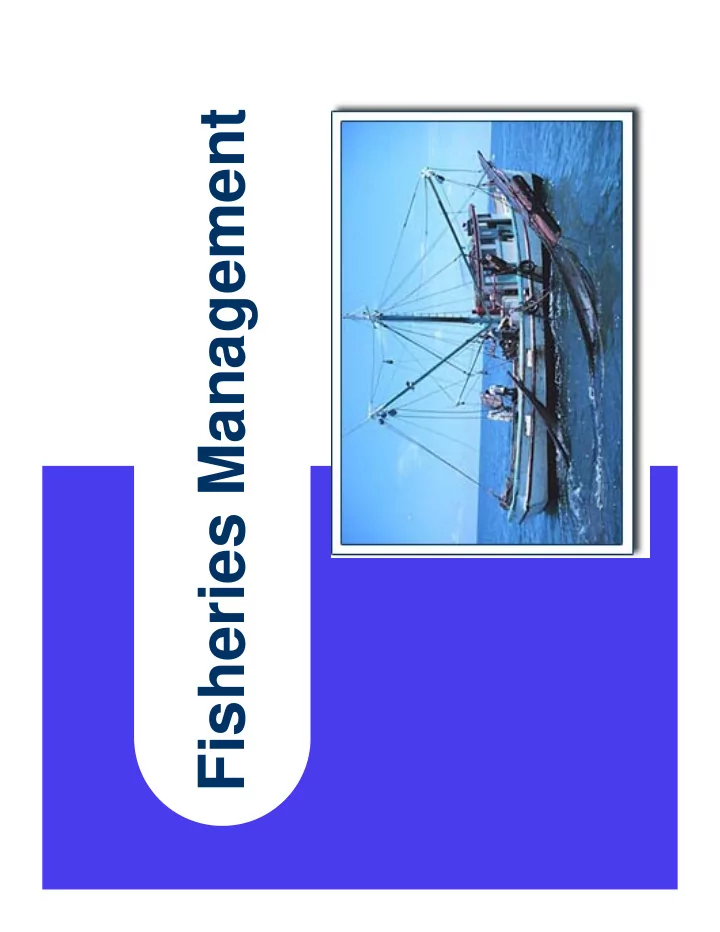
Fisheries Management

slide-2
SLIDE 2

Common Property Resources

Tragedy of the Commons

– When resource owned by all, no incentive to

conserve or invest in resource.

To prevent this “tragedy”, most common

property resources are held in trust and managed for the people by state and federal government agencies.

So who owns the fish? We do!

slide-3
SLIDE 3

Magnuson- Stevens Fishery Conservation and Management Act

Primary law regulating U.S. fisheries.

– Authorized the federal government to regulate

fishing from three miles offshore (nine off Texas and Florida Gulf Coast) out to 200 miles. (EEZ)

– Original purposes of the act – conserve fish

stocks and eliminate foreign fishing while developing a sustainable U.S. fishing industry.

Reauthorized in 1996 and 2006

slide-4
SLIDE 4

Federal and State Authorities

NOAA Fisheries has primary responsibility

from three miles to 200 miles offshore.

Coastal states are responsible for inshore

waters and offshore waters out to three miles, with exceptions in Florida and Texas

slide-5
SLIDE 5

Fishery Management Councils

slide-6
SLIDE 6

Membership

Voting members include:

– Each state’s director of marine fisheries; – One individual from each state knowledgeable or

experienced in recreational or commercial fishing,

  • r marine conservation;

– At-large members from any of the states in the

region;

– Regional director of NOAA Fisheries for the area.

slide-7
SLIDE 7

Panels and Committees

Advisory Panels Scientific, Management, and Statistical

Committees

Stock Assessment Panels

slide-8
SLIDE 8

Fisheries Management Plans (FMPs)

Produced by the Councils for implementation

by Secretary of Commerce.

– Must protect fisheries resources while maintaining

  • pportunities for commercial and recreational fishing

at sustainable levels.

Describe the nature and problems of a fishery

and regulatory recommendations to conserve the fishery.

slide-9
SLIDE 9

Ten National Standards

  • FMPs must conform to Ten National

standards identified in the Act.

  • Standards 1, 2, 8, and 9 are most

commonly referenced.

slide-10
SLIDE 10

Standard # 1

Conservation and management measures shall prevent overfishing while achieving, on a continuing basis, the optimum yield from each fishery for the United States fishing industry.

slide-11
SLIDE 11

Overfishing vs. Overfished

Overfishing

– Refers to removals from the population. – Implies that too many fish are being killed

annually.

Overfished

– Implies that a population has declined to

biomass levels that are below an established threshold.

slide-12
SLIDE 12

Standard # 2

Conservation and management measures shall be based upon the best scientific information available.

slide-13
SLIDE 13

Standard # 8

Measures shall, consistent with conservation requirements, take into account the importance of fishing resources to fishing communities to provide for sustained participation and minimize adverse economic impacts.

slide-14
SLIDE 14

Standard # 9

Conservation and management measures shall, to the extent practicable, (A) minimize bycatch and (B) to the extent bycatch cannot be avoided, minimize the mortality of such bycatch.

slide-15
SLIDE 15

Bycatch

“Fish which are harvested in a fishery, which

are not sold or kept for personal use.”

– Includes economic discards and regulatory discards – Excludes fish released alive under a recreational

catch and release program.

Many FMPs require the use of bycatch

reduction devices (BRDs).

slide-16
SLIDE 16

Turtle Excluder Devices (TEDs)

slide-17
SLIDE 17

Reauthorization

On January 12, 2007, the President signed the Magnuson-Stevens Fishery Conservation and Management Reauthorization Act of 2006 into law, strengthening the 1996 provisions and extending the Act until 2013.

slide-18
SLIDE 18

New Mandate to End Overfishing

  • Rebuilding plans to end overfishing must be

developed and implemented within two years

  • f a declaration that a stock is overfished.
  • FMPs must now establish a mechanism for

specifying annual catch limits at a level that prevents overfishing.

  • Catch limits must be in place by 2010 for stocks

already subject to overfishing.

slide-19
SLIDE 19

Limited Access Privilege Programs

Basically a new term for IFQ programs. LAPPs assign specific shares of the annual

harvest quota to eligible fishermen, fishing communities, and regional fishing associations.

There is a term limit of 10 years on quota

shares.

slide-20
SLIDE 20

Deep Sea Coral Protection

Authorizes inclusion of deep sea coral

protections in FMPs.

Mandates the mapping of coral locations and

development of technologies to assist fishermen in reducing the fishing gear interactions.

slide-21
SLIDE 21

Coastal Conservation Assn. v. Gutierrez

Challenge to NMFS’ adoption

  • f Amendment 22 to the Gulf of

Mexico Reef Fishery Management Plan.

In March, Texas District Court

  • rdered the Secretary to issue

a red snapper rebuilding plan with measures to reduce bycatch in the shrimp fishery within the next nine months

slide-22
SLIDE 22

Unit 5: Aquaculture

slide-23
SLIDE 23

Policy Context

The United States is a net importer of

seafood, with a current seafood trade deficit

  • f approximately $8 billion.

About 40 percent of the seafood imported

into the United States is farm raised, mostly consisting of salmon and shrimp.

slide-24
SLIDE 24

Ocean Spar 3000

slide-25
SLIDE 25

Current Federal Regulatory Regime

National Aquaculture Act of 1980 Clean Water Act Magnuson-Stevens Fishery Conservation

and Management Act

slide-26
SLIDE 26

Major Concerns

Conflicting/Competing Uses Escapes Water Pollution Habitat Impacts Increased Pressure on Wild Stocks

slide-27
SLIDE 27

NOAA’s Definition

"The propagation and rearing of aquatic

  • rganisms in controlled or selected

environments for any commercial, recreational or public purpose."

slide-28
SLIDE 28

National Offshore Aquaculture Act of 2007

Purpose: Create regulatory framework

allowing for safe and sustainable aquaculture

  • perations for fish and shellfish in U.S.

federal waters (3 – 200 miles offshore).

Transmitted to the Congress on March 12,

2007.

Introduced by Representative Rahall (D-WV)

  • n April 24, 2007 (H.R. 2010).
slide-29
SLIDE 29

What would the Act do?

Authorize the Secretary of Commerce to issue

  • ffshore aquaculture permits.

Require Sec. to establish environmental

requirements.

Require Sec. to work with other agencies to

develop and implement coordinated permitting process.

Exempt permitted offshore aquaculture from

fishing regulations that restrict size, season and harvest methods.