First-principles modeling of defects and hydrogen in oxides Chris - - PowerPoint PPT Presentation

first principles modeling of defects and hydrogen in
SMART_READER_LITE
LIVE PREVIEW

First-principles modeling of defects and hydrogen in oxides Chris - - PowerPoint PPT Presentation

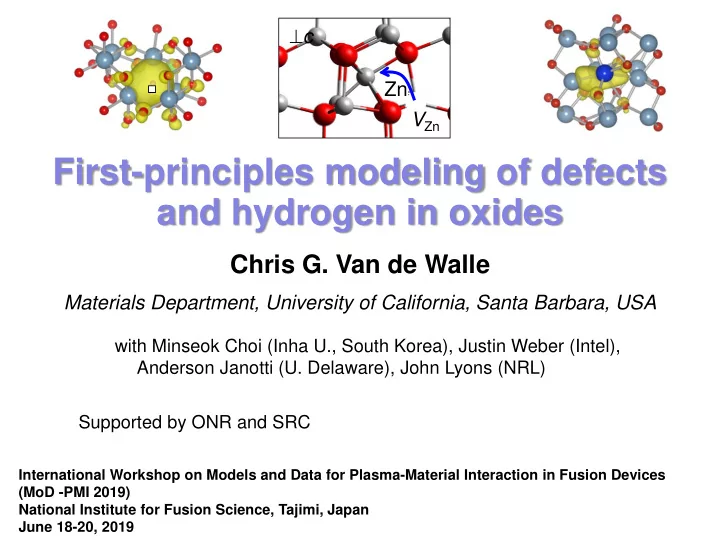
c Zn i V Zn First-principles modeling of defects and hydrogen in oxides Chris G. Van de Walle Materials Department, University of California, Santa Barbara, USA with Minseok Choi (Inha U., South Korea), Justin Weber (Intel), Anderson


slide-1
SLIDE 1

First-principles modeling of defects and hydrogen in oxides

Chris G. Van de Walle

Materials Department, University of California, Santa Barbara, USA

with Minseok Choi (Inha U., South Korea), Justin Weber (Intel), Anderson Janotti (U. Delaware), John Lyons (NRL) Supported by ONR and SRC

International Workshop on Models and Data for Plasma-Material Interaction in Fusion Devices (MoD -PMI 2019) National Institute for Fusion Science, Tajimi, Japan June 18-20, 2019

Zni ⊥c VZn

slide-2
SLIDE 2

Van de Walle Computational Materials Group

www.mrl.ucsb.edu/~vandewalle

Nitrides

  • Doping
  • Surfaces
  • Interfaces
  • Efficiency, loss

Ga N N

First-principles calculations

Density functional theory, many-body perturbation theory

Hydrogen as a fuel

  • Kinetics
  • Complex hydrides
  • Metal hydrides
  • Proton conductors

Oxides

  • Transparent

conductors

  • Dielectrics
  • Thermal barriers
  • Complex oxides

Quantum computing with defects

  • Qubits
  • Single photon emitters
slide-3
SLIDE 3

Computational Approach

  • Traditional density functional theory approach

–Local or semi-local density approximation

  • Hard to interpret due to band-gap problem
  • Major problem when addressing defects or

surface/interface states

  • Our approach: Hybrid functional calculations

–The HSE hybrid functional

  • A fraction of screened Hartree-Fock exchange
  • Accurate band gaps and defect levels
  • 120-atom supercell, 400 eV cutoff energy,

2x2x1 k-point mesh

  • J. Heyd, G. E. Scuseria, M. Ernzerhof, J. Chem. Phys 118, 8207 (2003).
slide-4
SLIDE 4

Defect Formation Energy

− +

VO

Al2O3: VO Al2O3

+

½ O2 1 2

− +

O chemical potential

Determine defect concentrations: [D]=NO exp(-Ef/kT)

slide-5
SLIDE 5

Defect Formation Energy

− +

VO

Al2O3: VO Al2O3

+

½ O2 1 2

− +

e-

e− @ εF

εF

+

+

O chemical potential

Determine defect concentrations: [D]=NO exp(-Ef/kT)

slide-6
SLIDE 6

Defect Formation Energy

− +

VO

Al2O3: VO Al2O3

+

½ O2 1 2

− +

e-

e− @ εF

εF

  • O chemical potential

Determine defect concentrations: [D]=NO exp(-Ef/kT)

“First-principles calculations for point defects in solids”,

  • C. Freysoldt, B. Grabowski, T. Hickel, J. Neugebauer, G. Kresse,
  • A. Janotti, and C. G. Van de Walle, Rev. Mod. Phys. 86, 253 (2014).
slide-7
SLIDE 7

Defect Formation Energies

O-Rich Al-Rich

  • Plotted for extreme Al-rich and

O-rich limits

  • Very wide range given by

ΔHf (Al2O3)= -17.36 eV

  • Actual chemical potential is

somewhere in between

  • Slope indicates charge
  • Kinks: charge transition levels
  • Information used to study fixed

charge and defect levels

Fermi level (eV) Formation Energy (eV)

example: VO

slide-8
SLIDE 8

Native point defects in α-Al2O3

Fermi level (eV) Fermi level (eV)

O-Rich Al-Rich

Formation Energy (eV)

VO VAl Ali Oi

slide-9
SLIDE 9

Defect level positions in α-Al2O3

Conduction band Valence band

Energy (eV)

VO VAl Ali Oi

(0/2-) (3+/+) (+/0) (2+/+) (+/0) (0/-) (0/-) (2-/3-) (-/2-)

slide-10
SLIDE 10

Ali VO

e−

O Al

VAl

h+

Local geometry and charge densities

Oi

VO VAl Ali Oi

slide-11
SLIDE 11

Defect levels in κ- and α-Al2O3

κ: J. R. Weber, A. Janotti, and C. G. Van de Walle, J. Appl. Phys. 109, 033715 (2011). α: M. Choi, A. Janotti, and C. G. Van de Walle, J. Appl. Phys. 113, 044501 (2013).

Energy (eV) VO VAl Ali Oi OAlAlO VO VAl Ali Oi α-Al2O3 κ-Al2O3 ** GaN

slide-12
SLIDE 12

Hydrogen in Al2O3

Fermi level (eV)

Al-rich

Formation Energy (eV)

HO Hi

O-rich μO = -0.65 eV O2 gas @ 270 oC and 1 Torr

slide-13
SLIDE 13

Hydrogen in Al2O3

Fermi level (eV) Formation Energy (eV)

HO Hi

2 4 6 8 8 6 4 2

  • 2
  • 4
  • 6

+1

  • 1

+1

  • 1
  • Hydrogen can easily incorporate

into Al2O3

  • Hydrogen occupies the

interstitial site (Hi)

  • (+/-) impurity level near mid-gap
  • Low migration energy
  • Hi can interact with native

defects or impurities in Al2O3

α-Al2O3 μO = −0.65 eV O2 gas @ 270 oC and 1 Torr

slide-14
SLIDE 14

H complexes with Al vacancy in Al2O3

Fermi level (eV) Formation Energy (eV) 2 4 6 8 6 4 2

  • 2
  • 4
  • 6

κ-Al2O3

  • Al vacancy:

−3 charge state over most of Al2O3 band gap negative fixed-charge center

  • H captured by Al vacancy:
  • VAl+nH (n=1,3) complexes lower

the electrical charge of VAl

  • VAl+3H complex is electrically

inactive

VAl Hi VAl+H VAl+2H VAl+3H

slide-15
SLIDE 15

Local geometry and charge density

Ga N H C

GaAl NO CAl Hi

slide-16
SLIDE 16

Gallium in Al2O3

Fermi level (eV)

Ga-rich

Formation Energy (eV)

GaAl GaO Gai

O-rich μO = -0.65 eV O2 gas @ 270 oC and 1 Torr

slide-17
SLIDE 17

Nitrogen in Al2O3

Fermi level (eV)

Al-rich

Formation Energy (eV)

NO NAl Ni

O-rich μO = -0.65 eV O2 gas @ 270 oC and 1 Torr

slide-18
SLIDE 18

Carbon in Al2O3

Fermi level (eV)

Al-rich

Formation Energy (eV)

CO CAl Ci

O-rich μO = -0.65 eV O2 gas @ 270 oC and 1 Torr

slide-19
SLIDE 19

Impurity Levels in Al2O3

Energy (eV) GaN Al2O3

CAl Ci CO NAl Ni NO HO Hi

(+1/-1) (+1/-1) (0/-1) (+1/0) (-1/-2) (+1/-1) (+3/+1) (+4/+3) (0/-1) (+3/0) (+2/+1) (0/-1) (+1/0) (-1/-2) (0/-1) (+2/0) (+3/+2) (+4/+3) (0/-1) (0/+1) (+4/+3) (+3/+2) (0/-1)

EFermi

GaAl Gai GaO

(+2/+1) (+1/-1) (+3/+1) (-1/-3) (0/-1) (+1/0)

slide-20
SLIDE 20

Diffusion of point defects

Side View Top View

  • Relevant for …

– growth

» Defects ‘frozen in’ or not

– Ion implantation

» Anneal damage

– Degradation – Irradiation

  • Zinc interstitial:

– Em=0.57 eV

slide-21
SLIDE 21

Annealing temperature of point defects

Eb (eV) T annealing (K) Zni

2+

0.57 219 VZn

2-

1.40 539 VO

2+

1.70 655 VO 2.36 909 Oi

0(split)

0.87 335 Oi

2-(oct)

1.14 439      − Γ = Γ kT Eb exp

1 13

s 10

≈ Γ

1

s 1 − ≈ Γ

  • A. Janotti and C. G. Van de Walle, Phys. Rev. B 76, 165202 (2007).
slide-22
SLIDE 22

Summary

  • First-principles calculations provide qualitative insights and

quantitative details for point defects

  • Native defects and impurities in Al2O3
  • References
  • Defects: C. Freysoldt, B. Grabowski, T. Hickel, J. Neugebauer, G. Kresse,
  • A. Janotti, and C. G. Van de Walle, Rev. Mod. Phys. 86, 253 (2014).
  • κ-Al2O3: J. R. Weber, A. Janotti, and C. G. Van de Walle, J. Appl. Phys. 109,

033715 (2011).

  • α-Al2O3: M. Choi, A. Janotti, and C. G. Van de Walle, J. Appl. Phys. 113,

044501 (2013).

  • ZnO: J. L. Lyons, J. B. Varley, D. Steiauf, A. Janotti and C. G. Van de Walle, J.
  • Appl. Phys. 122, 035704 (2017).
  • GaN: J. L. Lyons and C. G. Van de Walle, NPJ Comput. Mater. 3, 12 (2017).