
SLIDE 1
18TH INTERNATIONAL CONFERENCE ON COMPOSITE MATERIALS
1 Introduction Plain weave fabrics are used as reinforcements in composites in order to obtain balanced ply properties and improved inter-laminar properties. These advantages are realized at the cost of reduced stiffness and strength in the in-plane directions. So, it is necessary to study the mechanical behavior of such composites in order to fully realize their potential. Plain weave fabrics are formed by interlacing or weaving two sets of orthogonal tows. The tows in the longitudinal direction are known as warp tows. The tows in the transverse direction are known as the fill tows or weft. The interlacing causes bending in the tows, called tow crimp. Plain weave fabrics can be arranged in different laminate stacking configurations [1]. A single lamina consists of warp and fill-tows surrounded by matrix in a single layer as shown in Fig.1. The iso-phase configuration consists of plain weave laminate arranged one above the other so that the undulations are in phase. The
- ut-of-phase configuration consists of plain weave
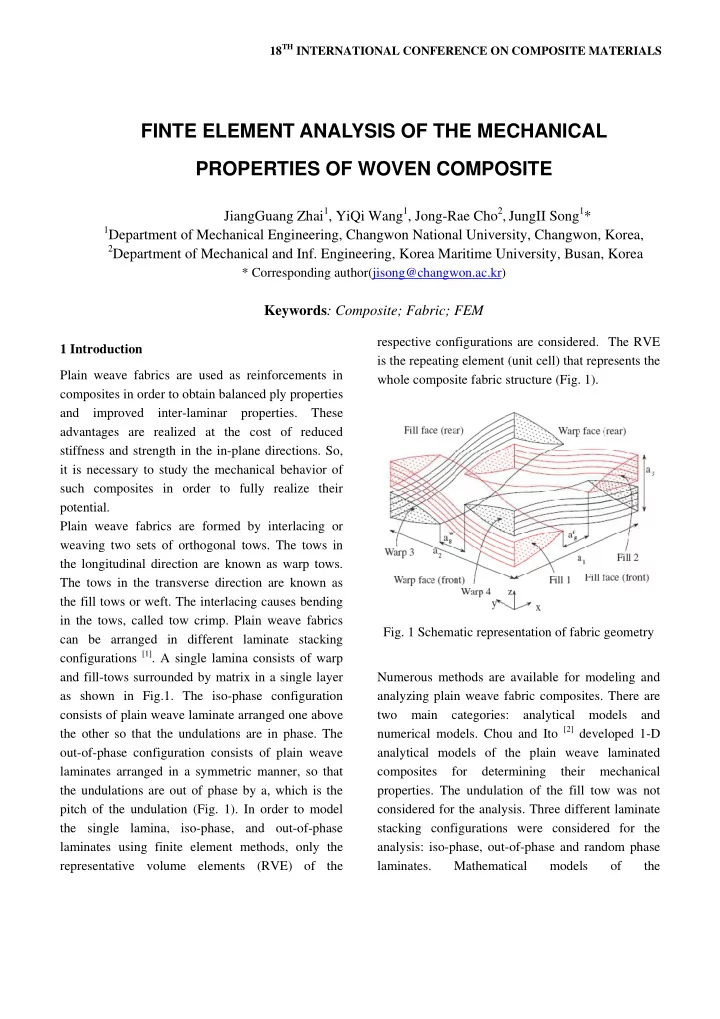
laminates arranged in a symmetric manner, so that the undulations are out of phase by a, which is the pitch of the undulation (Fig. 1). In order to model the single lamina, iso-phase, and out-of-phase laminates using finite element methods, only the representative volume elements (RVE) of the respective configurations are considered. The RVE is the repeating element (unit cell) that represents the whole composite fabric structure (Fig. 1).
- Fig. 1 Schematic representation of fabric geometry
Numerous methods are available for modeling and analyzing plain weave fabric composites. There are two main categories: analytical models and numerical models. Chou and Ito [2] developed 1-D analytical models of the plain weave laminated composites for determining their mechanical
- properties. The undulation of the fill tow was not
considered for the analysis. Three different laminate stacking configurations were considered for the analysis: iso-phase, out-of-phase and random phase laminates. Mathematical models
- f
the
FINTE ELEMENT ANALYSIS OF THE MECHANICAL PROPERTIES OF WOVEN COMPOSITE
JiangGuang Zhai1, YiQi Wang1, Jong-Rae Cho2, JungII Song1*
1Department of Mechanical Engineering, Changwon National University, Changwon, Korea,