Financial markets in developing countries (rough notes, use only as - - PowerPoint PPT Presentation

financial markets in developing countries rough notes use
SMART_READER_LITE
LIVE PREVIEW

Financial markets in developing countries (rough notes, use only as - - PowerPoint PPT Presentation

Econ 355W - A. Karaivanov Lecture Notes Financial markets in developing countries (rough notes, use only as guidance; more details provided in lecture) The role of the fi nancial system matching savers and investors (otherwise each person


slide-1
SLIDE 1

Econ 355W - A. Karaivanov Lecture Notes

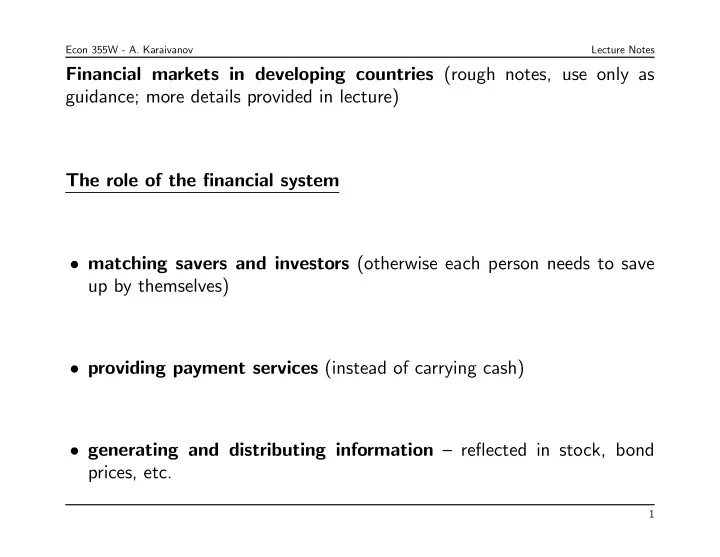
Financial markets in developing countries (rough notes, use only as guidance; more details provided in lecture) The role of the financial system

  • matching savers and investors (otherwise each person needs to save

up by themselves)

  • providing payment services (instead of carrying cash)
  • generating and distributing information — reflected in stock, bond

prices, etc.

1

slide-2
SLIDE 2

Econ 355W - A. Karaivanov Lecture Notes

  • allocation of credit/capital in the economy (to the uses that yield

greatest returns)

  • pricing, pooling and trading risk (through the insurance market, part
  • f the financial system)
  • providing asset liquidity (some investments are long-lived; but can be

made liquid through the stock market, etc.)

2

slide-3
SLIDE 3

Econ 355W - A. Karaivanov Lecture Notes

Credit markets

  • matching skills with resources
  • if

financial markets are efficient (perfect information, perfect enforcement) then resources flow to highest returns (highest skills)

  • otherwise, economic outcomes depend on how much wealth people start

with, not their talents

  • thus, financial markets are important for efficiency, for the economy to

reach its potential

3

slide-4
SLIDE 4

Econ 355W - A. Karaivanov Lecture Notes

  • Why are financial markets particularly likely to be imperfect in developing

countries?

  • Buying something vs. paying are often separated over time
  • Presence of ‘transaction costs’ — when the time to pay comes people can

be: — unable to repay (information needed in advance to prevent this; this is costly) — unwilling to repay (enforcement needed ex-post to prevent this; this is costly) — evidence from India: in 1997, 3.2 outstanding debt cases; 40% for more than 8 years — also, limited liability — in today’s world there are legal limits on punishment for reneging on contracts (not true in the past or in black markets)

4

slide-5
SLIDE 5

Econ 355W - A. Karaivanov Lecture Notes

Lenders anticipate these issues, so they:

  • screen borrowers (if asymmetric information problem in borrower’s

riskiness/type)

  • monitor borrowers (if asymmetric info in borrower’s effort — if cannot
  • bserve it)
  • threaten to cut off from future loans (to help with enforcement problems)
  • require collateral (to help with enforcement problems)

5

slide-6
SLIDE 6

Econ 355W - A. Karaivanov Lecture Notes

FACTS

  • high interest rates in LDCs (Banerjee, 2004) — 52% in rural areas in

India; 28-62% in urban; in the US — 6-14% 1980-2000 — cannot be explained by default alone (explains at most 23% of the interest rate level) — cannot be explained by monopoly power alone — why kill the demand so much? also, public banks and competition from informal sector present

  • presence of large informal sector, including moneylenders (provides 20-

30% of all loans)

  • personalized interest rates (co-existence of various rates, e.g. 12% vs.

60% without arbitrage)

  • loan amount often restricted by borrower’s wealth/assets — no more loans

possible, no matter what the interest rate — “credit rationing”

6

slide-7
SLIDE 7

Econ 355W - A. Karaivanov Lecture Notes

  • some people not given a loan of any amount and at any offered interest

rate (not consistent with standard supply and demand theory under perfect markets)

7

slide-8
SLIDE 8

Econ 355W - A. Karaivanov Lecture Notes

  • Evidence for transaction costs:

— the case of Debt Recovery Tribunals in India (Visaria, 2007) — sped up resolution of civil cases about unpaid loans; — reduced loan delinquency by 6-11 percentage points — interest rates fell by 1-2 percentage points

  • Cross-country evidence (Djankov et al. 2006)

— study 129 countries over 25 years — finds that lenders’ legal rights (ability to enforce repayment; sell the collateral) is positively correlated with the private debt to GDP ratio

8

slide-9
SLIDE 9

Econ 355W - A. Karaivanov Lecture Notes

  • Financial development and growth (Rajan and Zingales, 1998)

— across countries the size of domestic credit market positively correlated with GDP per capita — however, causality can run the other way around — richer countries may have larger market for credit — or, both can be caused by third factors (institutions, good government policies) — however, they also find a strong positive evidence on financial development on growth of industries that are more credit-dependent.

  • King and Levine (1993) — find positive correlation between higher initial

levels of financial development and subsequent growth (controlling for many country and policy characteristics)

9

slide-10
SLIDE 10

Econ 355W - A. Karaivanov Lecture Notes

THEORY Three major problems causing financial market imperfections

  • 1. Limited enforcement — borrowers can default even if able to pay
  • 2. Moral hazard — unobserved effort by borrowers affect the probability of

successful investment, hence repayment

  • 3. Adverse selection — unobserved characteristics by borrowers (e.g.,

riskiness) affect probability of repayment

  • the reason for the market imperfections/failure is either contract

enforcement problem (1.) or asymmetric information between lenders and borrowers (2. and 3.)

10

slide-11
SLIDE 11

Econ 355W - A. Karaivanov Lecture Notes

Limited Enforcement Example

  • suppose the borrower can choose not to repay since probability of getting

caught (loan enforced) is π < 1 — limited enforcement

  • penalty if default and caught is F; interest rate r, e.g. 20% (i.e. for $1

borrowed must return $(1 + r), e.g. $1.20)

  • investment of I needed to set up production; borrower has initial wealth

A < I

  • borrower borrows I − A
  • output is q (if investment made)
  • the borrower will not default if:

q − (1 + r)(I − A) > q − πF (1)

11

slide-12
SLIDE 12

Econ 355W - A. Karaivanov Lecture Notes

  • the above inequality says that the income if not default (left hand side)

should be larger than the expected income if default (escape with the money) — the right hand side

  • from (1), we obtain that default will not happen as long as:

A > I − πF 1 + r (2)

  • thus, only people with high enough wealth will be lent to (the lender will

not lend to someone they know will default; think of F as jail time, etc. not something that the lender gets).

  • note how the limited enforcement problem creates credit rationing and

inefficiency! — some poor people will not obtain loans, even if their business projects are profitable (say q > (1 + r)I)

12

slide-13
SLIDE 13

Econ 355W - A. Karaivanov Lecture Notes

  • the minimum wealth necessary to borrow depends on πF — the highr the

fine or the probability of repayment — the more people will be able to

  • borrow. On the other hand, the higher I (i.e., the loan required) or the

interest rate, the higher the wealth threshold.

  • Note if the right hand side in (2) is negative then any person can borrow.
  • refusing future loans or interlinking can alleviate the above problems

13

slide-14
SLIDE 14

Econ 355W - A. Karaivanov Lecture Notes

Moral Hazard Example

  • suppose output from a business can be either high (success), yH = 2 or

low (failure), yL = 0

  • the probability of success is a function of borrower’s ‘effort’, e; assume

for simplicity prob(yH) = e and prob(yL) = 1 − e.

  • putting effort is costly, cost 1

2e2

  • investment I = 1 required to run business; opportunity cost of funds, ρ
  • assume yH > (1 + r)I — i.e. the investment is worth doing (2 > 1 + r)

Case I: self-financed entrepreneur max

e

e(2) − ρ(1) − 1 2e2

14

slide-15
SLIDE 15

Econ 355W - A. Karaivanov Lecture Notes

take the derivative and set to zero to find the optimal effort level: e∗ = 2

15

slide-16
SLIDE 16

Econ 355W - A. Karaivanov Lecture Notes

Case II: borrowing when effort is observable (no incentive/moral hazard problems)

  • the efficient effort level e∗ will be achieved if it is possible to monitor

effort.

  • assume the lender is only paid in case of success (the borrower has

nothing otherwise)

  • The lender’s expected profit is: ΠL = eI(1 + r) − ρI = e(1 + r) − ρ
  • the borrower’s expected profit is ΠB = e(yH − (1 + r)I) − 1

2e2 =

e(1 − r) − 1

2e2

  • if effort is monitorable, the two parties will choose e in the the optimal

way to maximize joint profits: Π = ΠL + ΠB = 2e − ρ − 1

2e2 which is

exactly the same expression as that of the self-financed entrepreneur.

  • the same, first-best effort level, e∗ is obtained as a result.

16

slide-17
SLIDE 17

Econ 355W - A. Karaivanov Lecture Notes

Case III: moral hazard due to unobservable effort

  • suppose now the lender cannot observe the effort the borrower puts in
  • the borrower knows that when output is low he will pay nothing, while

when output is high he must pay the interest;

  • it’s as if the borrower’s success is ‘taxed’ — reduces his incentive to put

in effort (a ‘moral hazard’ problem occurs)

  • The borrower chooses effort alone (to maximize his own income):

max

e

e(yH) − e(1 + r)I − (1 − e)(0) − 1 2e2 = 2e − e(1 + r) − 1 2e2

  • take the derivative and set to zero:

2 − (1 + r) − e = 0

17

slide-18
SLIDE 18

Econ 355W - A. Karaivanov Lecture Notes

  • r, eMH = 1 + r which is less than e∗ (see above)
  • the moral hazard problem leads to lower effort, and inefficiency (higher

default rates than in the first best; lower expected output).

  • possible role for collateral: a collateral requirement (making the

borrower lose something in the low output case) will alleviate the moral hazard problem by increasing incentives to work hard

18

slide-19
SLIDE 19

Econ 355W - A. Karaivanov Lecture Notes

Adverse Selection Example

  • suppose there are two types of borrowers in the population with different

probability of success of their business projects

  • projects either succeed (positive output) or fail (zero output)

— ‘risky’ borrowers have prob. of success 1/2 in which case they get return of 4 — ‘safe’ borrowers have prob. of success 1 in which case they get return

  • f 2

— note, the expected return is the same (2) in both cases but the risky types have uncertain (variable return, 4 or 0) vs. the sure return from the safe types.

  • both types need a loan of size L = 1 to start up their investment project
  • risky borrowers default (can’t pay anything) if their project fails

19

slide-20
SLIDE 20

Econ 355W - A. Karaivanov Lecture Notes

  • suppose the lender does not know the borrower’s type (‘asymmetric

information’, since borrowers know their type)

  • If they knew — easy what to do — just charge different interest rates to

both types (higher for the risky ones)

  • However, with unobserved type this is impossible — the same interest

must be charged since unable to tell who is who

  • a given loan interest rate may attract very different pools of borrowers

depending how high it is — if the interest rate set by the lender is low, both types will apply for a loan — however, setting a high interest rate will only attract the risky types (since they only pay back when their project succeeds) — note, the risky type expected income is (1/2)(4)+(1/2)(0)−(1/2)(1+ r)L = 2 − (1/2)(1 + r) so they will borrow up to an interest rate of

20

slide-21
SLIDE 21

Econ 355W - A. Karaivanov Lecture Notes

r = 3 (this is the maximum r at which they get at least zero expected income) — for safe types, their expected income is 2 − (1 + r)L = 1 − r so they’ll

  • nly borrow if r ≤ 1.
  • This is called ‘adverse selection’ problem — the level of the interest rate

set determines the pool of borrowers a lender faces

  • setting higher price (interest rate) instead of yielding higher profits (like

in a conventional market) may result in facing increasingly more risky borrowers and actually decrease profits.

  • Thus, an (inefficient) equilibrium may result in there is excess demand

for loans (credit rationing again) — but lenders don’t raise the price (the interest rate) as this may reduce their profits due to the adverse selection effect.

  • other examples of adverse selection — in insurance markets — plans with

very small deductibles likely to attract very risky clients

21

slide-22
SLIDE 22

Econ 355W - A. Karaivanov Lecture Notes

  • role for collateral again: if the lender offers two contracts: one with low

r but high collateral and one with high r but low collateral — borrowers will self-select into them (safe will pick low r, risky will pick high r) — can show this can restore efficiency (obtained in the benchmark with no asymmetric information)

22

slide-23
SLIDE 23

Econ 355W - A. Karaivanov Lecture Notes

APPLICATIONS/POLICY

  • the above theoretical considerations explain the relative success of certain

innovative credit mechanisms in developing countries such as microcredit ROSCAs (rotating credit and savings associations)

  • — in the presence of credit market impeftections (credit rationing) often

formed in LDCs to facilitate buying expensive households asset (e.g. TV, washer) or business assets (e.g. motorbike) — group of people make monthly contributions and one (often randomly) chosen to take the pot each month — on average, everyone but the last person to win the pot buys the asset sooner — efficiency improvement — issues: enforcement, how to ensure people keep contributing after winning; group size/composition matters

23

slide-24
SLIDE 24

Econ 355W - A. Karaivanov Lecture Notes

Microfinance institutions (MFI)

  • microfinance: supply of credit, saving vehicles and insurance to poor

people who are otherwise outside the formal financial sector (rationed

  • ut)
  • original idea (Mohammad Yunus’ Grameen Bank in Bangladesh) — group

lending — a group of borrowers responsible for a loan to one of its members — meaning that if a group member does not pay — all others are responsible for their loan; can be cut off from future credit — typically, no collateral required — very high repayment rates reported

  • Why does it work?

several reasons, related to the theory discussion above.

24

slide-25
SLIDE 25

Econ 355W - A. Karaivanov Lecture Notes

  • Moral hazard — reduced since the group members can monitor each other

(the bank effectively delegates these costs to the borrowers)

  • Adverse selection — reduced since the group members know each other

and would form groups with people like them

  • Enforcement problems — reduced since group members can exercise peer

pressure to ensure repayment

  • Basically, instead of physical asset collateral, the group’s superior

information, monitoring and enforcement serves as ‘social collateral’ that the lender can exploit to provide credit to poor people who would

  • therwise be rationed out by traditional, individual liability lenders such

as commercial banks

  • Other ‘innovations’ used by MFI

— dynamic incentives — at first small loans are given and new, larger

25

slide-26
SLIDE 26

Econ 355W - A. Karaivanov Lecture Notes

loans provided only if previous loans are paid (same as what credit card companies here do) — flexible collateral — accept items that are valuable to the borrower (e.g. wedding ring; working animals) even if not so valuable to the lender — targeting women borrowers — higher repayment rates achieved. Why? possible explanations are that women are more risk-averse (psychology) and that they have fewer outside options (lower incentives to default, ‘nowhere to go’)

26

slide-27
SLIDE 27

Econ 355W - A. Karaivanov Lecture Notes

MFI and subsidies

  • historically MFI have been subsidized by NGOs or governments
  • should we keep subsidizing or require that MFIs start breaking even?
  • are MFI a tool for re-distribution (to target the poorest potential

microentrepreneurs) or filling in a profitable niche in the financial market?

  • possible idea: tie microcredit to social services that are demanded only

by the poor and are costly to participate in (act as screening mechanism to find out who really needs the money

  • for more discusison see the case studies after ch. 5 and ch. 11 in the

book

27