Final Presentation Design Problem Recap Current walker users - - PowerPoint PPT Presentation

final presentation design problem recap
SMART_READER_LITE
LIVE PREVIEW

Final Presentation Design Problem Recap Current walker users - - PowerPoint PPT Presentation

Final Presentation Design Problem Recap Current walker users generally have trouble getting into and out of chairs independently. The solution for this problem is to come up with an enhanced walker design that allows the user to raise


slide-1
SLIDE 1

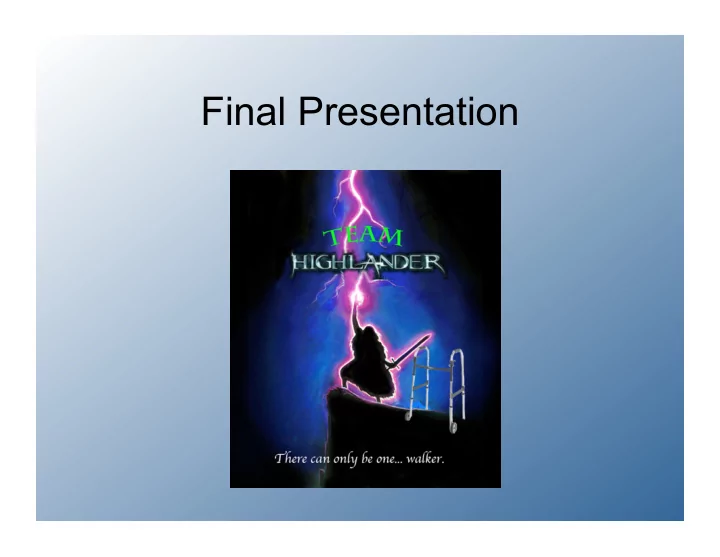
Final Presentation

slide-2
SLIDE 2

Design Problem Recap

  • Current walker users generally have trouble

getting into and out of chairs independently.

  • The solution for this problem is to come up with

an enhanced walker design that allows the user to raise and lower themselves without impeding normal walker function.

  • The motivation of this project is to give people

with motor disabilities the sense of independence in their mobility.

slide-3
SLIDE 3

Previous Comments

  • Make It Cheaper!

– Aluminum is already cheap. For ease of construction, will use plastic for lever assembly and linkage rod.

  • Make It Lighter!

– All parts weigh less than 3 lbs. – The walker’s total weight is still less than 10 lbs.

  • Are the skis a trip hazard?

– Stopper/ski made solid to avoid tripping.

slide-4
SLIDE 4

Previous Comments

  • Is the lever subassembly redundant?

– The lever creates ease of operation while standing. From our visit to the ALF, users do not want to have to crouch down. Prefer to stand straight up. It is also significantly safer.

  • Can the mechanical components be further

concealed?

– No assemblies were found unaesthetic or dangerous enough to require concealment.

slide-5
SLIDE 5

Previous Comments

  • Do these additions limit the collapsibility
  • f the walker?

– Our design is still fully collapsible.

  • Can the lever be actuated upward

instead of pulling it downward?

– The lever being actuated upwards was not a feasible solution as the motion of the linkage assembly was limited by geometrical constraints.

slide-6
SLIDE 6

Final Design vs. Prototype

slide-7
SLIDE 7

Working Shots

slide-8
SLIDE 8

Working Shots

slide-9
SLIDE 9

Complex Parts

  • Pivot Brackets

– Needed the waterjet due to intricate design of parts.

  • Stopper/Skis

– Utilized the 3D Printer as the part would have required custom tooling and extremely precise machining.

slide-10
SLIDE 10

Major Prototype Changes

  • Stopper/Skis were made solid rather than just

curved bars

  • Pivot brackets are screwed to frame rather than

welded on

– Frame surface is anodized, prohibiting the welding of the brackets. – Final concept would still utilize the welding of the brackets.

slide-11
SLIDE 11

Material Costs

  • Estimated cost of raw materials

– $200 – This includes aluminum, steel bolts, silicone for handle grips, and plastic needed for injection molded parts

  • Cost of walker

– $60

  • Total cost = $260
slide-12
SLIDE 12

Video Presentation

slide-13
SLIDE 13

Conclusions

  • The task of this design team was to perform a design
  • ptimization of a walker used by individuals who have

trouble rising from and sitting down in chairs independently.

  • Problem is solved with relatively low cost (<$300), very

small added weight (<3 lbs), and no hindrance in walker performance and collapsibility.

  • With a safety factor of 1.6, our prototype can support 120

lbs.

slide-14
SLIDE 14

THE END

Any Questions?