
SLIDE 1
1
CSE 421/521 - Operating Systems Fall 2011
Tevfik Koşar
University at Buffalo
November 3rd, 2011
Lecture - XVIII
File Systems
File Systems
- Provides organized and efficient access to data on
secondary storage:
- 1. Organizing data into files and directories and supporting
primitives to manipulate them (create, delete, read, write etc)
- 2. Improve I/O efficiency between disk and memory (perform I/O
in units of blocks rather than bytes)
- 3. Ensure confidentiality and integrity of data
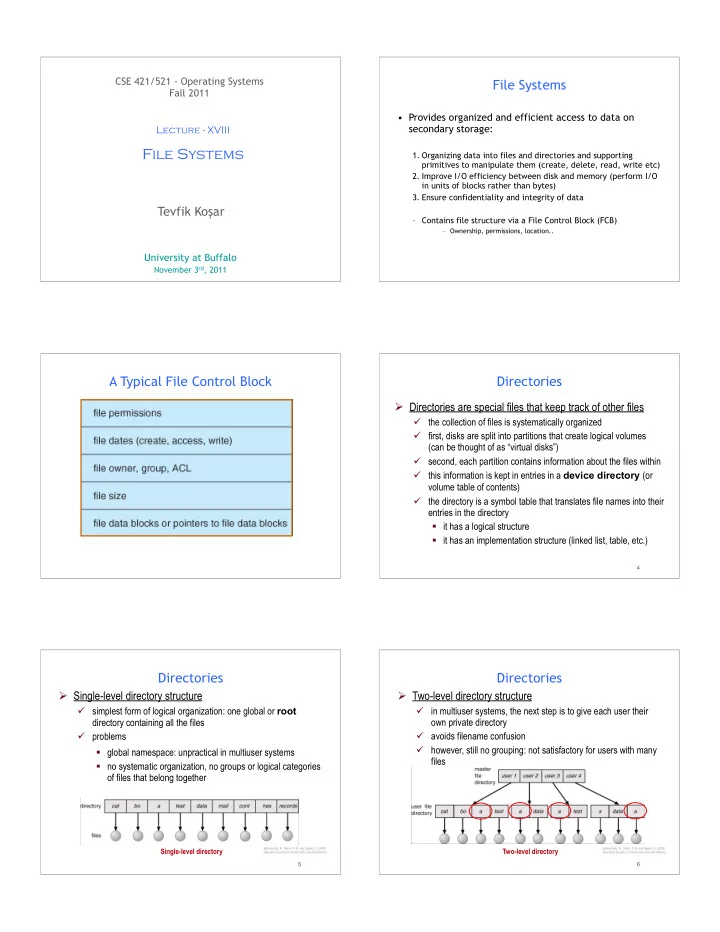
– Contains file structure via a File Control Block (FCB)
– Ownership, permissions, location..
A Typical File Control Block Directories
4
! Directories are special files that keep track of other files
" the collection of files is systematically organized " first, disks are split into partitions that create logical volumes (can be thought of as “virtual disks”) " second, each partition contains information about the files within " this information is kept in entries in a device directory (or volume table of contents) " the directory is a symbol table that translates file names into their entries in the directory # it has a logical structure # it has an implementation structure (linked list, table, etc.)
Directories
5
Single-level directory
! Single-level directory structure
" simplest form of logical organization: one global or root directory containing all the files " problems # global namespace: unpractical in multiuser systems # no systematic organization, no groups or logical categories
- f files that belong together
Silberschatz, A., Galvin, P. B. and Gagne. G. (2003) Operating Systems Concepts with Java (6th Edition).
Directories
6
Two-level directory
! Two-level directory structure
" in multiuser systems, the next step is to give each user their
- wn private directory
" avoids filename confusion " however, still no grouping: not satisfactory for users with many files
Silberschatz, A., Galvin, P. B. and Gagne. G. (2003) Operating Systems Concepts with Java (6th Edition).