Solving problems: coping with C instead of C++ Only pass-by-value, - - PowerPoint PPT Presentation

solving problems coping with c instead of c
SMART_READER_LITE
LIVE PREVIEW

Solving problems: coping with C instead of C++ Only pass-by-value, - - PowerPoint PPT Presentation

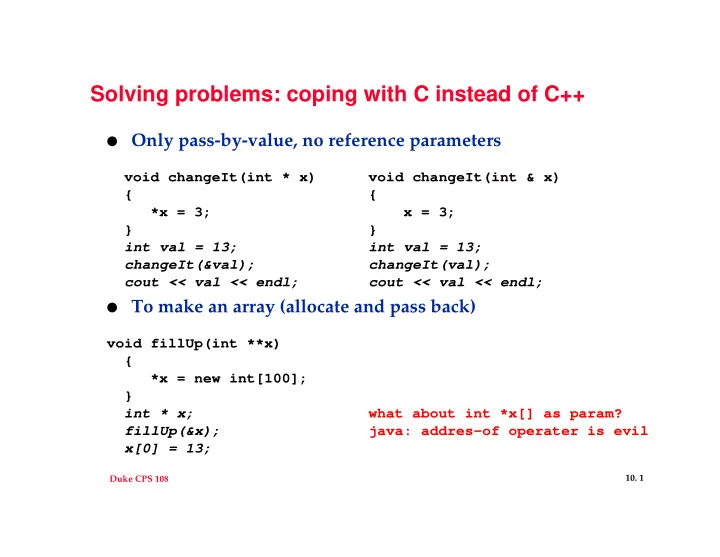
Solving problems: coping with C instead of C++ Only pass-by-value, no reference parameters void changeIt(int * x) void changeIt(int & x) { { *x = 3; x = 3; } } int val = 13; int val = 13; changeIt(&val); changeIt(val); cout


slide-1
SLIDE 1

Duke CPS 108

  • 10. 1

Solving problems: coping with C instead of C++

  • Only pass-by-value, no reference parameters

void changeIt(int * x) void changeIt(int & x) { { *x = 3; x = 3; } } int val = 13; int val = 13; changeIt(&val); changeIt(val); cout << val << endl; cout << val << endl;

  • To make an array (allocate and pass back)

void fillUp(int **x) { *x = new int[100]; } int * x; what about int *x[] as param? fillUp(&x); java: addres-of operater is evil x[0] = 13;

slide-2
SLIDE 2

Duke CPS 108

  • 10. 2

C++ and C-isms

  • In C++ a struct is a class in which public is default

➤ supports everything a class does, including inheritance ➤ in C, a struct requires the word struct, typedef often used

typedef struct node_s { int value; struct node_s * next; struct node_s * bar; } Node; Node * foo;

  • pointers to functions: use right-left-right rule (watch parens)

void foo(int (*df) (double,double)); typedef int (*iddfunc) (double,double); void foo(iddfunc df);

slide-3
SLIDE 3

Duke CPS 108

  • 10. 3

Function objects instead of function pointers

  • Problem: a function cannot maintain state that is accessible
  • utside the function over a sequence of function calls

➤ static inside the function maintains state: not accessible ➤ global variables can be used, pollute the global namespace ➤ solution: combine state and behavior, use a class

  • Function object: a class that can be used as a fucntoin

➤ overload operator() so that object can be used

syntactically as a function [like a function pointer]

➤ STL supplies these as templated functions, e.g., less<int>

template <class T> struct less : public binary_function<T,T,bool>{ bool operator() (const T& x, const T& y){ return x < y; } }

slide-4
SLIDE 4

Duke CPS 108

  • 10. 4

When to filter entries?

  • when scandir object is constructed

StrFilter ccmatch(“.cc”); Scandir scanner(ccmatch);

  • when DirEntry objects are loaded

Scandir scanner; scanner.load(“afs/acpub/users/o/l/ola”,StrFilter(“.html”));

  • after DirEntry objects are loaded

scanner.load(“/afs”); scanner.filter(ccmatch);

  • when iterating

Iterator<DirEntry> * iter = scanner.makeIterator(ccmatch);

  • pros/cons of different methods?
  • What does StrFilter look like?