Fertility Traits: Whats in a phenotype? Where we are and Why weve - - PDF document

fertility traits
SMART_READER_LITE
LIVE PREVIEW

Fertility Traits: Whats in a phenotype? Where we are and Why weve - - PDF document

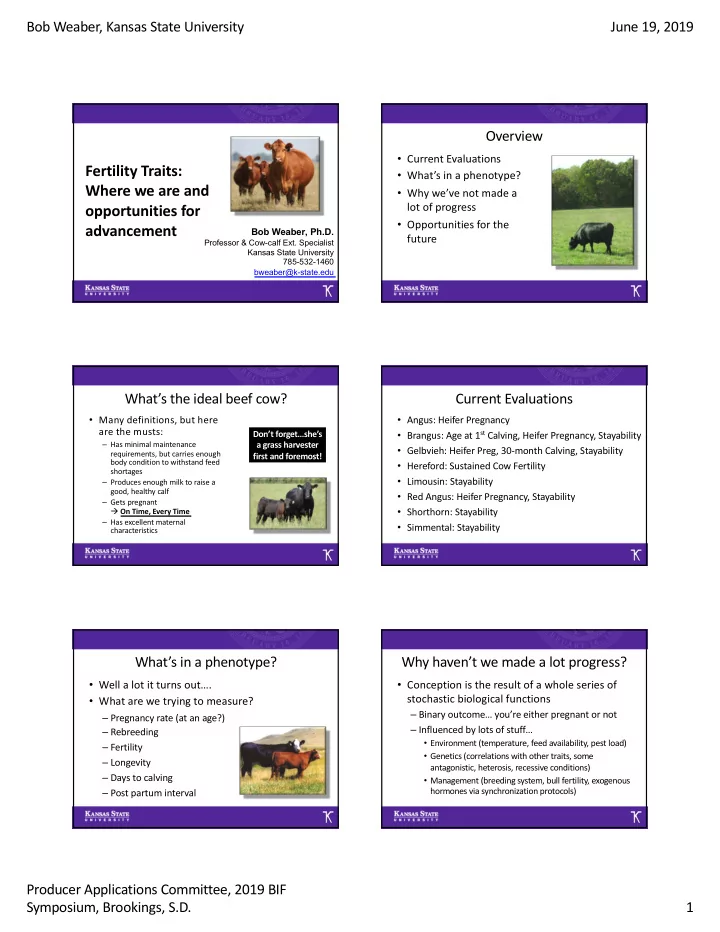
Bob Weaber, Kansas State University June 19, 2019 Overview Current Evaluations Fertility Traits: Whats in a phenotype? Where we are and Why weve not made a lot of progress opportunities for Opportunities for the


slide-1
SLIDE 1

Bob Weaber, Kansas State University June 19, 2019 Producer Applications Committee, 2019 BIF Symposium, Brookings, S.D. 1

Fertility Traits: Where we are and

  • pportunities for

advancement

Bob Weaber, Ph.D.

Professor & Cow-calf Ext. Specialist Kansas State University 785-532-1460 bweaber@k-state.edu

Overview

  • Current Evaluations
  • What’s in a phenotype?
  • Why we’ve not made a

lot of progress

  • Opportunities for the

future

What’s the ideal beef cow?

  • Many definitions, but here

are the musts:

– Has minimal maintenance requirements, but carries enough body condition to withstand feed shortages – Produces enough milk to raise a good, healthy calf – Gets pregnant à On Time, Every Time – Has excellent maternal characteristics

Don’t forget…she’s a grass harvester first and foremost!

Current Evaluations

  • Angus: Heifer Pregnancy
  • Brangus: Age at 1st Calving, Heifer Pregnancy, Stayability
  • Gelbvieh: Heifer Preg, 30-month Calving, Stayability
  • Hereford: Sustained Cow Fertility
  • Limousin: Stayability
  • Red Angus: Heifer Pregnancy, Stayability
  • Shorthorn: Stayability
  • Simmental: Stayability

What’s in a phenotype?

  • Well a lot it turns out….
  • What are we trying to measure?

– Pregnancy rate (at an age?) – Rebreeding – Fertility – Longevity – Days to calving – Post partum interval

Why haven’t we made a lot progress?

  • Conception is the result of a whole series of

stochastic biological functions

– Binary outcome… you’re either pregnant or not – Influenced by lots of stuff…

  • Environment (temperature, feed availability, pest load)
  • Genetics (correlations with other traits, some

antagonistic, heterosis, recessive conditions)

  • Management (breeding system, bull fertility, exogenous

hormones via synchronization protocols)

slide-2
SLIDE 2

Bob Weaber, Kansas State University June 19, 2019 Producer Applications Committee, 2019 BIF Symposium, Brookings, S.D. 2 Why haven’t we made a lot progress?

  • What role does longevity play and why

important?

– Seedstock needs to turn generations to sample and capture germplasm

  • Shorten generation interval
  • No/limited opportunity to observe longevity

– Commercial lengthen generation interval to minimize replacement costs

  • May shorten to minimize depreciation costs
  • Optimization

Beef Cow Nutrient Partitioning

Short and Adams, 1988

Opportunities for the future

  • Data Recording-THR, WHR

– Need exposure date data – Need bull cohort data – Breeding system (ET and some AI synch really challenging to get at fertility/repro)

Opportunities for the future

  • Use data you already have for

– Calving records and disposal codes – Breeding type maybe helpful (code for FTAI with natural cleanup) – Infer reproductive performance – Survival analysis…sensitive to culling criterion and censoring (voluntary culling events)

  • Commercial herd data

– Capture information about fertility/productive life in environments where expected to perform

  • Leverage genomics

What should we measure?

  • Fertility and Longevity (Thallman, 2019)
  • Fertility as a 0/1 conception to know breeding

season (need bull cohort, turnout date, preg result) for each parity as a trait

  • Days to calving-naturally exposed females,

captures differences in PPI and days to breeding from start of breeding period

  • Longevity-how many calves did cow produce to

some age end point, censored records, survival analysis, some standardized culling definition for skipped calves.

Days to Calving

Natural service matings, no exogenous hormone synch. 1. Joining details of all females naturally mated within the herd. 2. Details of all females removed from the herd, particularly those present at joining that were no longer within the herd by the time

  • f the subsequent calving.

3. Details of all calves (dead or alive) that are born as a result of these joinings.

slide-3
SLIDE 3

Bob Weaber, Kansas State University June 19, 2019 Producer Applications Committee, 2019 BIF Symposium, Brookings, S.D. 3

Thank you! Questions?