SLIDE 1
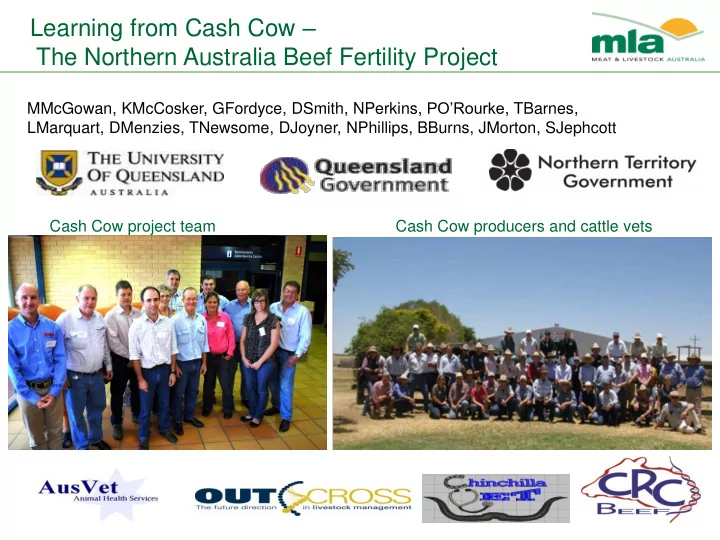
Cash Cow producers and cattle vets Cash Cow project team MMcGowan, KMcCosker, GFordyce, DSmith, NPerkins, PO’Rourke, TBarnes, LMarquart, DMenzies, TNewsome, DJoyner, NPhillips, BBurns, JMorton, SJephcott
Learning from Cash Cow – The Northern Australia Beef Fertility Project
SLIDE 2 The Cash Cow project sought answers to 2 fundamental questions
- Why do some cows become pregnant quickly after
calving whilst others takes significantly longer, or fail to become pregnant?
- Why do some pregnant cows successfully wean their calf
whilst others fail to do so
- However during the course of the project we developed a
more holistic approach focussed on answering the question ‘how is my breeding herd performing in relation to what is practically achievable in this environment’.
SLIDE 3 Estimating business KPI’s using readily available data – ‘The BRICK”
Measure Value Measure Value Branding rate (C§ mated) 74% Herd size 4,656 AE# Weaning rate 72% Average annual steer growth 170 kg/yr Branding rate (C retained) 91% Weaner production 183 kg/cow Lactation rate 90% Herd LWP 168 kg/AE Heifers as replacements 86% Breeding cattle LWP 161 kg/AE Average herd size change 5% Steer LWP 187 kg/AE Mortality: Female weaners 1.9% Herd LWP ratio 0.37 kg/kg Mortality: Yearling heifers 1.9% Breeding cattle LWP ratio 0.36 kg/kg Mortality: Heifers 2-3 yrs 2.3% Steer LWP ratio 0.42 kg/kg Mortality: Cows 5.2% Income $1.43 /kg Mortality: Spays Cost of production $0.95 /kg Mortality: Male weaners 1.9% Operating margin $0.48 /kg Mortality: Yearling males 2.3% Labour $0.30 /kg Mortality: Males 2-3 years 5.7% Mortality effect on sales
/kg Mortality: Mature males 8.3% Income $241 /AE Mortality: Bulls 1.0% Variable costs $4 /AE Sold: Male weaners 4% Gross Margin $237 /AE Sold: Male yearlings 3% Overhead costs $155 /AE Sold: Males 2-3 years 71% EBIT $83 /AE Sold: Mature males 27% Labour $50 /AE Female / Total sales 48% Bull costs $24 /weaner
LWP – liveweight production
SLIDE 4 Measuring beef production
- If I retain 500 cows at the
end of the year how much beef can I potentially sell 12 months later
production - annual change in total weight of cows adjusted for mortality plus weaner production
SLIDE 5 Weaner production is easy to measure, and provides a good estimate of annual live weight production
Annual total number
multiplied by average weaner weight, divided by number of females retained the previous year
50 150 250
100 200 300 Weaner Production (kg/cow retained) Northern Forest Northern Downs Central Forest Southern Forest
50th percentile 75th percentile Weaner production (kg/cow retained) by country type
SLIDE 6 CC65M_2009 CC65M_2010 CC66M_2009 CC66M_2010 CC81M_2009 CC81M_2010 CC84M_2009 CC84M_2010 CC85M_2009 CC85M_2010 CC97M_2009 CC79M_2009 CC79M_2010
Northern Forest 50 100 150 200 Weaner Production (kg/cow retained)
What is commercially achievable beef production?
Commercially achievable performance by country type
SLIDE 7
Weaner production is similar to annual steer growth
SLIDE 8
Measuring reproductive performance and identifying the major factors affecting performance – a key objective of Cash Cow
performance of ~78,000 cows managed in 142 breeding mobs located on 72 properties monitored over 3 to 4years
SLIDE 9
Cash Cow country types and producer estimates of annual steer growth
N Forest – 100kg p.a N Downs – 170kg p.a S Forest – 200kg pa C Forest – 180kg p.a
SLIDE 10
Data collected during the Cash Cow project
SLIDE 11 Crush Crush-side side elec electro tronic da nic data ta ca capt ptur ure
12 to 20 pieces of data on factors affecting cow and heifer performance electronically recorded at first annual weaning muster and/or at pregnancy test muster for 3 to 4years
Cows processed per hour
~8% of NLIS tags needed to be replaced
SLIDE 12 The Cash Cow measures of reproductive performance
- Percentage of lactating cows pregnant within 4 months of calving
- a measure of the proportion of cows likely to wean a calf in consecutive years
- Annual pregnancy rate
- Percentage foetal/calf loss
- Incidence of missingness – the Cash Cow estimate of mortality
Foetal aging used to define month of calving and month of re-conception
SLIDE 13 Understanding what level of performance is achievable
Observed performance (median, inter
cow s (
≥
4years old) by country type .
Measure Southern Forest Central Forest Northern Downs Northern Forest Pregnant within 4month s
(%) 74 (39
) 77 (56
) 68 (60
) 17 (7
) Annual p regnancy rate (%) 87 (77
) 88 (79
82 (75
) 66 (56
) Foetal/calf loss (%) 5 (2
6 (4
7 (3
5 ) 14 (9
9 ) Pregnant cow missingness (%) 8 (3
6 (1
7 (4
12 (6
Values in red are what is commercially achievable
SLIDE 14
Have you any questions
SLIDE 15 Major factors affecting percentage of lactating cows pregnant within 4months of calving (P4M)
̴
- Country type – on average when all other major factors were
taken into account, performance in Southern Forest was 12% higher than Central Forest, 23% higher than Northern Downs and 59% higher than Northern Forest
- Parity - 1st lactation cows 13-16% lower than mature and aged
- cows. Supports recommendations that replacement heifers
should be segregated until they wean their first calf
- Average wet season (Nov-Apr) CP:DMD - when this ratio was
<0.125 performance was 7.5% lower. Potential response to ‘best practice’ grazing management such as wet season spelling
- Cows which gained condition between the PD and the W/D
muster were 8% higher than those which lost condition
SLIDE 16
Effect of time of calving
49% difference Concept of an optimum calving period and hence an optimum re-conception period
SLIDE 17
Effect of body condition score at time of pregnancy diagnosis
Performance of females in poor body condition 18% lower than those in good condition, however impact much less in Northern Forest
SLIDE 18
Effect of wet season cow phosphorous status
24% difference High risk of P deficiency affecting performance Low risk of P deficiency affecting performance 26%, 25%, 63% & 72% of average wet season FP:ME in the Southern Forest, Central Forest, Northern Downs and Northern Forest were <420mgP/MJ ME 9.5% difference
SLIDE 19
Have you any questions
SLIDE 20 Major factors affecting percentage foetal/calf losses between confirmed pregnancy and weaning
- Country type - percentage loss in the Central Forest, Northern
Downs, and Northern Forest were respectively 4%, 2% and 7% higher than in the Southern Forest
- Reproductive history of cow – percentage loss in cows which
lactated previous year 4% lower than in those that did not lactate
- Lactation number – when all other factors were taken into
account percentage loss in heifers was 2% higher than in mature cows
- Mustering efficiency – 9% higher loss where mustering efficiency
was <90%.
- Inadequate protein status ( low CP:DMD) during the dry season
(May-Oct) prior to calving – 4% higher loss
SLIDE 21
Mustering around time of calving
Foetal aging enables period of calving to be estimated and hence when weaning musters should be conducted to minimise these losses ̴ 9% difference Heifers -
SLIDE 22 Heat stress during month of calving
Critical importance of mothering ability & distance to waters. Paddock shade?
2.5 7.5 12.5 17.5 22.5 27.5
5 10 15 20 25 30 Southern forest Central forest Northern downs Northern forest Country Type THI above 79 during expected month of calving for < 15 days THI above 79 during expected month of calving for >= 15 days
Heat stress resulted in 4-7% higher loss, except in NF
SLIDE 23 Wet season P status and BCS at PD muster
Where risk of wet season P deficiency adversely affecting performance was high and cows were in poor condition at the previous pregnancy diagnosis muster calf loss was ~8% higher than where the risk of P deficiency adversely affecting performance was low and cows were in poor condition.
2.5 7.5 12.5 17.5 22.5 27.5
5 10 15 20 25 30 Percentage Calf Loss 1.0-2 2.5 3.0 3.5 4.0-5 Body Condition Score at Preg Test Faecal P:ME ratio during the wet season ≤500 Faecal P:ME ratio during the wet season >500
High risk of P deficiency effect Low risk of P deficiency effect
SLIDE 24 Effect of genotype and cow size/height
P4M in ≥50% B indicus 13-15%% lower than in <50% B indicus. P4M in shorter cows 5% higher than taller cows and, foetal/calf loss 4% lower in shorter cows compared to taller cows.
SLIDE 25
Impact of wild dogs on foetal/calf loss
Predicted percentage foetal/calf loss for each wild dog category. Wild dog Category Foetal/Calf Loss (%) 95% Confidence interval Lower Upper Wild dogs considered a problem – baiting used 11.81 9.33 14.29 Wild dogs considered a problem - intermittent control only 10.84 6.40 15.28 Wild dogs not considered a problem 6.29 3.27 9.31
There is a critical need to rethink our approach to control of wild dogs Producers knew when wild dogs were adversely affecting performance, but method of control had no significant effect.
SLIDE 26 Impact of infectious diseases
- Pestivirus (BVDV) – 23% lower percentage pregnant
within 4months in mobs with widespread evidence of
- infection. In mobs with high level of recent infection
foetal/calf loss was 8% higher
- Venereal diseases ( vibrio) – in mobs with evidence of
widespread infection foetal/ calf loss was 7% higher
- Lepto – only low level of infection detected. Trend for
higher foetal/calf loss in mobs with high level of recent infection with L.pomona
- 3-day (BEF) – widespread evidence of infection but no
significant impact on likelihood of cows becoming pregnant.
- Neospora – widespread evidence of infection but no
impact on foetal/calf loss
SLIDE 27 Key questions to ask Key questions to ask
- 1. How is my beef breeding business going? Use the BRICK to generate KPI’s.
- 2. How much beef is being produced by each of my breeding herds? Measure
annual liveweight production from each herd.
- 3. Are the annual kilograms of beef produced from each breeding herd lower
than expected or below what is commercially achievable? Compare to Cash Cow production benchmarks.
- 4. How are my breeding herds performing? Measure performance using the
Cash Cow measures.
- 5. Is the reproductive performance of my breeding herds lower than expected
- r below what is commercially achievable? Compare to Cash Cow
performance benchmarks.
- 5. What is likely to be contributing to any lower than expected or below what
is commercially achievable performance? Examine the major factors affecting performance identified in the Cash Cow project.
Using the Cash Cow findings to improve my beef breeding business
SLIDE 28
Thankyou - questions
Rainfall variation during the Cash cow project