FEM Theory: Variational Approach Energy Minimization Another - - PowerPoint PPT Presentation

fem theory variational approach energy minimization
SMART_READER_LITE
LIVE PREVIEW

FEM Theory: Variational Approach Energy Minimization Another - - PowerPoint PPT Presentation

FEM Theory: Variational Approach Energy Minimization Another approach: Weighted Residual Minimization Fields distributed minimizing the energy CDEEP This course: boundary and/or initial value problems IIT Bombay EE 725 L __ /Slide


slide-1
SLIDE 1

Electrical Equipment and Machines: Finite Element Analysis (NPTEL - MOOC course)

  • Prof. S. V. Kulkarni, EE Dept., IIT Bombay
CDEEP IIT Bombay EE 725 L __ /Slide ___

FEM Theory: Variational Approach Energy Minimization

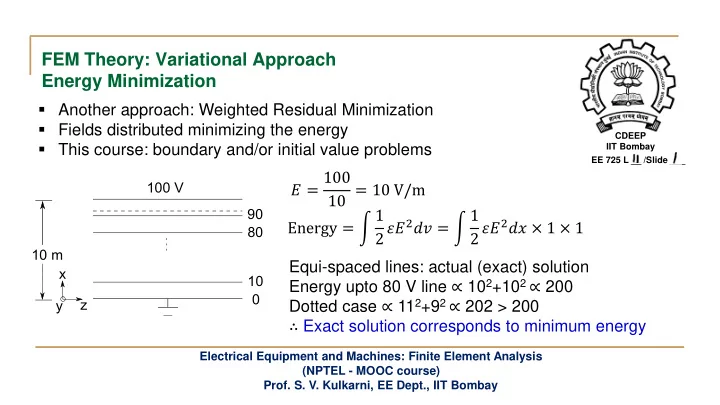
▪ Another approach: Weighted Residual Minimization ▪ Fields distributed minimizing the energy ▪ This course: boundary and/or initial value problems Equi-spaced lines: actual (exact) solution Energy upto 80 V line ∝ 102+102 ∝ 200 Dotted case ∝ 112+92 ∝ 202 > 200 ∴ Exact solution corresponds to minimum energy 𝐹 = 100 10 = 10 V/m Energy = න 1 2 𝜁𝐹2𝑒𝑤 = න 1 2 𝜁𝐹2𝑒𝑦 × 1 × 1

slide-2
SLIDE 2

Electrical Equipment and Machines: Finite Element Analysis (NPTEL - MOOC course)

  • Prof. S. V. Kulkarni, EE Dept., IIT Bombay

CDEEP IIT Bombay EE 725 L __ /Slide ___

Source free electrostatic proble : charges on plates → boundar voltage PDEs in Electromagnetics Mini i ation of න 1 2 𝜁𝐹2𝑒𝑤 ⇒ න 1 2 𝜁 𝜖𝑊 𝜖𝑦

2

𝑒𝑦 × 1 × 1 Energ = න 1 2 𝜁𝐹2𝑒𝑤 Magnetostatic: 𝛂2𝐁 = −𝜈 Transient: 𝛂2𝐁 − 𝜈𝜏 𝜖𝐁

𝜖𝑢 = −𝜈

Time harmonic ⇒ 𝛂2𝐁 − 𝑘𝜕𝜈𝜏𝐁 = −𝜈 𝐺(𝜚) = න

𝑄1 𝑄2

𝑔 𝑦, 𝜚, 𝜚′ 𝑒𝑦 𝜚(𝑄

1) = 𝜚1 , 𝜚(𝑄 2) = 𝜚2

Independent variable: 𝑦 Dependent variable: 𝜚 Laplace Eq: only 𝜚′ appears in F Poisson’s Eq: 𝜚 also appears J J J for 1-D Electrostatics

Define functional

slide-3
SLIDE 3

Electrical Equipment and Machines: Finite Element Analysis (NPTEL - MOOC course)

  • Prof. S. V. Kulkarni, EE Dept., IIT Bombay

CDEEP IIT Bombay EE 725 L __ /Slide ___

𝑒𝐺 = 𝜖𝐺 𝜖𝑦 𝑒𝑦 + 𝜖𝐺 𝜖𝜚 𝑒𝜚 + 𝜖𝐺 𝜖𝜚′ 𝑒𝜚′

𝜀𝐺 = 𝜖𝐺 𝜖𝜚 𝜀𝜚 + 𝜖𝐺 𝜖𝜚′ 𝜀𝜚′ 𝜀𝐺 = 𝐺(𝜚 + 𝜀𝜚) − 𝐺(𝜚) = 0 → gives solution = න

𝑄1 𝑄2

𝑔 𝑦 + 𝜀𝑦, 𝜚 + 𝜀𝜚, 𝜚′ + 𝜀𝜚′ 𝑒𝑦 − න

𝑄1 𝑄2

𝑔 𝑦, 𝜚, 𝜚′ 𝑒𝑦 = 0

Ref: M. N. O. Sadiku, Numerical Techniques in Electromagnetics, CRC Press, 3rd Edition, 2009

𝜀𝑦 = 0

𝜀𝜚 → variation in 𝜚 at (fixed) 𝑦  𝜚 → g(𝑦) 𝜀𝑦 = 0

⇒ 𝑦

𝜀𝜚→ g(𝑦)

𝑕 𝑕′

slide-4
SLIDE 4

Electrical Equipment and Machines: Finite Element Analysis (NPTEL - MOOC course)

  • Prof. S. V. Kulkarni, EE Dept., IIT Bombay

CDEEP IIT Bombay EE 725 L __ /Slide ___

Using Taylor series expansion and considering only 1st order terms න 𝜖𝑔 𝜖𝜚 𝑕𝑒𝑦 + 𝜖𝑔 𝜖𝜚′ 𝑕

𝑄1 𝑄2

− න 𝑕 𝑒 𝑒𝑦 𝜖𝑔 𝜖𝜚′ 𝑒𝑦 = 0 න 𝑔(𝑦, 𝜚, 𝜚′)𝑒𝑦 + න 𝑕 𝜖𝑔(𝑦, 𝜚, 𝜚′) 𝜖𝜚 + 𝑕′ 𝜖𝑔(𝑦, 𝜚, 𝜚′) 𝜖𝜚′ 𝑒𝑦 − න𝑔(𝑦, 𝜚, 𝜚′)𝑒𝑦 = 0 ⇒ න 𝜖𝑔 𝜖𝜚 − 𝑒 𝑒𝑦 𝜖𝑔 𝜖𝜚′ 𝑕𝑒𝑦 + 𝜖𝑔 𝜖𝜚′ 𝑕

𝑄1 𝑄2

= 0  න 𝜖𝑔 𝜖𝜚 − 𝑒 𝑒𝑦 𝜖𝑔 𝜖𝜚′ 𝑕𝑒𝑦 = 0 ⇒ 𝜖𝑔 𝜖𝜚 − 𝑒 𝑒𝑦 𝜖𝑔 𝜖𝜚′ = 0 ⇒ 𝜀𝐺 = 0 Function 𝑔 must satisfy Euler-Lagrange (E-L) Eq to minimize the functional F ∵ 𝑕 = 0 at boundary points (∵ potentials fixed) 𝜀𝜚

slide-5
SLIDE 5

Electrical Equipment and Machines: Finite Element Analysis (NPTEL - MOOC course)

  • Prof. S. V. Kulkarni, EE Dept., IIT Bombay

CDEEP IIT Bombay EE 725 L __ /Slide ___

Parallel Plate Capacitor Problem

𝐺 = 1 2 න 𝜁𝐹2 𝑒𝑦 × 1 × 1 = 1 2 𝜁 න 𝑒𝑊 𝑒𝑦

2

𝑒𝑦 ⇒ 𝑔 = 1 2 𝜁 𝑒𝑊 𝑒𝑦

2

Substituting 𝑔 in E-L equation: ⇒ 0 − 𝑒 𝑒𝑦 𝜖 𝜖𝑊′ 1 2 𝜁 𝑊′ 2 = 0 − 1 2 𝜁 𝜖 𝜖𝑦 2𝑊′ = 0 ⇒ 𝑒2𝑊 𝑒𝑦2 = 0 Laplace equation in −D 𝑔 : function of 𝑊′ here but in general of 𝑦, 𝑊, 𝑊′