
SLIDE 1
Feedlot health management
D.U. Thomson, Ph.D., D.V.M. Kansas State University College of Veterinary Medicine
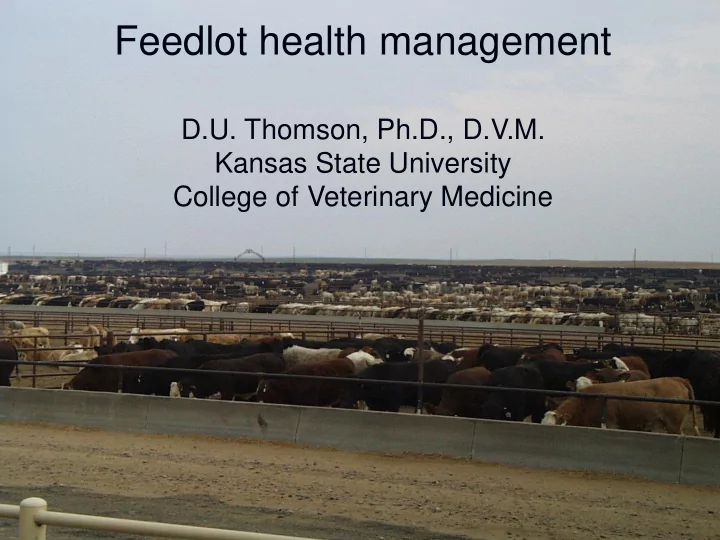
Feedlot health management D.U. Thomson, Ph.D., D.V.M. Kansas State - - PowerPoint PPT Presentation
Feedlot health management D.U. Thomson, Ph.D., D.V.M. Kansas State University College of Veterinary Medicine Why do cattle get sick? Overwhelming dose of pathogen Compromised immune system This causes morbidity! Common Diseases of
D.U. Thomson, Ph.D., D.V.M. Kansas State University College of Veterinary Medicine
Overwhelming dose of pathogen Compromised immune system This causes morbidity!
Respiratory Disease
16.2%
Digestive Disorders
4.3%
Atypical Interstitial Pneumonia
2.8%
Bullers
2.8%
Lameness
1.8%
Central Nervous System
1.1%
NAHMS 2011
3
Serpentine fashion Get all the cattle up Cattle will hide at the feed bunk
Water tank Feedbunk
Normal Rectal temperature 101.5 to 103.5 Respiration rates 10 to 40 breaths per minute Heart rates 60 to 80 beats per minute Rumen contractions 1 to 2 contractions per minute
What does this mean?
Work with your veterinarian! Single or combination antimicrobials? How long to I wait to treat again? Route of delivery and speed to infection? What about ancillary therapy?
Papillae from the ventral floor of the cranial sac
Calf fed concentrates only
What are the main causes
Rapid intake of a soluble carbohydrate Improper diet change Environmental reasons
Sudden death Anorexia Depressed Can have CNS signs
Impaired thiamine production
Increased respiratory rates Dehydration Diarrhea
22
24
25
Cattle go off feed for a couple of days Decreased performance Feed left in bunk
Ahead the cattle
Subacute cases
Hospital stay with good grass hay in bunk
Acute cases
Tube with 500 grams of sodium bicarbonate in water Rumen evacuation (drastic)
Bloat
Decrease in rumen motility Decrease in eructation
Types of bloat
Free gas - concentrates Frothy – wheat pasture
Taken from Diseases and Disorders of Cattle, Blowey and Weaver
Free gas
Pass tube and let down Put on hay Three strikes and they’re out Fistula
Frothy bloat
Therabloat
Breaks up surface tension of froth
Bloat needle, knife (lock blade) Stick cattle high on left paralumbar fossa Do not let cattle lay down
If they go down they die very quickly
Taken from Diseases and Disorders of Cattle, Blowey and Weaver Puncture here
34
Factors Infectious causes(%) Non-infectious causes(%)
Pen condition
85.0 57.8
Pen surface
56.5 41.5
Weather patterns
45.6 19.7
Cattle Handling (prior to arrival)
34.7 63.9
Cattle Handling (post arrival)
28.6 37.3
Nutrition
27.9 25.2
Cattle temperament
23.8 65.3
Cattle type
15.6 11.6
Insufficient preconditioning
12.9 8.8
Breed
9.5 8.2
Cattle age
4.8 6.8
Terrel et.al Bov. Prac. Vol 48 No. 1 pp 53-60
Taken from Diseases and Disorders of Cattle, Blowey and Weaver
Taken from Diseases and Disorders of Cattle, Blowey and Weaver
Moving Downer Cattle
Acceptable Transportation Methods:
Alert downer verses moribund Animal husbandry
Shelter, hay and water 24 to 36 hours to show improvement Roll every 6 to 12 hours to prevent
compartmentalization
Humane euthanasia
Care of Downer Cattle
Keys to Proper Care