
SLIDE 1 TM TM
February 18, 2010
- Dr. John B. Miller, ULI Nashville
1
February 18, 2010 Dr. John B. Miller, ULI Nashville 1 Creative - - PowerPoint PPT Presentation
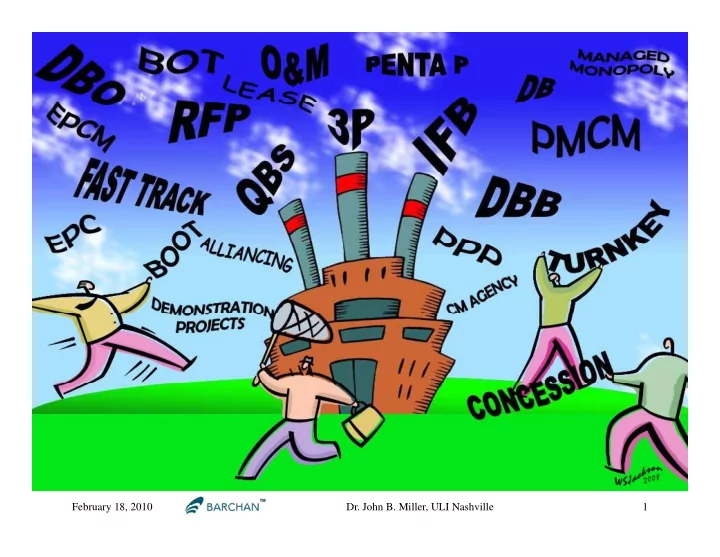
TM TM February 18, 2010 Dr. John B. Miller, ULI Nashville 1 Creative Solutions to a 222 Year Old Problem : Financing Americas Evolving Infrastructure Needs Infrastructure Needs TM TM TM TM February 18, 2010 Dr. John B. Miller,
February 18, 2010
1
February 18, 2010
2
Government pays for projects with public resources – “directly”. This includes monies obtained: (i) through taxes user fees or other funds This includes monies obtained: (i) through taxes, user fees, or other funds received by government; (ii) funds borrowed from capital markets (typically bonds or bond anticipation notes); and (iii) grants of money from other
Government attracts the Private Sector to pay for projects with private sector Government attracts the Private Sector to pay for projects with private sector resources – “indirectly.” This is typically done by ceding specific, limited, control over a public infrastructure asset to create a revenue stream which the private sector will use to earn a return on capital invested and a profit.
“Indirect” includes monies obtained: (i) through user fees, or other funds received by the private sector that are “at risk” to the private sector; (ii) funds borrowed by the private sector from capital markets (typically bonds or other debt); and (iii) equity invested. Funds are typically borrowed for design and construction based on the credit-worthiness of the project to produce sufficient
TM TMco s uc o b sed o e c ed wo ess o e p ojec
c e revenue to repay the borrowed funds (with interest), to pay for long term O&M, and a profit.
February 18, 2010 3
The three (3) key elements of infrastructure projects are delivered “Piecemeal” The three (3) key elements of infrastructure projects are delivered together integrated projects are delivered – Piecemeal – separated from each other – “Segmented.” Distinctions remain between capital budgets for the Initial Delivery of projects and the projects are delivered together – integrated with each other – “Combined.” Distinctions are eliminated between capital budgets and operating budgets for these
budgets for long term repair,
Combining Design with Construction (Design-Build) included here with O&M projects. All “Public Private Partnerships” (Design-Build) included here, with O&M.
Design C t ti Operations & Design-Build-Operate-Maintain
(including all combinations of public and i t t f di )
C bi d
Construction p Maintenance Design-Build
private sector funding)
TM TMCombined Segmented
February 18, 2010 4
Di t
Direct
nce
Combined Segmented
Project Delivery Method f Project Finan Source of
Indirect
TM TMFrom Principles Text, Miller 2000, Kluwer.
February 18, 2010 5
Direct
D i B ild D i B ild O t M i t i
“PU
Design-Build Design-Build-Operate-Maintain (Alt 1 - all public funding) Operate & Maintain D i B ild O M i i
UBLIC P
C bi d S t d
Design-Bid-Build (And Construction Mgmt. At Risk) Design-Build-Operate-Maintain (Alt 2 - mixed public & private funding)
Project Delivery Method
PRIVATE
Combined Segmented
Design-Build-Finance- Operate Maintain
Project Delivery Method ject Finance
E PARTN
Operate-Maintain (NO public funding)
Source of Proj
NERSHI
TM TMIndirect
S
IPS”
February 18, 2010 6
GOVERNMENT’S MONEY
Direct
Design Combined Design Combined With Constr ction And With O&M
GOVERNMENT’S MONEY
Operations Design Separated F C i With Construction But Separate from Ops Construction And With O&M ALL Public Money Design Combined With C t ti A d With O&M & Maint. Alone Combined Segmented
Project Delivery Method ce
From Construction And from Ops Construction And With O&M MIX of Public and Private Money
Project Financ
Design Combined With Construction And With O&M ALL P i t M ( d t i k)
Indirect
Source of
ALL Private Money (and at risk)
TM TMFebruary 18, 2010
7
Indirect
From Principles Text, Miller 2000, Kluwer. OTHER PEOPLE’S MONEY (at risk)
Direct
O&M Alliancing EPC Eng- DB TKY
Turnkey
DBO D
i B ild O t
“Super”-TKY Turnkey with Finance DBB D
i
PP
Parallel Prime Operate-Maintain
g CM Agency
Constr.Mangmt.
Concession with Govt Finance
g Proc-Construct
Combined Segmented
DB
Design Build
DBO Design-Build-Operate DBB Design-
Bid-Build
CM At Risk
Constr.Mangmt.
FT Fast
Track
DBOM Design-Build-Operate-Maintain
Combined Segmented
BOT Build-Operate-Transfer BOO Build-Own-Operate DBOT Design-Build-Operate Transfer BOOT Build Own Operate Transfer DBFOM Design-Build-Finance-Operate-Maintain Concession with Private Finance (at risk)
TM TMFebruary 18, 2010
8
Indirect
Concession with Private Finance (at risk)
Direct
Quadrants I and II Are Combined Segmented
Project Delivery Method
Confusingly Lumped Together as
Source of Pro
as
Indirect
TM TMFebruary 18, 2010
9
From Principles Text, Miller 2000, Kluwer.
American History Confirms this Answer [A Very Similar History in the U K [A Very Similar History in the U.K. Many of Britain’s innovations were quickly “borrowed” by the “Cousins” in America.]
TM TM TM TMFebruary 18, 2010
10
Prompt Transfer to Design- Bid- Build
TM TM TM TMFebruary 18, 2010
11
P t T f t I d t F DBFO t All D li M th d
TM TMFebruary 18, 2010
12
Prompt Transfer to Industry: From DBFO to All Delivery Methods
February 18, 2010
13
Direct
MBTA CR
US IHS
Northumberland
Big
Indianapolis WW Water
Golden Gate B
Combined Segmented
ZANE NatRd
EPA CGP
Northumberland Bridge
Dig Bay Bridge
Erie Canal
1850 1900
KEOK NYSub SltSM BrBr Eads Br Dulles Greenway
1950
SltSM SR 91 407 ETR
TM TMFebruary 18, 2010
14
Indirect
2000
Direct 800 Projects Authorized
By Congress Prior to 1933 Combined Segmented
1850
1850 1900
Indirect
1950
TM TMFebruary 18, 2010
15
From Principles Text, Miller 2000, Figure 3-5, Kluwer.
Quadrant I Quadrant IV
Direct
800 Projects
Quadrant I Quadrant IV
800 Projects Authorized By Congress P i t 1933 PRIOR TO 1933
Combined Segmented
93.4%
6.6%
Prior to 1933
Quadrant III Quadrant II
Indirect
TM TMFebruary 18, 2010
16
From Principles Text, Miller 2000, Figure 3-3, Kluwer.
Quadrant I Quadrant IV
Direct
GOVERNMENT’S MONEY
6.5% 31%
PRIOR TO 1933 GOVERNMENT S MONEY
Combined Segmented
Negligible 62%
Quadrant III Quadrant II
Indirect
g g
OTHER PEOPLE’S MONEY (at risk)
TM TMFebruary 18, 2010
17
Indirect From Principles Text, Miller 2000, Figure 3-4, Kluwer.
The Dual Track Strategy
Pre-1933 Pre-1933
Appropriations Contracts Direct Indirect (Franchises)
Harbor Improvements
Finance Finance
Most Canals Harbor Improvements Navigable Rivers Projects Navigation Aids Territorial Roads and Trails Military Roads Most Canals Commercial Docks, Piers Post Roads Railroads Telegraph Telephone
GOVT’S MONEY OTHER PEOPLE’S
Military Roads Public Buildings Telegraph, Telephone Power
MONEY PEOPLE S MONEY (at risk)
TM TMFebruary 18, 2010
18
From Principles Text, Miller 2000, Figure 3-1, Kluwer.
1.
150+/- years of spectacular government success as “public infrastructure [real estate] developer” ( ) (1789 – 1933);
Entire Networks built again and again, over and over:
With new technologies, designs, materials, and methods. Transportation of people, goods, information:
Roads, rail, highways, transit, airports, bridges Post, telegraph, telephone, internet, wireless, satellite
W t t t lid t
Water, wastewater, solid waste
2.
80+/- years of more narrowly targeted success by government on initial delivery ONLY (1933 to present);
1916 limited Fed Hwy Grants begin for design, then for
t ti f ll d b bli O&M
TM TM TM TMconstruction, followed by public O&M
19 February 18, 2010
Over the typical “life cycle” of a project.
For every One Dollar $1 spent on Design Ten Dollars $10 are spent on Construction and At Least One Hundred Dollars $100 are spent on
O&M, Repairs, and Refurbishment
Massachusetts Transit Authority:
Portions of Operating Deficits shifted, seriatim, to:
l
Four Original Cities 28 Cities and Towns 50+ Cities and Towns (Eastern MA) Commonwealth of Mass
TM TM TM TM20
Commonwealth of Mass Federal Government
February 18, 2010
21 February 18, 2010
A Crushing Burden in Highly
Fueled by Government Funding for
The World’s Best Examples:
Deferred Maintenance in Britain, US
TM TM TM TM22 February 18, 2010
23
Source: US Army Corps of Engineers, Micro Paver System.
February 18, 2010
Repair, O&M “Tail”
TM TM TM TMFebruary 18, 2010
24
Government: Federal, State, Regional and Local Private Sector: Craft Labor, Designers (Arch. & Eng.), C t t O t T h l S li M t i l Constructors, Operators, Technology Suppliers, Material Suppliers, Developers, Investors (larges and small: Bankers & Bond Holders), Taxpayers, Users
TM TM TM TM), p y ,
February 18, 2010
25
Gov’t Employs Private
Competition To Drive C t d LOS G i
Gov’t Employs Private
Competition to Provide S i Cost and LOS Gains
Government maintains “situational awareness” of bli i f t t d
Service
Government generally aware
public infrastructure needs:
Current and future costs, LOS
What services are possible? A hie ble? Wo th the $$?
General Knowledge of Current costs, current LOS
Competitive processes used to ti t d th
Achievable? Worth the $$?
Competitive processes produce chances to change what is provided how and by whom continue to produce these services:
Using one of the Delivery Methods
Gov’t $ or Other People’s $
provided, how, and by whom.
Long Term goal is to drive advantages to the regional economy thru lower prices
Gov t $ or Other People s $
Possible “Upfront” Payment (PPP)
Long Term goal is to provide the LOS that government is
TM TMFebruary 18, 2010
26
economy thru lower prices, better service. the LOS that government is able to support.
One I s Similar to Real Estate Developer’s View One is Similar to an Administrator’s View Estate Developer s View
Quite Dynamic, Focused on Revenue and Expense, Net R d R t
Administrator s View
Less Dynamic, Aware of Revenue and Expense, But L Littl F t Revenue, and on Return:
Improved Infrastructure P f (l C t d Less or Little Focus on net Revenue, or on Return
Focus is on administration of Performance (lower Cost and higher LOS) is a “means” to a more important “end” : idi titi
Focus is on administration of existing assets, stewardship of assets
Provision of Infrastructure
providing a competitive economic advantage to cities, regions, states.
Provision of Infrastructure Services is an “end” in itself, while also supporting economic performance.
TM TMp
February 18, 2010
27
February 18, 2010
28
February 18, 2010
29
February 18, 2010
30
February 18, 2010
31
February 18, 2010
32
February 18, 2010
33
Examples: Attracting New Technology to Infrastructure Attracting New Technology to Infrastructure
Tolt Water Treatment Project (Seattle) –
Chapter 15 Cases Textbook Chapter 15 Cases Textbook
A Turbidity Project to Stabilize Drinking Water Supply
Highway 407 ETR Project (Toronto)
7 & 9 Cases Textbook
Doubling Vehicular Capacity Across Metro Toronto
Northumberland Bridge Project (New
Textbook
A Fixed Link to Replace Ferry Service to Prince Edward Island
TM TM TM TMFebruary 18, 2010
34
A Fixed Link to Replace Ferry Service to Prince Edward Island
I IV
INPUTS: DBO
II
Technology Cost
New Membrane Technology
34% Savings in Life Cycle Costs
From $156M to
gy
Dramatic Cut In Energy Use
From $156M to $102.5 M
Known (stable) costs for 25 years
Time Quality Time
Strict Water Quality Performance
25 Years Compliance with Water Quality St’ds
Early
Project Completion
Entry into
TM TMFebruary 18, 2010
35
St ds
Parent Company Guarantee
Entry into Service
INPUTS: DBO (I) then DBFO (II)
I IV
Phase II Phase I
III II
Phase II
Technology Cost
Attracts Hughes Electronics to Toll Collection Business
Slotted Aloha (TDMA) Protocol adapted to civilian use
$1.5 Billion initial cost in 1997
$3.0 Billion Received in 2000 from Private Sector
use
Technology Now Transferred to Cross Israel Xpway 2000 from Private Sector to Extend Road and Operate for 99 yrs
1997 Debt Retired in Full and $1.5 B Excess Applied to Other Projects
Quality Time
No Stopping or Slowing for Toll Collection
Easy Billing Procedures
Smaller Footprint for Road (Lower Environmental Impact)
Capacity Doubled Cross Toronto
On Time
Project Completion
Entry into Service
TM TMFebruary 18, 2010
36 C p y C
I IV
INPUT: DBFO
III II
Technology Cost
New Low Temp. Glues by DuPont
Global Positioning Systems
30+% Savings in Life Cycle Costs $750 M S i
OUTPUTS
g y Extended to Set Major Bridge Components <1”
New Design for Ice-Shields (Ice in meters)
New Techniques for High- Strength Underwater Grout
$750 M Savings
Bridge Transfers to
Time Quality
E l
Quality
Significant Improvement in Service (Yr. Round)
Designed for Ease of Construction, Repair, Maintenance
Early
Project Completion
Entry into Service
TM TMFebruary 18, 2010
37
February 18, 2010
38
A “R E Developer’s Mindset” in the Packaging of Public
A R.E. Developer s Mindset in the Packaging of Public
Infrastructure Projects for Competition
Hong Kong Harbor Crossings, Container Port, and Airport
Core Program are great examples.
Competitive Procurements Focused on Guaranteed
Improvements in LIFE CYCLE Revenue/Expense Improvements in LIFE CYCLE Revenue/Expense Performance and/or LOS of Public Facilities:
Tolt Water Treatment Plant is a great example. Recent Canadian Experience is Directly Applicable
A Sustained Focus AWAY from Initial Delivery TOWARD
Life Cycle Delivery
TM TM TM TMLife Cycle Delivery
February 18, 2010
39
Q d t I Off Quadrant IV Offers: Quadrant I Offers:
“Efficient Technology” Engine;
Combined Delivery with Owner’s Money Associated Capital Investment Quadrant IV Offers:
“Isolated Technology” Engine;
A Place to Diffuse Technology From Quadrants I & II Flexibility to Stop
Direct Direct
p Different Players Incrementally Better Solutions Sustainable Opportunities 20-40% Savings in Life Cycle $$ At Design Completion Quadrant II Offers:
“New Technology” Engine;
Combined Delivery with Quadrant III Offers:
Combined Combined Segmented Segmented
1850 1850 1900 1900
y Private Sector’s Money New Capital Investment New Players Different Solutions New Services Sustainable Opportunities Q Few Advantages (Command + Control) Averse to New Technology and To New Capital Example of Failure of This Strategy US Superfund Contracting Program
I di t I di t
1900 1900 1950 1950 2000 2000
TM TMFebruary 18, 2010
40
Sustainable Opportunities 30-40% Savings in Life Cycle $$ US Superfund Contracting Program Described in App. C, Principles Text
Indirect Indirect
2000 2000
Direct
i ild i ild O i i Design-Build Design-Build-Operate-Maintain
(Alt 1 - all public funding)
Operate & Maintain
C bi d S t d
Design-Bid-Build
(And Construction Mgmt. At Risk)
Design-Build-Operate-Maintain
(Alt 2 - mixed public & private funding)
Project Delivery Method
Combined Segmented
Design-Build-Finance-
Project Delivery Method ject Finance
Operate-Maintain
(NO public funding)
Source of Proj
TM TMFebruary 18, 2010
41
Indirect
S
Direct
i ild i ild O i i Design-Build Design-Build-Operate-Maintain
(Alt 1 - all public funding)
Operate & Maintain
C bi d S t d
Design-Bid-Build
(And Construction Mgmt. At Risk)
Design-Build-Operate-Maintain
(Alt 2 - mixed public & private funding)
Project Delivery Method
Combined Segmented
Design-Build-Finance-
Project Delivery Method ject Finance
Operate-Maintain
(NO public funding)
Source of Proj
TM TMFebruary 18, 2010
42
Indirect
S
I IV
Direct DB
Design Build
DBB D
i
DBOM Design-Build-
Tuen Mun Rd Ting Kau Bridge Tsing Ma Bridge
DBB Design-
Bid-Build
DBOM Design Build
Operate-Maintain
Tsing Ma Bridge Kap Shui Mun Bridge DBB Remains In Many Landfill Projects: WENT, SENT, NENT Network of 9 Waste Transfer St ti
Combined Segmented
Frequent Use (80% of the number Of Projects Annually) Stations Chemical Waste Treatment Plant
Investment in Quad’s I and IV;
DBFOM Design-Build-
Finance-Operate-Maintain
Central Harbour Crossing Eastern Harbour Crossing Tate’s Cairn Tunnel Country Park Section of Rte. 3 Kowloon Container Port (Multiple Franchises) W H b C i
Overall Results
I and II: a. improved initial quality b. attracted private investment in new technology.
Western Harbour Crossing Chek Lap Kok Airport (New) Fuel Distribution, Air Cargo, Aircraft Maintenance, Catering Facilities MTRC Joint Station Development
TM TM43
III II
Indirect
February 18, 2010
Provides
Transparency
Competition
LOWER Transaction Costs
P P t
Proven Procurement
Methods
Competitive Sealed Bids
Competitive Sealed Proposals
Competitive Sealed Proposals
Qualification Based Selection
Promotes A Market:
Good Planning
Good Planning
Clear Requirements
Fair Treatment of Potential and Actual Competitors Public Policy Protections
TM TM TM TM
Public Policy Protections
February 18, 2010
44
Direct
Design-Build Design-Build-Operate-Maintain
“PUBL
Design Build D i Bid B ild Design Build Operate Maintain
(Alt 1 - all public funding)
Operate & Maintain Design-Build-Operate-Maintain
LIC PRIVA
Combined Segmented
Design-Bid-Build
(And Construction Mgmt. At Risk)
Design-Build-Operate-Maintain
(Alt 2 - mixed public & private funding)
Project Delivery Method e
ATE PARTN
Combined Segmented
Design-Build-Finance- Operate-Maintain
roject Finance
NERSHIPS
Operate-Maintain
(NO public funding)
Source of Pr
S”
TM TM45
Indirect
February 18, 2010
Based on Census Data
90,000 govt/auth. $280 B Capital Exp. $695 B payroll
Gen Contractors
200,000 firms
Arch-Eng’rs-CM’s
93,000 firms
1.3 Million Employees $42 B payroll 1 Million Employees $47 B payroll
Heavy Contractors
43,000 firms 880 Thousand Employees
Specialty Contractors
415,000 firms 3.4 Million Employees
TM TM TM TMFebruary 18, 2010
46
p y $30 B payroll p y $101 B payroll
February 18, 2010
47
Model Code for Public Infrastructure Procurement 2007, ABA Web Store
http://www.abanet.org/abastore/index.cfm p // g/ /
Principles of Public and Private Infrastructure Delivery, J.B. Miller 2000
http://www.springer.com/east/home/generic/search/results?SGWID=5-40109-22-33359032-0
Case Studies in Infrastructure Delivery J B Miller 2002 Case Studies in Infrastructure Delivery, J.B. Miller 2002
http://www.springer.com/east/home/generic/search/results?SGWID=5-40109-22-33358995-0
Life Cycle Delivery of Public Infrastructure: Precedents and Opportunities in the Commonwealth, A Pioneer Institute White Paper, No. 44, J.B. Miller December 2008. Lessons Learned: An Assessment of Select Public-Private Partnerships in Massachusetts, A Pioneer Institute White Paper, No. 45 , J.B. Miller December 2008.
Barchan Foundation, Inc.
Cell: 339-221-0401 Email: jbmiller@barchanfoundation.com
TM TM TM TMEmail: jbmiller@barchanfoundation.com Web: www.barchanfoundation.com
February 18, 2010
48