Feasibility of Bioethanol Production from Cassava as an Alternative - - PowerPoint PPT Presentation

feasibility of bioethanol production from cassava as an
SMART_READER_LITE
LIVE PREVIEW

Feasibility of Bioethanol Production from Cassava as an Alternative - - PowerPoint PPT Presentation

Feasibility of Bioethanol Production from Cassava as an Alternative Cooking Fuel in the Bo Region of Sierra Leone Peter, Dana and Matthew Background and Situation Martin Kailie: Founder of Desert Water NGO, UC Davis Humphrey Fellow


slide-1
SLIDE 1

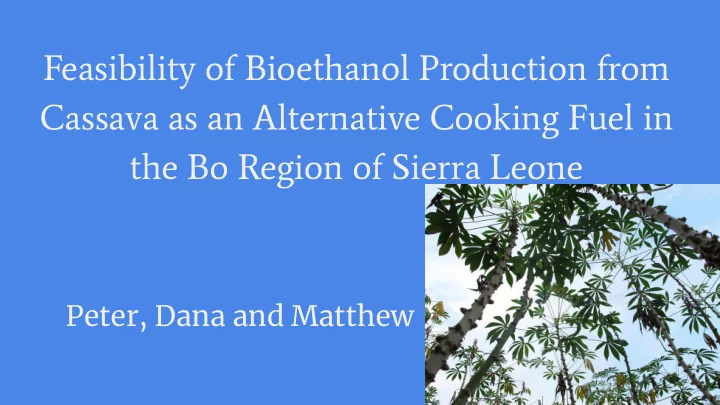
Feasibility of Bioethanol Production from Cassava as an Alternative Cooking Fuel in the Bo Region of Sierra Leone

Peter, Dana and Matthew

slide-2
SLIDE 2

Background and Situation

Martin Kailie: Founder of Desert Water NGO, UC Davis Humphrey Fellow Post-civil war, post-ebola country, 97% of population use wood to cook their meals

  • Deforestation rate about .7%/yr

(USAID 2010) Bo

slide-3
SLIDE 3

Project Objectives

Introduce stoves to 0.01% of the population, or 1,000 households in Bo and other urban areas where people are otherwise buying firewood. Introduce high-yield strain of cassava from SLARI that allows 20 tons/ha of production (current strain yields around 8 tons/ha). Contract farmers to produce cassava on 500 hectares (1000 ha considered for current strain) Create Organizational Model to determine staffjng, budget, and partnership needs

slide-4
SLIDE 4

Target Values

0.01% of population 1,000 households in Bo Each family consumes 2-3 liters

  • f ethanol

each week Ethanol Partners supply 156,000 liters/year 500 hectares of farmland producing cassava

slide-5
SLIDE 5

Project Chain Analysis

Critical Path: Yellow Boxes Gaps: Transportation, Cassava Processing

slide-6
SLIDE 6

Desert Water Organizational Plan

slide-7
SLIDE 7

Partner Map

slide-8
SLIDE 8

Gantt Chart

slide-9
SLIDE 9

SWOT Analysis

Strengths: Necessary partnerships are underway Weaknesses: potential for failure if market isn’t feasible Opportunities: Existing ag extension infrastructure can be utilized Threats: poor infrastructure including roads, potential for unforseen expense

slide-10
SLIDE 10

Recommendations...

1. Partnership model rather than building ethanol and processing plants 1. Do a pilot study for stove interest 1. Integrate the Desert Water staffjng model 1. Mapping of feedstock sources, ethanol production and market destination 1. Failure Analysis 2. Increase accuracy in budget (underway)

slide-11
SLIDE 11

THANK YOU!

slide-12
SLIDE 12

Tool 4: Risk Table

Desert Water has most control

  • ver
slide-13
SLIDE 13

Risk Table: Implications

1. Robust Farmer Participation will be necessary for sustainability 2. Stafg will be comprehensively evaluated before hiring, training will follow 3. Backup stove source will be identified, potential local partner producer will be identified 4. fire hazard will be evaluated in feasibility study 5. Work with Ag business centers, FAO and Ministry of Ag to ensure access to natural/chemical fertilizers if higher production needed

slide-14
SLIDE 14

Results:

Logframe flow chart for implementation plan

slide-15
SLIDE 15

Our Scope: Sequencing and Timeline

Winter Quarter: D Lab I

  • confirm budget, apply for grants
  • business plan/cleaner timeline
  • determine scaling to more detail
  • identify stove and ethanol plant designs
  • identify supply chain for stoves
  • identify cooperative capacity building needs

and training curriculum Spring Quarter: D Lab II

  • design and build a stove
  • test small scale ethanol production
  • Design research questions for household surveys
  • Design mini pilot-study for stoves

Summer: mini pilot study (test marketability of ethanol+stoves), household surveys and ground research, begin to forge relationships with cooperatives and other associations, Fall and Beyond: Implement Desert Water Cooperative Structure, contract farmer co-ops, build bioethanol plant(s), set up local manufacturing system for stoves

slide-16
SLIDE 16

Action Items For D-Lab 1

Write business and organizational plan for cooperatively-run social business enterprise Risk table: assess severity and likelihood Research: Perform a more rigorous meta-analysis of cassava bioethanol projects Stakeholder Outreach: Stove Producers, UNFAO, Ministry of Trade and IndustryAdax Bioenergy/ Mali/Nigeria initiatives Designing Mini-Pilot Study in Country Grants: Find and apply for grant funding

slide-17
SLIDE 17

Timeline

Winter Quarter: D-Lab I Complete Feasibility Study Continued Research

  • f cassava + ethanol

Business Plan Production Grant application(s) Spring Quarter: D-Lab II Stove and Ethanol Pilot Design In-Country Market Study Summer In Country Pilot Study

Fall and Beyond: Implement Desert Water Cooperative Structure, contract farmer co-ops, build bioethanol plant(s), set up local manufacturing system for stoves