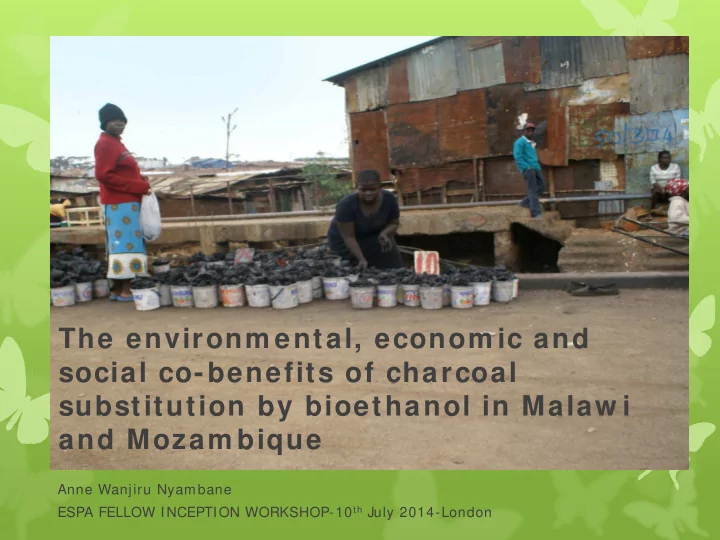
SLIDE 1 The environm ental, econom ic and social co-benefits of charcoal substitution by bioethanol in Malaw i and Mozam bique
Anne Wanjiru Nyambane ESPA FELLOW INCEPTION WORKSHOP-10th July 2014-London
SLIDE 2 I ntroduction
Demand for charcoal is on the increase and is unlikely to decrease soon:
urbanization and poverty
Charcoal industry is a source of livelihood but comes with high economic and environmental costs
high demand with limited
no supply, forest degradation/ loss
Charcoal also has some adverse health impacts on the users Interventions to reduce charcoal impacts have been
initiated in many Sub-Saharan Africa countries. For example: improve efficiency of charcoal production and use charcoal substitution with bioethanol
SLIDE 3
I ntroduction cont’
Knowledge gap:
Contrary to expectations, the latter intervention (charcoal substitution) is non-existent in Malawi In Malawi, biofuel has been used mostly as a substitute for petroleum Highlighting benefits that are of high value for local communities, such as environmental, social and economic benefits, may be a more effective way of changing charcoal practices and promote the use of bioethanol as an household fuel.
SLIDE 4 Aim of the study
To analyze the potential environmental and socioeconomic co- benefits of charcoal substitution by bioethanol To provide policy recommendations through which bioethanol can enhance human well-being and become an agent of poverty alleviation To compare the stated preference for bioethanol cooking in Malawi and revealed preference for bioethanol cooking in Mozambique To compare charcoal supply chains in Malawi (Lilongwe) and Mozambique (Maputo) with respect to the impacts
Ecosystem services and livelihoods
SLIDE 5
Research questions
What are the environmental, social and economic co- benefits of charcoal substitution by bioethanol? How can substitution of charcoal with bioethanol be an agent of poverty alleviation in Malawi and Mozambique?
Study sites:
Malawi: ESPA project, Lilongwe Mozambique: ESPA project, Maputo
SLIDE 6 Methodology
W ork Package Baseline: Current status of charcoal industry I ntervention: Substitution w ith bioethanol Environmental benefits (Climate regulation and provisioning services
- LCA- GHGs emission quantification
- Fuel/ Food/ fodder
- Energy
Economic benefits (expenditure, time,
- pportunity cost)
- Questionnaires and household surveys
- Willingness-to-pay technique (Stated
preference) Social benefits (cultural, health and other emerging benefits)
- Focus group discussions and one-on-one
interview schedules
SLIDE 7
Expected Outcom e
Providing a broader perspective on the impacts of charcoal production and use on important ecosystem services Providing evidence of how charcoal substitution with biofuel can reduce these impacts Catalyzing policy action that contributes to ESPA’s goal Generating country-specific insights: defining local and national context within which policy makers and scientist will operate
SLIDE 8
Academic output:
Two academic journal articles:
i) Economic, environmental and social co-benefits of charcoal substitution by bioethanol in Malawi ii) Policy implication and recommendation biofuel use at household level
Policy brief highlighting main relevant policy-findings from the study Presentation of results in conferences and workshop
Expected output cont’
SLIDE 9
Thank you!
anne.nyam bane@sei-international.org