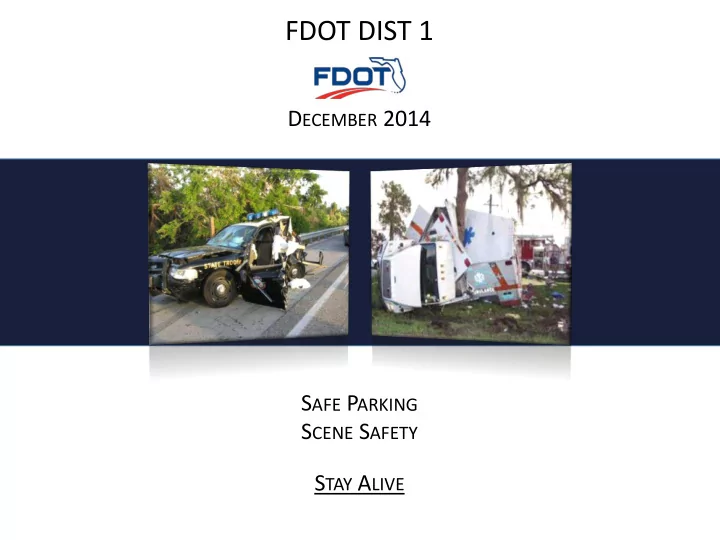
FDOT DIST 1 D ECEMBER 2014 S AFE P ARKING S CENE S AFETY S TAY A LIVE - - PowerPoint PPT Presentation

fdot dist 1
SMART_READER_LITE
LIVE PREVIEW

FDOT DIST 1 D ECEMBER 2014 S AFE P ARKING S CENE S AFETY S TAY A LIVE - - PowerPoint PPT Presentation

FDOT DIST 1 D ECEMBER 2014 S AFE P ARKING S CENE S AFETY S TAY A LIVE Typical Vehicle Positioning Upstream Downstream Upstream Downstream Law Enforcement Ambulance Fire Tow Truck DOT or Safety Service Other Support Units


slide-1
SLIDE 1

FDOT DIST 1

DECEMBER 2014 SAFE PARKING SCENE SAFETY STAY ALIVE

slide-2
SLIDE 2

Typical Vehicle Positioning

Upstream

  • Law Enforcement
  • Fire
  • DOT or Safety Service

Patrol Vehicle

Downstream

  • Ambulance
  • Tow Truck
  • Other Support Units

Upstream Downstream

4H-104

slide-3
SLIDE 3

Safe-Positioned – MUTCD Definition The positioning of emergency vehicles at an incident in a manner that attempts to:

  • 1. Protect the responders performing their

duties

  • 2. Protect road users traveling through the

incident scene

  • 3. Minimize, to the extent practical,

disruption of the adjacent traffic flow

4H-78

slide-4
SLIDE 4

Blocking

  • Blocking is the action of positioning a

responder vehicle in advance of an incident to obstruct the flow of moving traffic in one or more lanes

– Linear Block – occurs when a responder positions their vehicle to block a single lane

  • r the shoulder

– Multi-Lane Block – occurs when the first responder positions their vehicle to block multiple involved lanes

4H-79

slide-5
SLIDE 5

Vehicle Positioning

  • There are two ways an emergency response vehicle is

commonly positioned on the roadway

– Angled – Parallel (straight)

  • Considerations for determining how to position a

vehicle include:

– Current conditions, such as roadway geometry, sight distance, weather, etc. – Safety of other responders, crash victims, and passing motorists – Impact to vehicle visibility, including vehicle markings and emergency vehicle lighting

4H-81

slide-6
SLIDE 6

Typical Vehicle Positioning

Upstream

  • Law Enforcement
  • Fire
  • DOT or Safety Service

Patrol Vehicle

Downstream

  • Ambulance
  • Tow Truck
  • Other Support Units

Upstream Downstream

4H-104

slide-7
SLIDE 7

Verification

  • Verification involves collecting sufficient

information on the nature of the incident including identifying:

– Type and level of incident – Exact physical location – Number of vehicles involved

  • Color and type if possible

– Lanes affected – Injuries, entrapment

4H-62

slide-8
SLIDE 8

Initial/Windshield Size-Up

  • Upon first arriving on-scene, an initial or

windshield size-up report should be provided

– Confirmation of geographical location – Preliminary analysis of current situation – Actions required to mitigate the situation – Resources required to support those actions

  • Should take into consideration any unique

safety situations apparent to responders as they arrive on-scene

4H-65

slide-9
SLIDE 9

Incident Duration Classifications

Minor Intermediate Major

< 30 minutes 30 min - 2 hrs > 2 hours

4H-70

slide-10
SLIDE 10

Lane +1 Blocking – Protected Incident Space

4H-91

slide-11
SLIDE 11

Lane +1 Blocking

4H-94

slide-12
SLIDE 12

Responder Visibility MUTCD Section 6D.03 states: All workers, including emergency responders, within the right-of-way of a roadway who are exposed either to traffic (vehicles using the highway for purposes

  • f travel) or to work vehicles and

construction equipment SHALL wear high- visibility safety apparel…

4H-116

slide-13
SLIDE 13

Advance Warning Signs

4H-147