FBFN using OLS Feb 16 2016 Problem Definition 2 input, single - - PowerPoint PPT Presentation

fbfn using ols
SMART_READER_LITE
LIVE PREVIEW

FBFN using OLS Feb 16 2016 Problem Definition 2 input, single - - PowerPoint PPT Presentation

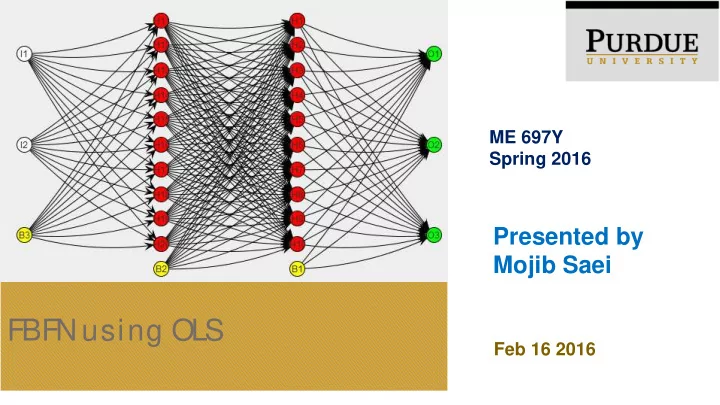
ME 697Y Spring 2016 Presented by Mojib Saei FBFN using OLS Feb 16 2016 Problem Definition 2 input, single output function used for HW#2 2 input, single output function from OLS RBFN + + + = + 2 2


slide-1
SLIDE 1

FBFN using OLS

Presented by Mojib Saei

Feb 16 2016 ME 697Y Spring 2016

slide-2
SLIDE 2

2

Problem Definition

  • 2 input, single output function used for HW#2
  • 2 input, single output function from OLS RBFN

2 2 2 2 2 1 2 1

( 0.5) (x 0.5) ( 1.5) (x 1)

6*sin(1.1 ) 10*cos(0.5 )

x x

y e e

− + − − − + − +

= + − +

2 2 2 2 1 2 1 2

4*( 1.5) (x 1) ( 0.5) (x 2)

1.5* 1.5*

x x

e e

− − − + − − − −

+ +

1 2

4 4, 4 4 x x − ≤ ≤ − ≤ ≤

slide-3
SLIDE 3

3

Methodology

Fundamental Difference with RBFN

For Example: Li-Xin Wang and Jerry M. Mendel, “Fuzzy Basis Functions, Universal Approximation, and Orthogonal Least-Squares Learning”, IEEE, VOL. 3, NO. 5, 1992

slide-4
SLIDE 4

4

Methodology

Does it make a difference?

  • The summation in the denumerator is for all the hidden nodes
  • At the beginning of OLD: P is evaluated assuming each data point is a

potential hidden node

  • If data points are concentrated in a region, it is possible to get higher P value

(in the order of 1000) for some regions and zero for far regions

Evaluated for the region with high concentration of data points Evaluated for the region with lower concentration of data points Here σ is fixed to 0.5 for all the calculations (RBFN, FBFN)

slide-5
SLIDE 5

5

FBFN Training Results RBFN First Function Second Function

slide-6
SLIDE 6

6

Test Results First Function FBFN RBFN # nodes=30

slide-7
SLIDE 7

7

Test Results Second Function FBFN RBFN # nodes=30 # nodes=50

slide-8
SLIDE 8

8

Graphical Approximation

  • For all previously shown data:

a grid of [-3:0.1:3]*[-3:0.1:3] is used for training data for first function a grid of [-4:0.1:4]*[-4:0.1:4] is used for training data for first function

  • To investigate sensitivity of method to the training data

→ 2000 random data points is added to the grids mentioned in the previous slide → so number of training points is increased by: 35% for the first function 23% for the second function

slide-9
SLIDE 9

9

Test Results RBFN # nodes=30 1st run FBFN 2nd run 3rd run 4th run

slide-10
SLIDE 10

10

Test Results FBFN RBFN # nodes=50 1st run 2nd run 3rd run 4th run

slide-11
SLIDE 11

11

Conclusion

  • Chosen system is too small to show the real power of FBFN
  • It has been shown that OLS method for FBFN should be done with

care in regard to the choice of training data (which was the source

  • f error in my first presentation)
  • The summation in the denumerator of P function is the source of

this issue

  • Overall RBFN and FBFN demonstrate the same performance

To check the results (for the case of 2000 data points added): Use RBFNcheck7.m and FBFNcheck7.m