FATIGUE BEHAVIOR OF UNIDIRECTIONAL JUTE SPUN YARN REINFORCED - - PDF document

fatigue behavior of unidirectional jute spun yarn
SMART_READER_LITE
LIVE PREVIEW

FATIGUE BEHAVIOR OF UNIDIRECTIONAL JUTE SPUN YARN REINFORCED - - PDF document

18 TH INTERNATIONAL CONFERENCE ON COMPOSITE MATERIALS FATIGUE BEHAVIOR OF UNIDIRECTIONAL JUTE SPUN YARN REINFORCED BIODEGRADABLE RESIN H. Katogi 1 *, Y. Shimamura 2 , T. Tohgo 2 , T. Fujii 2 1 Graduate Student, Graduate School of Science and


slide-1
SLIDE 1

18TH INTERNATIONAL CONFERENCE ON COMPOSITE MATERIALS

1 Introduction Natural fiber reinforced composites, which can be carbon neutral materials, have expected to be alternative materials

  • f

GFRP (Glass Fiber Reinforced Plastics). Many papers on natural fiber reinforced composites have been published [1-3]. Natural fiber reinforced composites with unidirectional reinforcement have been developed for improvements of modulus and strength [4, 5]. Fatigue property of the unidirectional reinforced composites should be investigated to assure the structural integrity. Fatigue property of natural fiber reinforced petroleum-based thermosetplastics has been reported [6, 7], but as far as we knows, fatigue property of unidirectional jute spun yarn reinforced biodegradable resin has never been reported. In this study, fatigue behavior of unidirectional jute yarn reinforced biodegradable was investigated. 2 Material Water-dispersible PLA resin (Miyoshi Oil and Fat Co., Ltd., PL-2000) was used as matrix. Jute spun yarn (BMS Co., Ltd., Asa no himo) was used as

  • reinforcement. The average diameters of filaments

and spun yarn are 28 m and 0.7 mm, respectively. Alkaline treatment with NaOH5% of jute spun yarn was conducted for 3 hr at room temperature to make performs [8]. The alkaline treated fibers were washed by water, wound around a metallic plate, and dried in a furnace. Then the water-dispersible PLA resin was impregnated into the preform and dried for 24 hr at room temperature to make prepregs. The prepregs were unidirectionally laminated and hot-pressed at 140°C for 20 min. The number of stacking is three, and five laminates were

  • prepared. The volume fraction was measured using

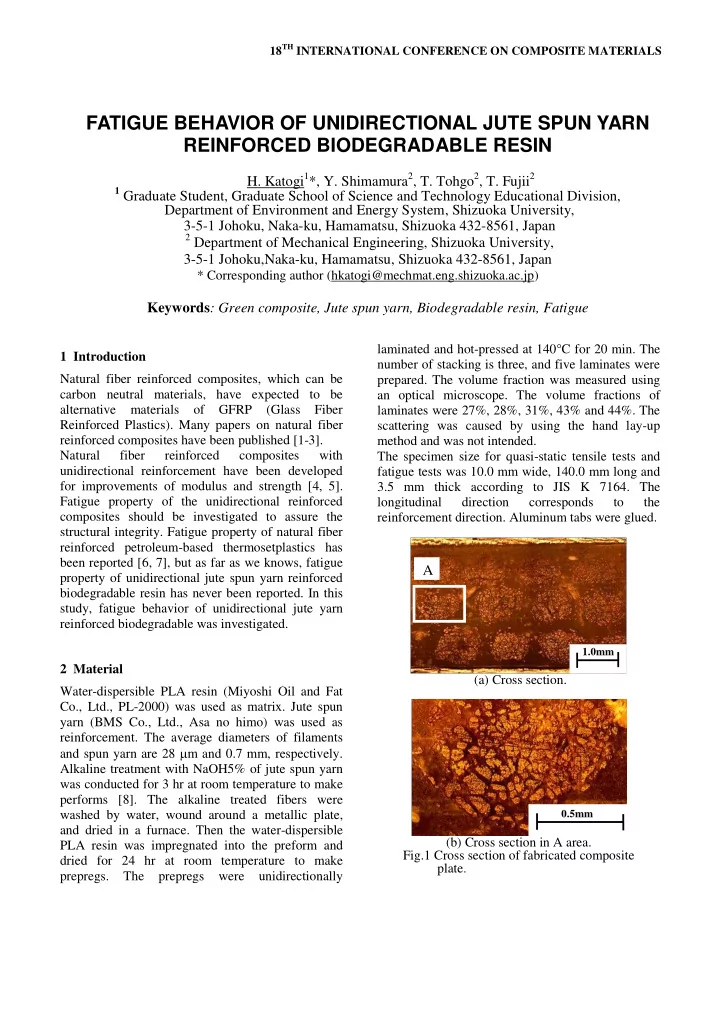
an optical microscope. The volume fractions of laminates were 27%, 28%, 31%, 43% and 44%. The scattering was caused by using the hand lay-up method and was not intended. The specimen size for quasi-static tensile tests and fatigue tests was 10.0 mm wide, 140.0 mm long and 3.5 mm thick according to JIS K 7164. The longitudinal direction corresponds to the reinforcement direction. Aluminum tabs were glued. (a) Cross section. (b) Cross section in A area. Fig.1 Cross section of fabricated composite plate.

A

1.0mm

FATIGUE BEHAVIOR OF UNIDIRECTIONAL JUTE SPUN YARN REINFORCED BIODEGRADABLE RESIN

  • H. Katogi1*, Y. Shimamura2, T. Tohgo2, T. Fujii2

1 Graduate Student, Graduate School of Science and Technology Educational Division,

Department of Environment and Energy System, Shizuoka University, 3-5-1 Johoku, Naka-ku, Hamamatsu, Shizuoka 432-8561, Japan 2 Department of Mechanical Engineering, Shizuoka University, 3-5-1 Johoku,Naka-ku, Hamamatsu, Shizuoka 432-8561, Japan

* Corresponding author (hkatogi@mechmat.eng.shizuoka.ac.jp)

Keywords: Green composite, Jute spun yarn, Biodegradable resin, Fatigue

0.5mm

slide-2
SLIDE 2

Figure 1 shows the cross section of the composite

  • plate. It was found that PLA resin was well

impregnated into yarns. 3 Experiment Method 3.1 Tensile Testing Tensile tests were conducted to measure Young’s modulus and ultimate strength according to JIS K

  • 7164. The cross-head speed was 1.0 mm/min. Strain

gauges and an extensometer were both used for measuring strain. Five specimens were prepared. The volume fraction of specimens was 44%. 3.2 Fatigue Testing The fatigue tests of the composite specimens were conducted using a hydraulic servo testing machine. The maximum stress was set to 90% ~ 40% of the ultimate strength and the stress ratio was set to be 0.1. The volume fractions of specimens were 28, 27, and 31%. 3.3 Residual Tensile Strength Residual tensile strength was measured after cyclic loading with max=0.8B. The conditions of cyclic loading were the same as those of fatigue testing. The volume fraction of specimens was 43%. 4 Results and Discussion 4.1 Quasi-static Tensile Testing

Strain [%] Stress [MPa] 0.5 1 1.5 2 2.5 10 20 30 40 50 60

Fig.2 Stress – strain curve for quasi-static tensile test. Quasi-static tensile tests were conducted for 5

  • specimens. Loading direction was the yarn
  • direction. Figure 2 shows a typical stress-strain
  • curve. The stress-strain relation was almost

linear. The average tensile strength was 60.9MPa, and the average Young’s modulus was 5.8 GPa. 4.2 Fatigue Testing Figure 3 shows an S-N diagram of the

  • composite. The fatigue strength decreases with

increasing the number of cycles. The fatigue strength at 106 cycles was around 55% of ultimate strength, which is almost the same percentage as GFRP [9]. Figure 4 shows surface crack just before fatigue failure under different loading conditions. Cracks orthogonal to the loading direction occurred in PLA resin during cyclic loading. Figure 5 shows macroscopic fracture after fatigue failure at low and high stress amplitudes. Figure 6 shows SEM images

  • f the fracture surface of the composite. Except

for long delamination at low stress amplitudes, the macroscopic and microscopic fracture morphologies were similar regardless of the stress amplitude. The results imply that the fatigue strength of the unidirectional jute yarn reinforced composite was probably dominated by fatigue of PLA resin. Number of cycles to failure Nf [cycle] Stress amplitude [MPa] 100 101 102 103 104 105 106 107 5 10 15 20 25 30

Tensile strength (Vf=44%) Vf=27% Vf=28% Vf=31%

Fig.3 S-N diagram.

slide-3
SLIDE 3

(a) σmax=0.8σB. (b) σmax=0.6σB. (c) σmax=0.4σB. Fig.4 Surface crack just before fatigue failure under different loading conditions. (a) σmax=0.8σB. (b) σmax=0.5σB. Fig.5 Macroscopic fractures after fatigue failure.

(a) σmax=0.8σB.

(b) σmax=0.5σB. Fig.6 SEM images of the fracture surface after fatigue failure.

20 mm Side 20 mm Side Top Top

20mm 20mm 20mm 20μm 20μm

slide-4
SLIDE 4

Conclusions The fatigue behavior of unidirectional jute spun yarn reinforced PLA was investigated. As a result, it was found that the fatigue strength decreased with increasing the number of cycles and that at 106 cycles was around 55% of ultimate strength. Fatigue

  • f PLA resin had an important role for fatigue of the

composite. References

[1] Y. Cao, K. Goda and S. Shibata, “Development and mechanical properties of bagassa fiber reinforced composites”, Adv. Compos. Mater., Vol. 16, 4, pp 283-298, 2007. [2] H. Takagi, S. Kato, K. Kusano and A. Ousaka, “Thermal conductivity

  • f

PLA-bamboo fiber composites”, Adv. Compos. Mater., Vol. 16, 4, pp 377-384, 2007. [3] K. Takemura and Y. Minekage, “Effect of molding condition on tensile properties of hemp fiber reinforced composite”, Adv. Compos. Mater., Vol. 16, 4, pp 2385-394, 2007. [4] O. A. Khondker, U. S. Ishiakua A. Nakai and H. Hamada, “A novel processing technique for thermoplastic manufacturing

  • f

unidirectional composites reinforced with jute yarns”, Compos. A,

  • Vol. 37, 12, pp 2274-2284, 2006.

[5] G. Ben, Y. Kihara, K. Nakamori and Y. Aoki, “Examination of heat resistant tensile properties and molding conditions of green composites composed of kenaf fibers and PLA resin”, Adv. Compos. Mater.,

  • Vol. 16, 4, pp 361-376, 2007.

[6] A. N. Towo and M. P. Anell, “Fatigue sisal fibre reinforced composites: constant-life diagrams and hysteresis loop capture”, Compos. Sci. Technol., Vol. 68 pp 915-924, 2008. [7] A. N. Towo and M. P. Anell, “Fatigue evaluation and dynamic mechanical thermal analysis of sisal fibre- thermosetting resin composites”, Compos. Sci. Technol., Vol. 68, pp 925-932, 2008. [8] H. Kobayashi, M. Kubouchi, T. Sakai, T. Tumolva and K. Tsuda, Proc.10th Japan International SAMPE Symposium & Exhibition (2007) (CD-ROM). [9] B. Harris, “Fatigue - glass fibre reinforced plastics, in handbook of polymer fibre composites”, F.R. Jones (ed.) longman, 1994.