
SLIDE 1
18TH INTERNATIONAL CONFERENCE ON COMPOSITE MATERIALS
1 Introduction The goal of this research is to develop a comprehensive understanding and analysis package for applying fasteners as a fail-safe mechanism for disbond/delamination arrest in laminated composite structure in aerospace applications. A properly sized mechanical fastener, whose primary purpose is to fasten different parts together during assembly, is
- ne way to provide damage tolerance to disbond/
delamination (here referred to as crack) type
- damages. Such design has the potential to increase
structural efficiency, enhance safety, and can be used as basis for certification. A plane-strain FEA model for understanding the effectiveness of fastener as crack arrest mechanism has been constructed. The elastic behavior of the fastener is modeled using linear springs using fastener flexibility approach by Huth [2]. The FEA results show that the fastener provides significant crack retardation capability in both Mode I and Mode II loading conditions. An analytical model based on the principle of minimum potential energy (PMPE) is developed. The model consists of a split-beam with a fastener
- attached. An interference-triggered elastic layer is
placed between the beams on the cracked faces to resolve contacts. The mode-decomposed strain energy release rates (SERR) are solved analytically using Qiao’s crack tip element (CTE) [7-9]. The ultimate goal is to develop a computationally efficient analysis tool to predict crack arrest effectiveness for optimization and probabilistic
- analysis. Multiple failure modes may be considered
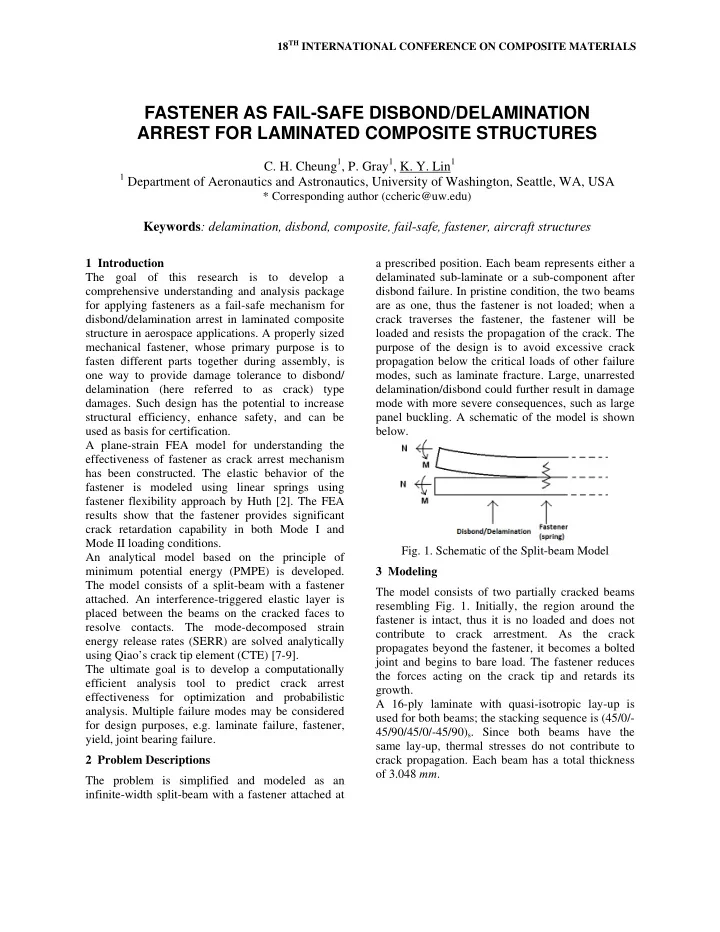
for design purposes, e.g. laminate failure, fastener, yield, joint bearing failure. 2 Problem Descriptions The problem is simplified and modeled as an infinite-width split-beam with a fastener attached at a prescribed position. Each beam represents either a delaminated sub-laminate or a sub-component after disbond failure. In pristine condition, the two beams are as one, thus the fastener is not loaded; when a crack traverses the fastener, the fastener will be loaded and resists the propagation of the crack. The purpose of the design is to avoid excessive crack propagation below the critical loads of other failure modes, such as laminate fracture. Large, unarrested delamination/disbond could further result in damage mode with more severe consequences, such as large panel buckling. A schematic of the model is shown below.
- Fig. 1. Schematic of the Split-beam Model
3 Modeling The model consists of two partially cracked beams resembling Fig. 1. Initially, the region around the fastener is intact, thus it is no loaded and does not contribute to crack arrestment. As the crack propagates beyond the fastener, it becomes a bolted joint and begins to bare load. The fastener reduces the forces acting on the crack tip and retards its growth. A 16-ply laminate with quasi-isotropic lay-up is used for both beams; the stacking sequence is (45/0/- 45/90/45/0/-45/90)s. Since both beams have the same lay-up, thermal stresses do not contribute to crack propagation. Each beam has a total thickness
- f 3.048 mm.
FASTENER AS FAIL-SAFE DISBOND/DELAMINATION ARREST FOR LAMINATED COMPOSITE STRUCTURES
- C. H. Cheung1, P. Gray1, K. Y. Lin1
1 Department of Aeronautics and Astronautics, University of Washington, Seattle, WA, USA