FABRICATION AND CHARACTERATION OF EXFOLIATED GRAPHITE NANOPLATELET - - PDF document

fabrication and characteration of exfoliated graphite
SMART_READER_LITE
LIVE PREVIEW

FABRICATION AND CHARACTERATION OF EXFOLIATED GRAPHITE NANOPLATELET - - PDF document

18 TH INTERNATIONAL CONFERENCE ON COMPOSITE MATERIALS FABRICATION AND CHARACTERATION OF EXFOLIATED GRAPHITE NANOPLATELET MULTIWALLED CARBON NANOTUBE HYBRID FREESTANDING SHEET S.H. Hwnag 1 , Y.-B Park 1 * 1 School of Mechanical and Advanced


slide-1
SLIDE 1

18TH INTERNATIONAL CONFERENCE ON COMPOSITE MATERIALS

1 Introduction Freestanding mats of densely entangled carbon nanotubes, so-called “buckypapers” were studied in a various applications including artificial muscles [1], sensors and actuator [2, 3]. More recently, it has been shown that graphite oxide can be exfoliated in water to yield hydrophilic, oxygenated graphene

  • xide nanosheets that can be macroscopically

assembled into a paper-like structure through vacuum filtration [4]. Some of previous buckypaper research was focused

  • n the effect of CNT morphology on the pore size

[5] or its barrier properties [6]. However, there are very few reports on the fabrication of carbon nanotube and graphite or graphene hybrid freestanding sheets and the effect of morphology of CNT or graphite on their mechanical and electrical characteristics. In this work, freestanding hybrid sheets that are comprised

  • f

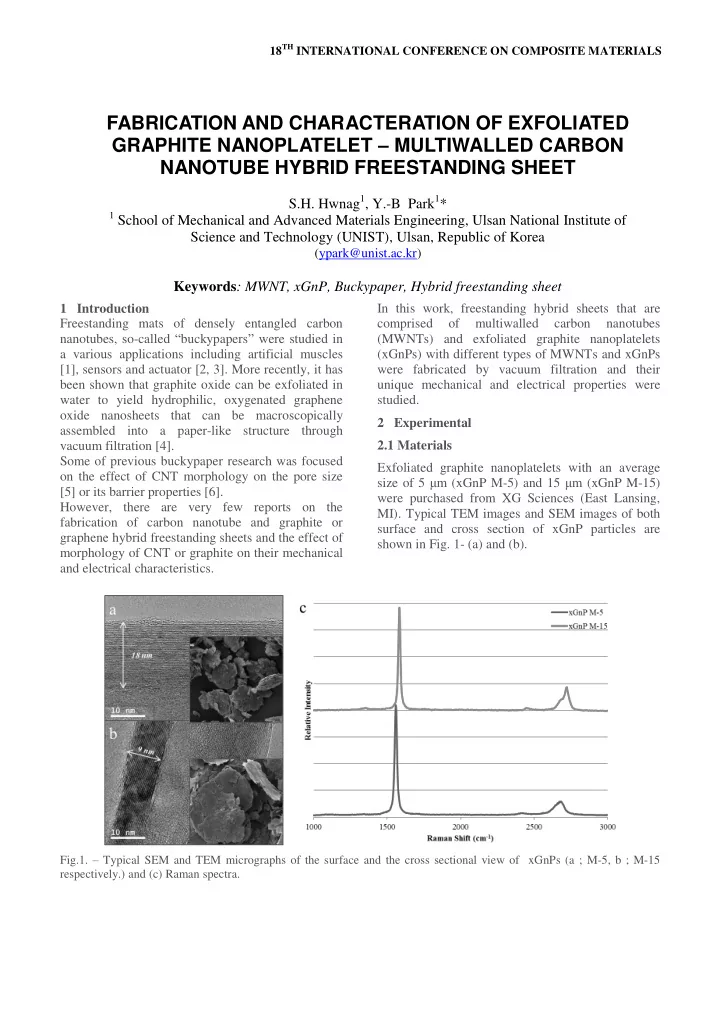
multiwalled carbon nanotubes (MWNTs) and exfoliated graphite nanoplatelets (xGnPs) with different types of MWNTs and xGnPs were fabricated by vacuum filtration and their unique mechanical and electrical properties were studied. 2 Experimental 2.1 Materials Exfoliated graphite nanoplatelets with an average size of 5 μm (xGnP M-5) and 15 μm (xGnP M-15) were purchased from XG Sciences (East Lansing, MI). Typical TEM images and SEM images of both surface and cross section of xGnP particles are shown in Fig. 1- (a) and (b).

Fig.1. – Typical SEM and TEM micrographs of the surface and the cross sectional view of xGnPs (a ; M-5, b ; M-15 respectively.) and (c) Raman spectra.

FABRICATION AND CHARACTERATION OF EXFOLIATED GRAPHITE NANOPLATELET – MULTIWALLED CARBON NANOTUBE HYBRID FREESTANDING SHEET

S.H. Hwnag1, Y.-B Park1*

1 School of Mechanical and Advanced Materials Engineering, Ulsan National Institute of

Science and Technology (UNIST), Ulsan, Republic of Korea

(ypark@unist.ac.kr)

Keywords: MWNT, xGnP, Buckypaper, Hybrid freestanding sheet

slide-2
SLIDE 2

18TH INTERNATIONAL CONFERENCE ON COMPOSITE MATERIALS

High aspect ratio of the platelet is evidenced by the large lateral dimension of the particle versus the thickness, which is less than 20 nm and 10 nm for xGnP-M-5 and 15, respectively. The Raman spectrum of both xGnP M-5 and M-15 particles are shown in Fig. 1c. The small D band and a sharp G band confirm the sp2 type bonding of the carbon atoms in the basal plane. It is thus believed that the intercalation process and subsequent pulverization processes did not oxidize the surface of the xGnP which might degrade the electrical and mechanical properties of an individual platelet. The lengths of CVD grown MWNTs (100nm and 250nm) are indicated in their product names, CM- 100 and CM-250, both of which were purchased from Hanwha Nanotech. 2.2 Preparation of MWNT-xGnP Hybrid Sheets Surfactants of sodium lauryl sulfate (SLS) and Triton X-100 were purchased from Aldrich and Daejung Chemicals, respectively, and solutions were prepared with a concentration of 0.05 wt.% in methyl alcohol. 120mg of MWNTs or xGnP-MWNT mixture with proportions of xGnP versus MWNTs 5:5 with various MWNT and xGnP types were dispersed in 2L of SLS / Triton X-100 solution. After 1 hr of stirring and 3 hrs of sonication in bath type sonicator, the solutions were further treated for 2 hrs using a horn-type sonicator. A nylon membrane (0.45 μm pore size, Millipore) was used for paper making by vacuum filtration. Two liters of the suspension was filtered to make

  • ne 78 mm diameter paper. The paper was then

washed using methanol and acetone to remove residual surfactants and then placed in an oven and dried at 60°C overnight before being peeled off the membrane. 3 Results and Discussions 3.1 Surface Area and Morphology It is noted in Fig. 3a that the hybrid sheet is robust under flexural stress, and Fig. 3b and c show basal plane morphology of the CM-250/M-5 hybrid sheet before and after stretching. In Fig. 3c, crack morphology suggests that the surface adhesion between MWNT and xGnP is very strong because of their van der Waals interaction and π-π interaction of sp2 carbons. The surface areas of xGnP measured by BET using N2 adsorption at 77 K are shown in Table 1. The reported specific surface area (ABET) of MWNT buckypaper is around 200m2/g [7] and our measurement showed a similar value. From the BET measurement, it is clear that the buckypaper has much higher surface area as compared to hybrid sheets because of its morphology and scale. The measured ABET’s of xGnP M-5 and M-15 were around 90 m2/g and 70 m2/g, respectively. The ABET’s of hybrid sheets were in good agreement with the calculated values.

Fig.2. - (a) Digital micrographs of MWNT-xGnP hybrid sheet (CM-250/M-5). (b) SEM image of hybrid sheet

  • surface. (c) Crack morphology of hybrid sheet after

stretched under tensile stress. Table 1. Specific surface area of buckypapers and hybrid sheets Sample ABET (m2/g) CM-250 195.0 CM-250/M-5 152.2 CM-250/M-15 139.4 CM-100 197.2 CM-100/M-5 148.8 CM-100/M-15 133.6

3.2 Mechanical Properties Mechanical properties of buckypapers and hybrid sheets are shown in Fig. 3. Young’s modulus of buckypaper CM-250 was increased by 21% from 513 to 609 MPa with the addition of xGnP M-5, while its tensile strength and elongation were decreased from 21.3 MPa and 6.3% to 14.3MPa

and 3.5%, respectively. Despite the fact that the

aspect ratio of xGnP M-15 is much higher than M-5, their efficiency of Young’s modulus enhancement is lower than CM-250/M-5 hybrid sheet (only 2.5%). This trend is also shown in the CM-100/xGnP hybrid sheets.

slide-3
SLIDE 3

3 FABRICATION AND CHARACTERATION OF EXFOLIATED GRAPHITE NANOPLATELET – MULTIWALLED CARBON NANOTUBE HYBRID FREESTANDING SHEET

The Young’s moduli of the porous sheets studied can be considered to be indicative of the packing densities of the carbon nanomaterials sheets. And their strengths and elongations are governed by the interaction of carbon nanoparticles or domains. We can easily imagine from SEM images and BET results that the MWNT bundles exhibit not just strong van der Waals interaction and π-π interaction but also mechanical entanglement. This results in the higher strength and elongation of buckypapers as compared to hybrid sheets. Although it is clear that xGnPs are disturb interaction between MWNTs, sonication induced damaged small particle of xGnPs are inserted to free volume of buckypaper, hence increase the occupied volume and modulus.

Fig.3. Mechanical properties of xGnP-MWNT hybrid sheet with various type of MWNT and xGnP under tensile stress.

  • Fig. 4. Storage moduli of MWNT-xGnP hybrid sheets with frequency.

3.3 Dynamic Mechanical Study When the mechanical properties of a material is based on secondary bonding, such as van der Waals, π-π interaction and hydrogen bonding, high frequency vibration is sometimes critical for its elastic properties. Dynamic mechanical analysis (DMA) of buckypaper and hybrid sheet with frequency sweep test is shown in Fig. 4. The strain amplitude was determined in the

slide-4
SLIDE 4

range of elastic deformation from the tensile test (20μm for all samples). Both buckypapers showed decrease in elastic factor in high frequency regions. However, addition of xGnP prevents this negative effect to increase elastic performance up to 100Hz of strain frequency. Also their average moduli show the same trend as tensile test. This effect can be very useful when hybrid sheet are applied in a high vibrational environment.

  • Fig. 5. Surface resistivities of xGnP-MWNT hybrid sheets.

3.4 Volume and Surface Conductivities In Fig. 5, the same trend of volume and surface resistivities of buckypapers and hybrid sheets were

  • bserved. It is easy to explain the difference in the

conductivity of buckypapers based on their different

  • lengths. it is easier to form CNT conductive network

for CM-250 than CM-100. Also, xGnP exhibits inherently different morphology and lower conductivity than MWNT. This results in increase in volume resistivity of both CM-250 and CM-100 hybrid sheets. The different resistivity with xGnP type can be explained by its aspect ratio. From Fig. 1- (a) and (b), it is clear that M-15 has higher aspect ratio compared to M-5. This means M-15 is easier to contribute to make conductive network than M-5. 4 Conclusions xGnPs and MWNTs stabilized by SLS and Triton X- 100 were successfully prepared to paper-like structure by vacuum assisted filtration, and their mechanical and electrical properties were studied. Young’s modulus was increased with addition of xGnPs while their ultimate strength and maximum elongation were decreased due to the additive effect

  • f xGnP. With xGnP type, M-5 shows much higher

reinforcing effect to modulus as compared to M-15 in both CM-250 and CM-100 hybrid sheets due to their particle size. DMA study revealed that elastic performance of hybrid sheet is maintained in high frequency deformation region, and it can be useful for highly vibrational environment applications. Complex interactive mechanism of MWNT length and aspect ratio of xGnPs affects the conductivities

  • f buckypapers and hybrid sheets, which show the

same trend in both volume and surface resistivities. References

[1] Hennrich F, Lebedkin S, Malik S, Tracy J, Barczewski M, Rosner H, et al., “Preparation, characterization and applications of free-standing single walled carbon nanotube thin films.” Phys.

  • Chem. Chem. Phys., 4, 2273–7, 2002.

[2] I-Wen C, Zhiyong L, Ben W, Chuck Z, “Charge- induced asymmetrical displacement of an aligned carbon nanotube buckypaper actuator.” Carbon, 48, 1064–1069, 2010. [3] Ákos K*, Rita S, Mariann Ő, Balázs S , Henrik H, Zoltán K, and Imre K, “Multiwall carbon nanotube films surface-doped with electroceramics for sensor applications.”, phys. stat. sol., 245, 2331–2334, 2008. [4] Dmitriy D, Stankovich S, Zimney J, Piner D, Dommett B, Evmenenko G, et al., “Preparation and characterization of graphene oxide paper.” Nature, 448, 457–60, 2007. [5] Raymond W, Takahiro F, Toru M, Stuart J, Sergey M, “Geometric control and tuneable pore size distribution of buckypaper and buckydiscs.” Carbon, 46, 949–956, 2008. [6] Sarah C, Helen C, Martin C, Brett C and M. Meyyappan, “Gas Permeability of a Buckypaper Membrane.” Nano Lett., 3, 189–192, 2003.

slide-5
SLIDE 5

5 FABRICATION AND CHARACTERATION OF EXFOLIATED GRAPHITE NANOPLATELET – MULTIWALLED CARBON NANOTUBE HYBRID FREESTANDING SHEET [7] Rita S, Ákos K, Zoltán K, Imre K, “Structure and gas permeability

  • f

multi-wall carbon nanotube buckypapers.” Carbon, 45, 1176–1184, 2007.